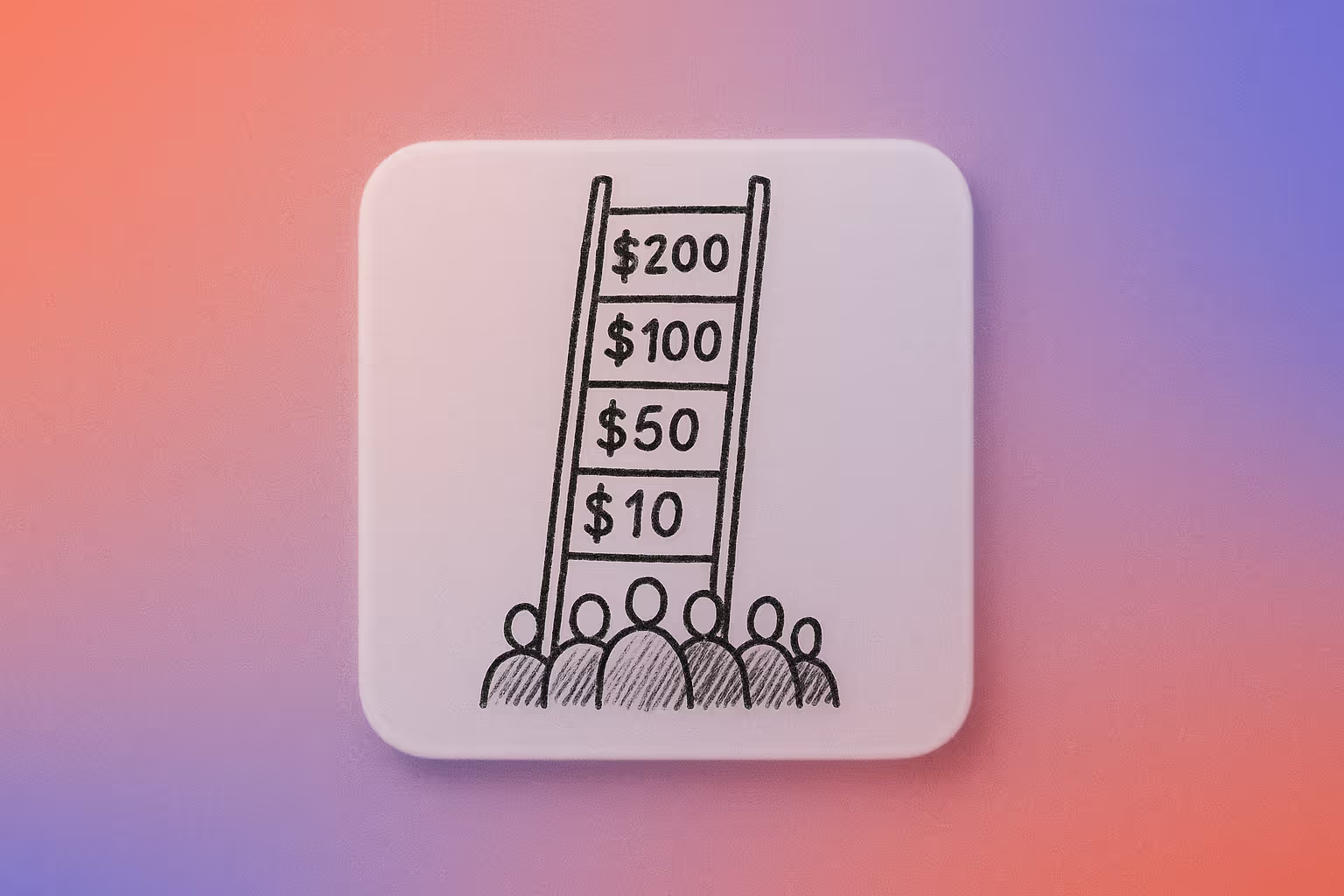

Start with your revenue goal and work backward. If you want to earn $100K/year from your community, that's roughly $10K/month after taxes. At $49/month, you need ~200 members. At $149/month, you need ~67. The price you pick determines what kind of community you're building, how you deliver value, and whether the whole thing is sustainable three years from now, not just on launch day.
Most community builders get pricing wrong in the same way: they charge too little, offer too much, and burn out. The fix isn't a single magic number. It's understanding which pricing category your community fits into and reverse-engineering from there.
We've hosted 85+ expert-led tutorials at Heartbeat where working community builders teach what they've learned scaling real businesses. When it comes to pricing, a few frameworks keep coming up, and they've been pressure-tested across hundreds of communities. Here's what actually works.
| Tier | Price/mo | Delivery model | Members | Editorial note |
|---|---|---|---|---|
| Micro | <$15 | Content library / casual network | 500+ members | Hardest tier to do well |
| Low Ticket | $15–$97 | Live programming + async community | 50–200 members | Where most builders land |
| High Ticket | $100–$500 | Transformation, not information | 20–75 members | Where more should be |
| Premium | $500+ | Done-with-you / mastermind | 10–30 members | Members are the product |
The 4 pricing categories for community memberships
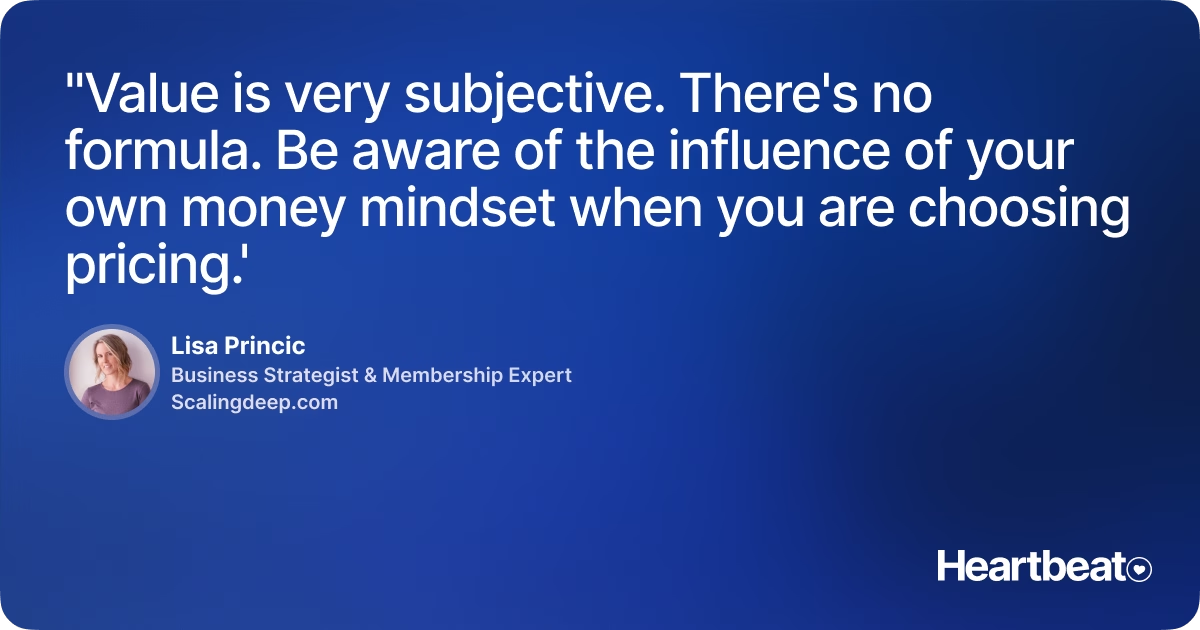
Not all communities are the same product, and they shouldn't be priced the same way. Lisa Princic, a Business Strategist & Membership Expert who's worked with hundreds of community builders over 16 years in business, teaches four pricing categories, each with a distinct delivery model and business math. This framework is one of the clearest ways to figure out where your community actually fits.
Micro memberships (under $15/month)
Here's the counterintuitive thing about the cheapest tier: it's actually the hardest one to do well.
Micro memberships work when you're building a large-scale content library or casual networking space. Think of it like a gym membership for your niche. Members show up, access resources, and engage at their own pace. But the math requires volume. You need hundreds or thousands of members to make this sustainable. If you're running a micro membership with 30 people, you're earning $450/month and probably putting in $2,000 worth of effort. That breaks fast.
To make this tier work, you need an existing audience. On social, that usually means north of 5K-10K followers around a specific niche or topic. For an email newsletter, at least 2,000 subscribers who are engaged around a specific subject. You have to be very good at high-volume plays and content plays because at this price, the content is how you deliver value, and it's consumed almost entirely asynchronously. People paying $15/month aren't jumping on a ton of live events. They're not trying to be super active. They want to consume on their own time.
And this is where the value trap kicks in. Because the revenue per member is so low, you're naturally pushed to keep adding more and more value to justify the price, and before you know it, your effort dramatically outpaces what you're earning. If you don't already have that content muscle and that existing audience, this tier is really hard to pull off.
What good looks like: A creator with 10K+ newsletter subscribers launches a $12/month community as a companion to their free content. Members get access to an archive of templates, a private discussion space, and one curated resource drop per week. The creator spends 2-3 hours/week on community; the rest is content they'd be making anyway. At 400 members, that's $4,800/month. The community is a natural extension of the content engine they already run.
Low ticket ($15–$97/month)
This is where most community builders land, and for good reason. The classic setup looks like this: a monthly workshop or AMA, a couple of courses or resource libraries, group calls every two to three weeks, and ongoing discussions around a specific space. It's the most common community build-out because it balances real value delivery with a manageable workload.
At $49/month with 100 members, you're at $4,900/month. That's a real business with a manageable member count.
One important threshold: if you're charging anything under $25/month, you're really in micro-membership territory regardless of what you call it. Under $25 is where people genuinely forget they're paying you for a thing. It gets very hard to be useful or valuable at that price, and the engagement patterns look more like a micro membership than a low-ticket one.
What good looks like: Alejandro Bernardo Diaz at Nocodehackers runs cohort-based courses at €349 for 6 weeks, teaching non-technical people to build products using no-code tools. He started during COVID charging €5 for an Airtable tutorial, posted it to 300 Twitter followers, and had 30-80 people sign up on day one. He tried a subscription model and it failed; only five people did more than two courses. He switched to cohort pricing and had 50 sales in the first two days. Revenue went from ~€100K to ~€350K in two years. The key: he found a specific niche, tested pricing upward, and landed on a structure where the price matched the value.
High ticket ($100–$500/month)
This is where I'd actually like to see more communities starting, or moving into.
High ticket is for communities that deliver meaningful transformation. You're helping members get from point A to point B, not selling access to content. This includes direct access to an expert, structured cohorts or programs, and a small, curated group. The value is proximity and accountability.
What I like about this tier is that it's a real price point. It justifies genuine thought about whether or not you swipe your credit card. And that's a feature, not a bug, because when the price matches the transformation being delivered, members both expect results AND are willing to put in the time and energy to get those results.
This solves one of the most common frustrations community builders have: "I'm putting in all this time and effort, but my members aren't." If someone's paying you $15/month, there's no way in hell they're going to put in the level of effort you expect, especially if what you're really delivering is a high-ticket transformation at a low-ticket price. At $400-$500/month, that dynamic flips. Members show up because they've made a real investment, and the results follow.
Most coaching communities should honestly be closer to $400-$500/month rather than the $150/month they tend to hover at. The transformation they deliver is worth it. They just haven't built the confidence to charge for it yet.
What good looks like: Kat Weaver at Power to Pitch runs programs from $2K to $15K helping founders raise capital. She started at $99 with 2 members. Now she has 400+ active members, over $1M in lifetime sales, and her founders have collectively raised $55M+. Her rule: "People who pay, pay attention. There is not one free spot." She tested giving away $10K worth of free coaching once, and only 20% showed up. Every month has been profitable since she started.
Premium ($500+/month)
This is the mastermind tier, but it's more than just "small group, deep access, high commitment." At this level, you're probably doing real work for and with your members. There are pieces you actively help them with on a regular basis, maybe even things you manage or execute on their behalf. The community is a done-with-you service wrapped in a community model.
This works for communities where the members themselves are the product. The network effect of being in a room with other high-performers is worth the price of admission. You don't need many members here. Ten people at $500/month is $60K/year from a group that fits in a Zoom room.
What good looks like: Emily Claire Hughes at The 10K Email Club charges $1,500/month for a done-with-you email marketing membership. Members draft their emails, and Emily's team actually edits them: professional copywriting coaching where she's doing deep work for each member. She went from zero members on her first launch to ~18 members at $1,500/month, roughly $160K/year, with 500%+ year-over-year growth. She shut down $10K/month in client work to go all-in on the club. The key: the premium price is justified because she's actively investing real time and expertise into each member's output.
The mistake most people make is offering premium-level delivery at low-ticket pricing. If you're doing weekly live calls, personal feedback, and curated matchmaking for $19/month, you're not running a business. You're running a charity with a subscription form.
How to pick your price: the reverse-engineering method
Doc Williams, CEO & Founder of Brand Factory who's built communities for ESPN, VaynerMedia, and the NBA's Summer League, teaches a four-step process for pricing that cuts through the noise. It starts with math, not feelings.
Step 1: ID your revenue goal. Not a vague aspiration, a specific number. Write down what you need this community to generate in the next 12 months. Then divide by 12, subtract ~20% for taxes if you're in the US, and you have your monthly target.
If you want $60K/year, that's $5K/month after taxes. If you want $120K/year, that's $10K/month. Simple math, but most community builders skip it entirely. They pick a price based on vibes instead of working backward from what the business needs to survive.
The math, step by step:
| Price/mo | Members needed |
|---|---|
| $49 | 85 |
| $99 | 42 |
| $149 | 28 |
Step 2: Understand what your members actually need. Not what you think they need, what they tell you. Doc recommends that if you have a small audience (under 30 people), get on one-on-one calls. Record them with consent. Listen for the specific problems they describe, the language they use, and what they're already spending money on.
A lot of people hesitate on one-on-one calls. Don't. If you're sub-30 members, these conversations are going to give you more value than any survey, any competitor analysis, or any pricing template you find online. The words your potential members use to describe their pain become your marketing copy and your pricing justification.
And here's a tip that didn't exist a couple years ago: once you have those call transcripts, you can use an AI agent to pull out themes, identify patterns, and distill the learnings. Feed those insights into a tool like Pulse in Heartbeat, and now your community's AI has memory of what your members actually care about. Every piece of content you build, every discussion you start, every course you create is informed by real customer language. That's a powerful loop that most community builders aren't taking advantage of yet.
Step 3: Sell painkillers, not vitamins. A vitamin is nice to have. A painkiller solves an urgent problem. Communities that solve urgent, specific problems command premium pricing. "Nice to have" communities get cancelled first.
But the vitamin-painkiller analogy is one of those things that sounds great in theory and then people struggle to apply. So here's what it actually looks like in practice:
Existential painkiller: Kat Weaver's Power to Pitch helps founders raise capital. If you don't raise funding, your business might literally die. That's an existential problem you're solving, not a nice-to-have. Members will pay premium prices because the alternative is the end of their company. Kat's programs run $2K-$15K, and her founders have raised $55M+.
Aspirational painkiller: Alejandro Bernardo Diaz's Nocodehackers teaches people to build products without code. Nobody's going to die if they don't learn Webflow. But the unlock is enormous: you can literally build anything you have in your head when you know how to use these tools. It's less "things will get really bad if I don't get this" and more "this is an incredibly magical thing I get access to if I accomplish this." Alejandro charges €349 for 6-week cohorts, and students have gone from zero digital skills to full-time careers.
Vitamin territory: "A community for people who want to network." No specific outcome. No transformation. No urgency. This is what gets cancelled when someone's reviewing their subscriptions.
The key: ask yourself what specific outcome a member is giving up if they cancel today. If you can't answer that in one sentence, your value proposition isn't clear enough to charge what you're worth.

Step 4: Go for the ask. This is where most community builders stall. You've done the math, you've talked to your people, you've designed the offer, and then you underprice it by 40% because you're scared of rejection.
You have to just trust the offer you've built, put it out there, and ask. A lot of people will tell you no. That's fine. That's data.
Some of the best sales advice I ever got about selling a new product: charge a little higher than you think you should. Ask people what they'd be willing to pay, then bump it up 10% because people always sandbag. You have to get comfortable asking for a bigger number than your gut tells you, and then just stop talking and let them answer.
There's even a classic pricing discovery method where you pick a price, sell it, and then every time you sell it again, you try to double the price. At a certain point, people tell you to piss off, and that's your price point. That's exactly where you live. It sounds crude, but it works, because it's pure signal from the market instead of you guessing in a spreadsheet.
Doc shared a story that stuck with me: he had a student tell him, "I understand everything you said, it makes total sense, but I'm not going to do it because I'm afraid of rejection." That fear of asking is the single biggest reason communities are underpriced. Your potential members can't smell your business model, but they can absolutely smell hesitation.
The 4 pillars of sustainable pricing
A price that works today but burns you out in six months isn't a good price. Lisa teaches four pillars that every sustainable price needs to pass, and missing even one of them will catch up with you:
Profitable: Your revenue exceeds your expenses, including the value of your time. If you're six months in and not accounting for your own hours, you need to reconsider. Track your cost per member: how much time and money does each member actually require?
Scalable: Can you serve 10x your current membership at this price without 10x-ing your workload? If every new member means another hour of your personal time per week, the model doesn't scale. The delivery has to match the price tier.
Enduring: Will this price still make sense in two years? Memberships aren't courses. They potentially last for years. Price for any scenario: 50 members, 200 members, 500 members. A price that only works if you hit 1,000 members within the first year isn't enduring if you're realistically growing at 10-15 per month.
Satisfying: If you hate running your community because you're overdelivering for what you earn, you're not going to do as great a job. This sounds soft, but it's structural. Your satisfaction with the business model directly affects the quality of what members experience.
How to actually use these pillars: Don't just check them once when you launch. Run through all four every quarter, or any time something feels off. Getting a lot of cancellations? Check Enduring and Satisfying. Feeling burned out? Check Profitable and Scalable. Growing fast but the quality's slipping? Check Scalable. These are diagnostic questions, not a one-time exercise. The community builders who keep their pricing right are the ones who revisit these regularly as their community evolves.
Common pricing mistakes (and what to do instead)
Charging too little for a small audience. If you have 20 members, $15/month is $300/month. That's not a business. You'd be better off charging $97/month to a smaller, more committed group. Smaller communities can, and should, charge more because the intimacy and access are part of the value.
Copying competitor pricing without understanding their model. A community charging $29/month with 2,000 members has completely different economics than yours. Don't anchor to their price. Anchor to your revenue goal and delivery model.
Offering lifetime memberships priced below your member LTV. If your average member stays 14 months at $49/month, their lifetime value is ~$686. A $299 lifetime deal sounds generous to you but costs you $387 per member in lost revenue. If you do offer lifetime, price it above your calculated LTV.
Starting with multiple tiers. Start with one price. Maybe two, max. Every tier you add is another thing to manage, another comparison for the prospect to get confused by, and another reason to pick the cheapest option. You can always add tiers later once you understand what your most engaged members actually want access to.
What this looks like in practice
During a hot seat in Doc Williams' pricing tutorial, a community builder named Drew shared his experience testing three price points for his niche health community: $29/month, $9/month, and an annual plan. The $9/month tier performed worst, not just on revenue, but on actual response. Higher pricing got a better reception. He restructured around a single tier at a higher price point, and both engagement and revenue went up.
Lisa found the same pattern among her clients: the ones investing at the premium level had the most engaged members, not because the content was 100x better, but because the financial commitment changed their behavior entirely.
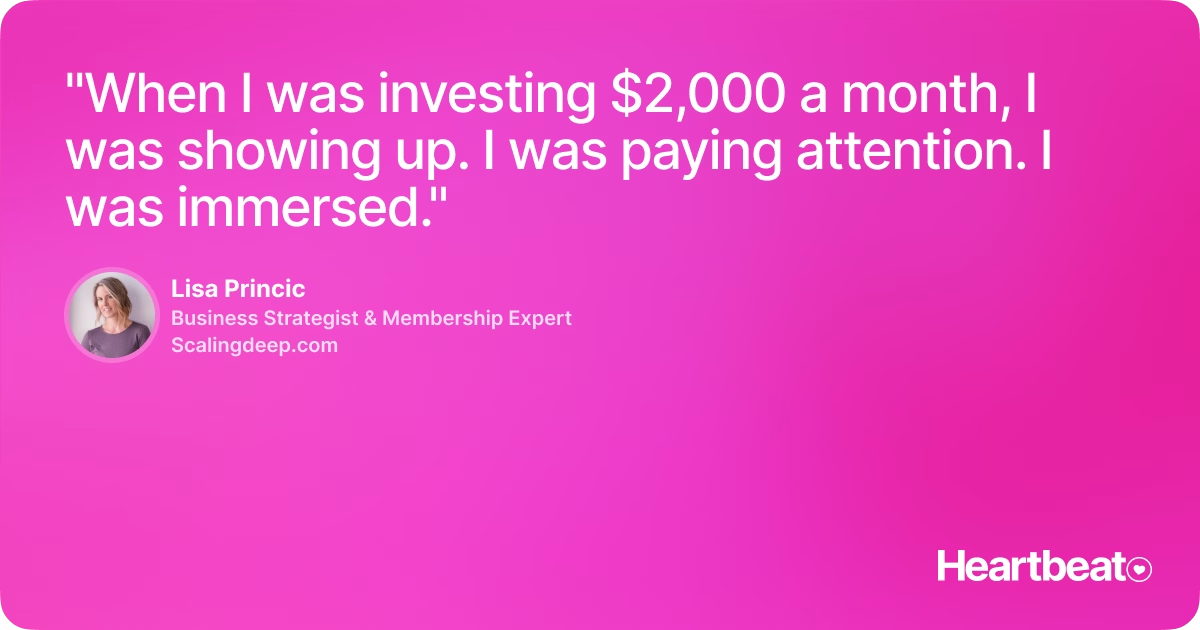
Nivi Achanta, Founder of Soapbox Project and a Heartbeat tutorial speaker on setting boundaries as a community builder, experienced this shift firsthand. She moved from $5/month to $250-$350 cohort-based pricing for her climate action community. The result: fewer members, but dramatically higher engagement and a business she could actually sustain. Her realization was that price itself is a boundary, and for a long time, the price she set didn't reflect the effort she was putting in.
The pattern is consistent: price communicates value. When you charge more, you attract people who are committed to the result, and you build a community worth being committed to.
Getting started
If you're launching a new community or repricing an existing one, here's the sequence:
Write down your 12-month revenue goal. Divide by 12. Subtract taxes. That's your monthly target. Pick the pricing category that matches your delivery model. Don't try to deliver high-ticket value at a micro price. Set one price. Launch it. Talk to your first 10-20 members about what they value most. Adjust in 3-6 months based on actual data, not guessing.
The best time to get your pricing right was before you launched. The second best time is now. And the good news is that when your community, payments, and member experience all live in one place, changing your pricing and testing what works is something you can do in an afternoon, not a migration project.
Faqs
How do I know if my community membership is priced too low?
Here's the nuance: as a new business, you're not going to immediately make what you made at a full-time job. That's normal. The question isn't "am I making enough right now?" The question is "can I see the path?" Even with your first 10-20 customers and your current price point, you should be able to look at the math and say: in six months I'll cross this amount, in twelve months I'll cross that amount. It should feel doable, like you just have to put in the work and the math adds up. The problem is when you're charging $10/month and even with optimistic projections, there's no realistic path to real revenue. If you can't see how the numbers get to a sustainable business within a year, you're priced too low.
Should I offer monthly or annual billing for my community?
Offer both if you can. Annual billing improves retention and cash flow. Members who pay upfront are more committed. A common approach is pricing annual at 10x the monthly rate (instead of 12x), giving members a two-month discount while you get the predictability of upfront payment.
When should I raise my community membership price?
When your delivery has improved, when you have social proof (testimonials, case studies, member results), or when your time investment per member is higher than your revenue justifies. Give existing members a grandfathered rate if you want to reward loyalty. This also creates a retention incentive.
What's the best price for a community with fewer than 50 members?
There's no universal answer, but the pattern is clear: smaller communities should charge more, not less. With fewer than 50 members, you're likely providing more intimate access and personalized value. That's worth $49-$149/month minimum, depending on your niche and what transformation you deliver.
How do I price my community if I have no audience yet?
Start with your revenue goal and work backward. If you need $3K/month and can realistically attract 30 members in the first 3 months, price at $100/month. Then validate with one-on-one conversations before you launch. The conversations will tell you whether the price matches the perceived value, and give you the language to sell it.