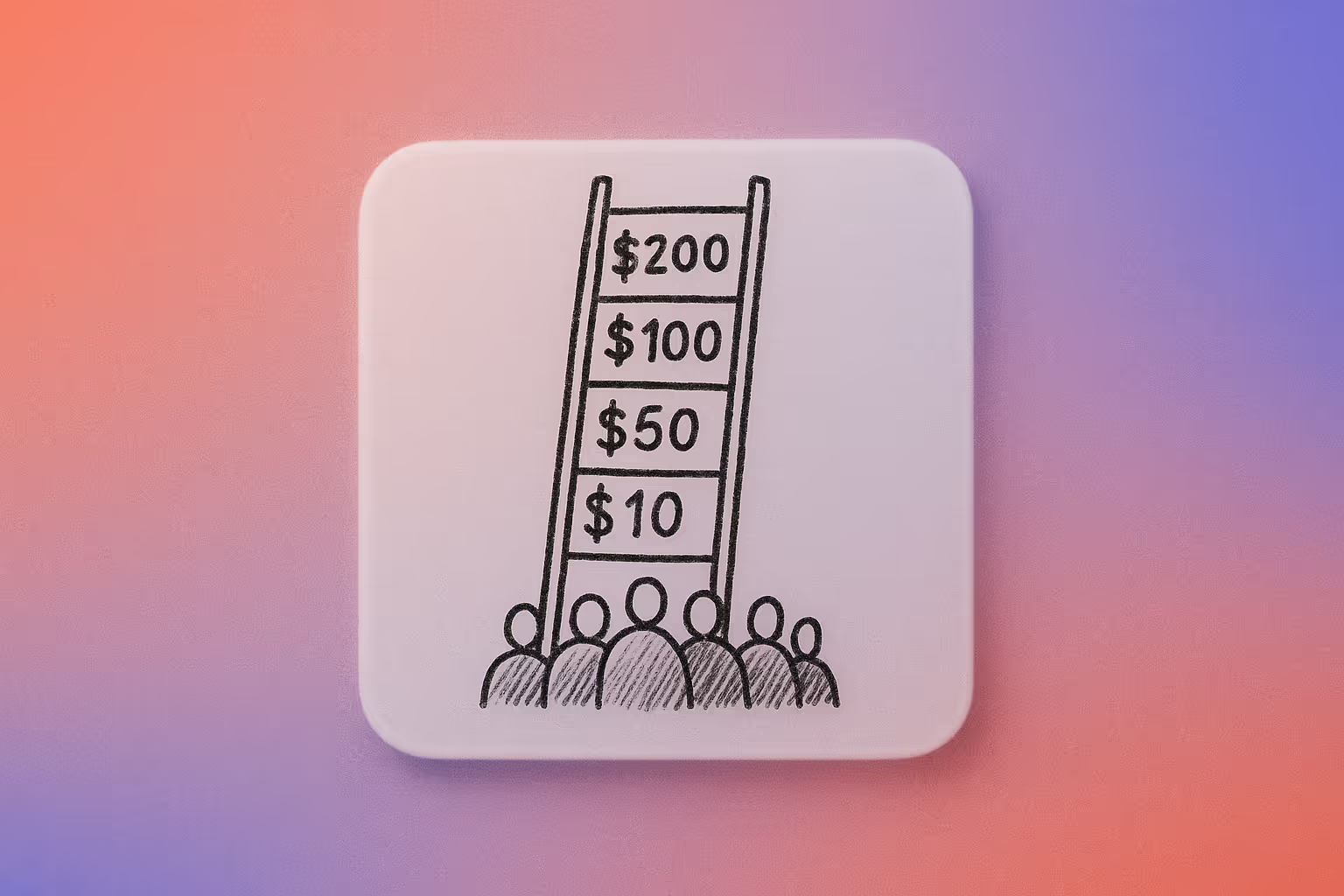
Don't try to make the jump in one move. The community builders who successfully go from low-ticket to high-ticket pricing don't wake up one morning and 5x their price. They build a ladder. Each rung earns trust, proves value, and gives members a reason to invest more. The transition from $29/month to $500/month (or $5K+ for a program) follows a specific pattern, and it works whether you're running a coaching community, a course platform, or a niche network.
The pattern shows up in almost every success story we see at Heartbeat. Alex Bernardo Diaz at Nocodehackers went from €5 to €349. Kat Weaver at Power to Pitch went from $99 to $15K. Emily Claire Hughes at The 10K Email Club went from $199 to $1,500/month. None of them made the jump overnight. All of them followed a version of the same framework. Alejandro's mix is a good example: he kept free Twitter threads at the top, sold a €5 tutorial to convert attention into a first transaction, ran standalone €120 courses for people who wanted more, and reserved the €349 cohort for members ready to commit to six weeks of structured work. Each rung fed the next.
| Step | Offer | Price range | Example | What it earns |
|---|---|---|---|---|
| 1 | Free content (YouTube, blog, newsletter) | $0 | Alejandro's free Airtable threads on Twitter | Attention |
| 2 | Low-ticket | $9–$97/mo | Alejandro's €5 Airtable tutorial; Drew's $29/mo vision-training community | Trust |
| 3 | Mid-ticket | $100–$500/mo | Nivi's $250–$350 climate-action cohorts; Emily's $199 email course | Commitment |
| 4 | High-ticket | $500–$15K+ | Kat's $15K program for founders raising capital; Amy's $12K VIP days | Transformation |
Every purchase makes the next one easier.
We've brought three experts into Heartbeat's own community to teach how this transition actually works in practice: Tom Morkes on the funnel architecture, Lisa Princic on the pricing confidence that makes or breaks the move, and Amy Yamada on VIP days as a bridge between the rungs. The rest of this article walks through their frameworks and the real revenue jumps we've seen when Heartbeat customers apply them.
Low-ticket buyers convert best
Most people assume their $29/month members would never pay $3,000 for a program. That assumption is wrong, and it costs community builders a lot of money.
Tom Morkes, a Launch Strategist & Growth Hacker (founder of Insurgent Publishing, creator of the AI Writing Summit, and now co-founder at Groove), teaches a framework for building sales funnels that move people from low-ticket purchases to high-ticket investments. His core insight: the first purchase changes the relationship entirely. Someone who pays you $29 is no longer a prospect. They're a customer. And customers buy again at a dramatically higher rate than prospects.
Tom's data suggests about 1% of your low-ticket buyers will eventually invest tens of thousands of dollars with you. That sounds small until you do the math. If you have 200 members at $49/month, that's 2 people who would pay $5,000+ for a premium program. That's $10,000 in revenue from a segment you weren't even serving.
The mistake is thinking of low-ticket and high-ticket as separate businesses. They're not. They're steps on the same ladder.
The value ladder framework
Tom teaches the AIDA funnel (Awareness, Interest, Desire, Action) applied specifically to community businesses. Here's how the ladder works at each level:
Rung 1: Free content
Your YouTube videos, blog posts, newsletter, social content. This is where people discover you. It costs them nothing, and it earns you their attention. The goal here is simple: demonstrate that you know what you're talking about and that you understand their specific problem.
This is NOT your community. This is the marketing that feeds your community. Keep this boundary clean.
Rung 2: Low-ticket
This is Tom's "just buy now" threshold. Under $49, people buy without extensive deliberation. They don't need a sales call. They don't need to think about it over the weekend. They see the offer, it makes sense, and they swipe.
A low-ticket community membership, a single cohort course, a templates pack, a workshop recording. The product matters less than the transaction. Because once someone pays you, everything changes. They've crossed from "person who follows your content" to "person who trusts you with their money." That's a fundamentally different relationship.
At this level, your community does the heavy lifting. Members engage with each other, attend live sessions, access resources. Your per-member effort is manageable. This is where most community builders land, and it can be a great business at this level. But if the transformation you deliver is worth more than what you charge, you're leaving money on the table and underserving your best members.
Rung 3: Mid-ticket
This is the transition zone. Members at this level expect more: structured programs, direct access, accountability, and measurable outcomes. You're selling transformation, not information. The delivery model shifts from "access to a community" to "a guided experience inside a community."
The key here is specificity. A $49/month community "for entrepreneurs" can become a $297/month program "for DTC founders doing $1M-$5M who want to scale without raising venture." Same expertise, 6x the price, because the promise is precise and the outcome is clear.
Rung 4: High-ticket
At this level, you need more touchpoints. Tom is clear about this: you can't automate your way to high-ticket sales. People need to talk to you. They need to see you present live. They need to feel confident that the investment will produce results.
The sales process changes too. Instead of a checkout page, you use an application. Instead of a sales page, you host a live webinar. Instead of email sequences that sell directly, you send emails that teach and build trust, planting seeds about your premium offer without pushing it.
Confidence is the barrier
Tom's framework assumes you're ready to charge premium prices. For most community builders, that's where the actual work sits. The biggest barrier to raising your price is rarely your members. It's you.
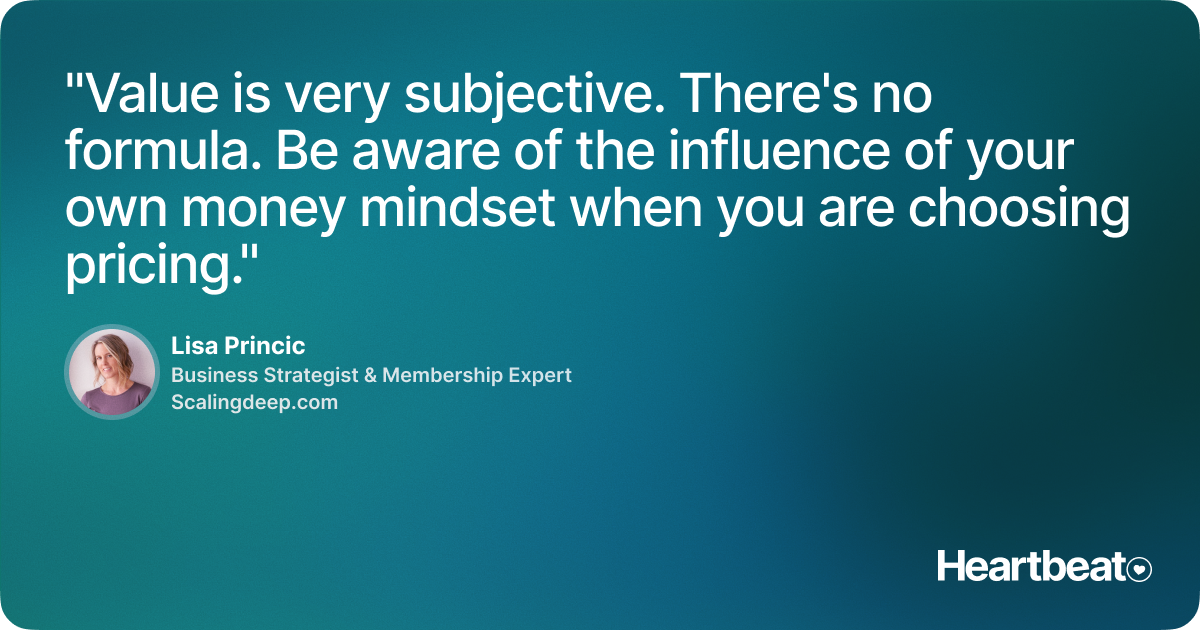
Lisa Princic, a Business Strategist & Membership Expert who's worked with hundreds of membership owners over 16 years, sees the same pattern constantly: community builders who deliver $500/month value but charge $29 because they're afraid of rejection. The gap between what the transformation is worth and what the builder charges is almost always a confidence gap, not a value gap.
Lisa teaches that your money mindset directly influences your pricing decisions. If you grew up believing that charging a lot is greedy, or that asking for money is uncomfortable, those beliefs will show up in your pricing. You'll round down instead of up. You'll add "but it's totally okay if you can't afford it" to your sales conversations. You'll create discount codes before anyone asks.
Here's how to close the gap: track your actual hours per member and calculate your real cost. Most community builders who do this math for the first time realize they're earning well below minimum wage. That realization is uncomfortable, but it's the catalyst for change. If you're spending 15 hours a week on your community and earning $2,000/month, that's $33/hour before expenses. For expertise that your members would pay $200-$500/hour for in a consulting context. The math doesn't lie.
VIP days as the bridge
Once the confidence catches up to the value, the next question is how to actually structure a premium offer without blowing up your existing community. Amy Yamada's answer: start with VIP days. If jumping straight from a $49/month community to a $5K program feels too big, there's a bridge.
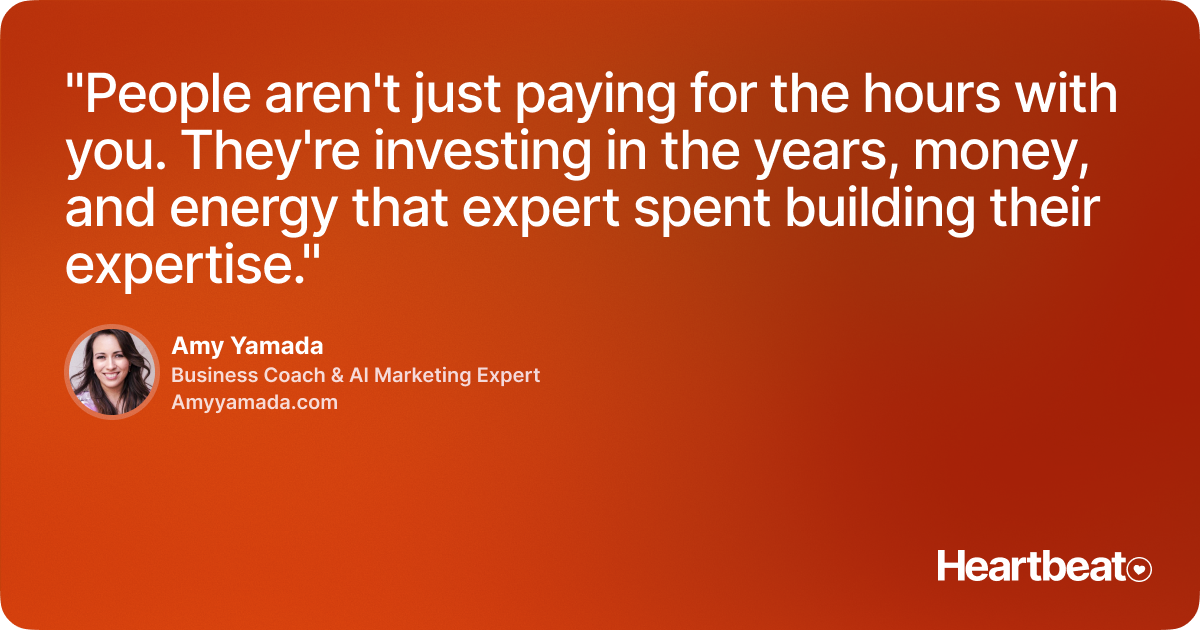
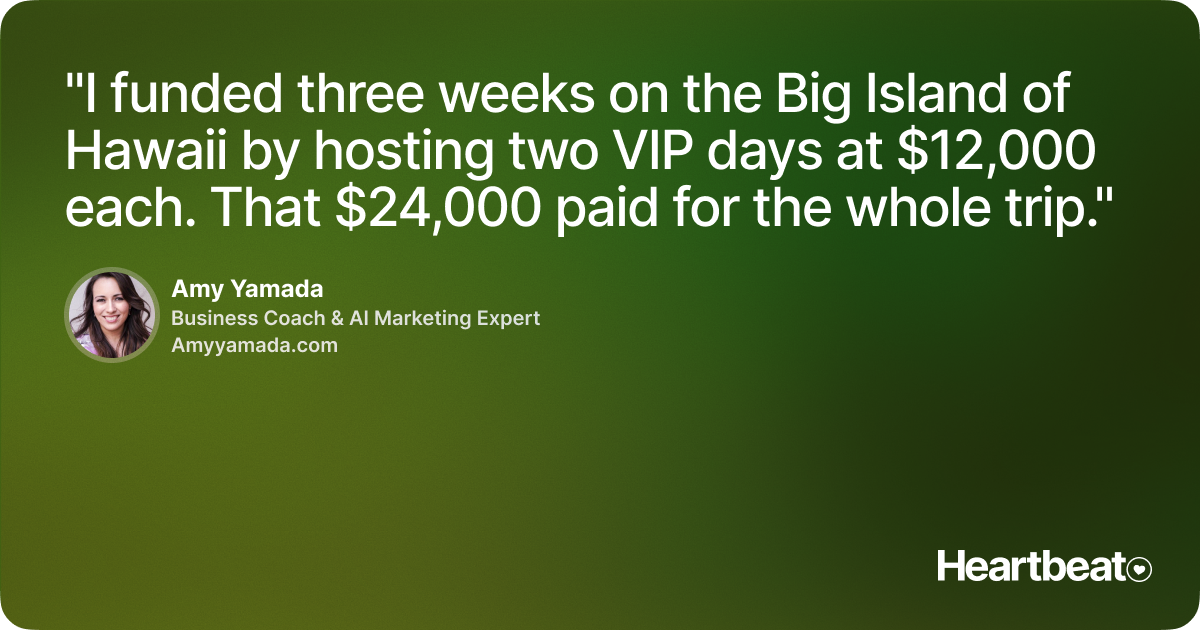
Amy Yamada, a Business Coach & AI Marketing Expert who's hosted 20+ VIP days ranging from $10K-$15K (generating over $200K in additional revenue in a single year), teaches a model built on three pillars: access, attention, and acceleration.
A VIP day is a one-day intensive where a member (or a small group) gets your undivided focus. You're solving a specific problem in a compressed timeframe. The value proposition is straightforward: what would take them months of trial and error, you help them accomplish in a single day.
Amy started at $5K per VIP day and incrementally raised her price as she built confidence and testimonials. Her framework:
Access: They're getting you, the expert, with no distractions. That's inherently valuable.
Attention: Your focus is 100% on their specific situation. No group dynamics, no waiting for their turn.
Acceleration: The outcome they'd get in 3-6 months of self-directed work, they get in one day.
The beauty of VIP days as a bridge is that they don't require you to change your community at all. Your $49/month community keeps running. VIP days are an additional offer for the members who want to go deeper and faster. You can sell them to existing members who've been with you for 3-6 months and are ready for more personalized help.
What revenue jumps look like
The theory is useful. The case studies are where it gets real.
Alejandro Bernardo Diaz at Nocodehackers: Started during COVID charging €5 for an Airtable tutorial. Posted it to 300 Twitter followers. 30-80 people signed up. He moved to €120 per course, then tried a subscription model (it failed, only 5 people did more than two courses). He switched to cohort-based courses at €349 for 6 weeks and had 50 sales in the first two days. Revenue went from ~€100K to ~€350K in two years. The key: he kept testing price points upward until the market told him to stop.
Kat Weaver at Power to Pitch: Started at $99 with 2 members. Moved to $2K programs, then $15K programs for founders raising capital. Now has 400+ active members, over $1M in lifetime sales, and her founders have collectively raised $55M+. Her rule: "People who pay, pay attention. There is not one free spot." She tested giving away $10K worth of free coaching once, and only 20% showed up.
Emily Claire Hughes at The 10K Email Club: Started at $199. Her first launch got zero signups. She relaunched, iterated on the model, and moved to $1,500/month done-with-you pricing. She shut down $10K/month in client work to go all-in. Now does ~$160K/year with 500%+ year-over-year growth. The premium price works because she's actively investing real time and expertise into each member's output.
DeWayne Williams at MAC Enterprise Consulting: Pre-Heartbeat: ~$80K from masterclass revenue. Post-Heartbeat: $5M+ in less than a year. His math: "I'm 45. If I worked 20 years at $80K, that's $1.6 million. We do $1.6 million in less than six months." The jump happened because he built a community business model around education and consulting, not just content.
The pattern across all four: they didn't just raise their price. They changed what they delivered to match the new price. Higher prices fund higher-quality delivery, which produces better member outcomes, which justifies the price. That's the virtuous cycle.
How to start the transition
If you're currently running a low-ticket community and want to move up, here's the sequence:
Step 1: Identify your best members. Who gets the most results? Who asks the most advanced questions? Who would pay for more? These are your first high-ticket candidates. Start by surveying them or getting on calls. One way to systematize this before you even ask: build automated workflows that send a DM from you at 7 days, 30 days, and 2 months after a member joins, checking in on what's working, what's missing, and what they'd want to see more of. The answers surface both your readiness signals and the shape of your next tier, before you've had to guess.
Step 2: Design a premium offer based on what they need. Don't just add more of the same content at a higher price. Add a different kind of value: direct access, structured programs, done-with-you work, VIP days, intensive cohorts. The premium offer should solve a more specific problem or deliver a faster result.
Step 3: Start with a pilot. Run a 4-6 week cohort at your new price point. The simplest way to do this: set up a waitlist for the premium offer using Heartbeat's membership payments, toggle on a member cap (5-10 is right for a first cohort), set your price, and publish. The waitlist captures real demand before you've built the full program, and the cap creates natural urgency without you manufacturing it. This is a feature most platforms don't have. On most community tools you'd track signups manually and close the offer yourself. Use the results from that first cohort as proof for the next round. Amy recommends creating a "confidence card," a one-page document that lists your deliverables, logistics, and price so you can reference it in sales conversations without second-guessing yourself.
Step 4: Keep your low-ticket community running. You're not shutting it down. You're building a second tier on top of it. Your low-ticket community is now the top of your funnel. It's where people discover you, build trust, and eventually graduate to your premium offer. In Heartbeat, both tiers live in the same community: low-ticket and high-ticket members share announcements and events, but premium channels are gated behind access groups. Low-ticket members can see the locked icons on everything they don't have access to yet, and every one of those locked icons is a passive sales moment. They're a constant, ambient reminder of what's available at the next level. Skool can't do this: one community, one price for everyone. Circle handles it by pushing you toward a separate space, which kills the community cohesion entirely.
Step 5: Give it time. Tom's data shows that high-ticket conversion cycles can take 12-24 months. Some people will attend three or four webinars before they book a call. That's normal. The low-ticket community keeps them engaged while they build confidence in the investment.
FAQ
How do I raise my price without losing existing members?
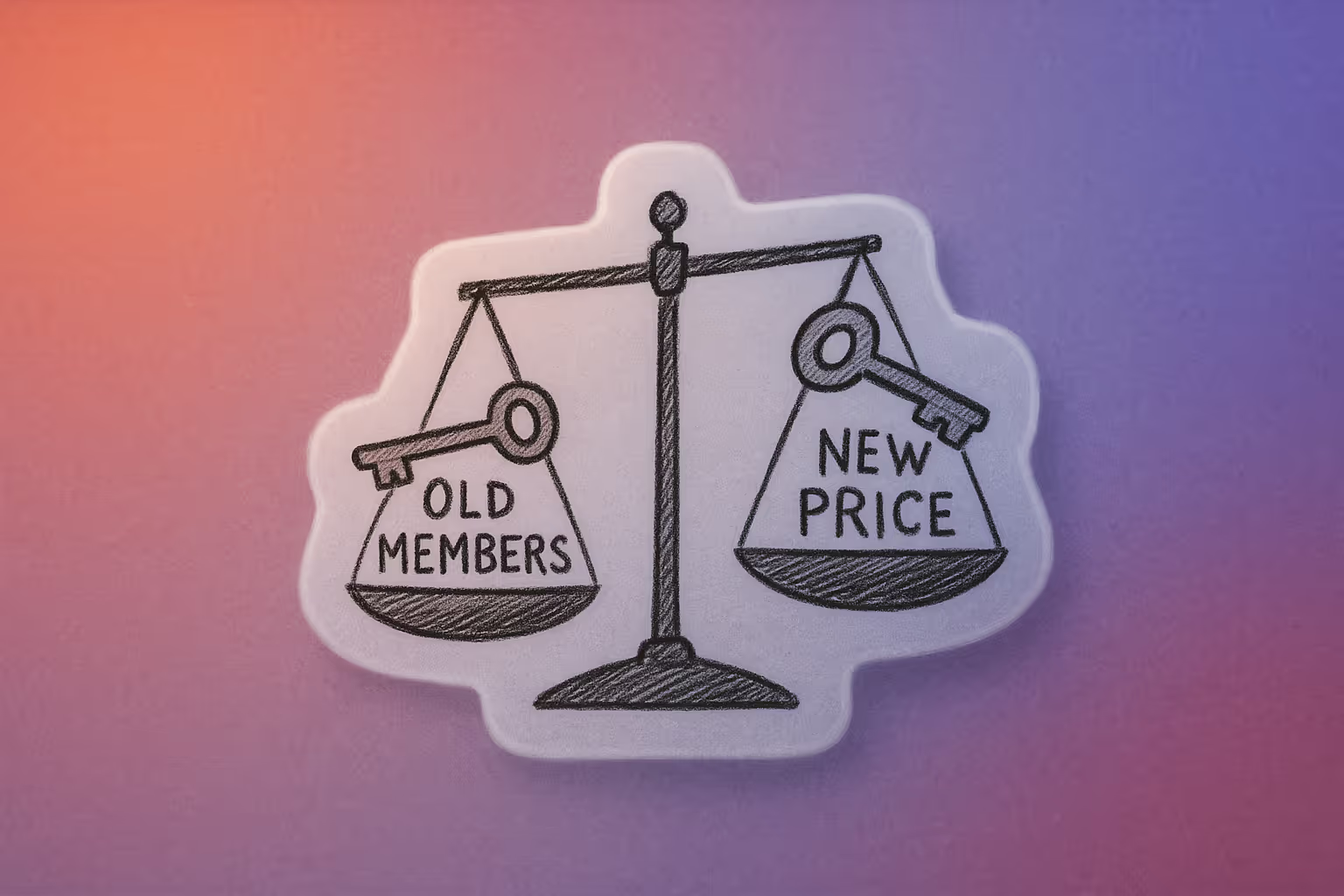
Grandfather your current members at their existing rate. Announce the new pricing for all new members going forward. This rewards loyalty and creates a retention incentive (leaving means they lose their locked-in rate). Most community builders who do this find that existing members stay, and new members accept the higher price without question because they never saw the old one. Grandfathering is a first-class workflow in Heartbeat: when you change the price of a tier, you're prompted to either keep existing members on their original rate or migrate them to the new price. Keep them on legacy pricing, let the new rate apply only to new signups. No manual tracking or spreadsheets to manage.
What if my community is too small to add a high-ticket tier?
You don't need a large community to sell high-ticket. Ten members at $49/month is a small community. But if 2 of those 10 would pay $2K for a VIP day, that's $4K in additional revenue from a community that generates $490/month. Start small. One VIP day per quarter with one client is a perfectly good way to test the model. In Heartbeat, the easiest way to test the premium tier without overcommitting is to spin up a paid waitlist for it. If people sign up and stay excited, you validate the offer before you build the full delivery. When you're ready, you can run both tiers inside a single Heartbeat community using access groups: low-ticket and high-ticket members see shared announcements and events, but each group gets its own gated channels and content. Turn on upsells and the high-ticket content stays visible to everyone, with a checkout prompt when a low-ticket member tries to open it. Those little locked icons across the platform do a lot of the selling for you.
Should I create a separate community for high-ticket members?
Not necessarily. You can run both tiers inside the same community using access groups. High-ticket members see everything low-ticket members see, plus their premium channels, courses, and events. This keeps the community feeling cohesive while delivering differentiated value. The platform architecture should let you manage tiers without running two separate spaces.
How do I know when I'm ready to raise my price?
Three signals:
1. You're consistently overdelivering relative to what you charge.
2. Your best members are asking for more: more access, more depth, more direct help.
3. You have case studies or testimonials proving the transformation you deliver.
If all three are true, you're already late.
What if people push back on the higher price?
Some totally will, and that's fine. Don't spend energy trying to convert the pushback. Focus on the people who see the value and are ready to invest. Those are the members your premium tier is actually built for.