
Intro
Circle has polish & aesthetics.
Heartbeat goes deeper on the business layer: payments architecture, tiered event pricing, cohort courses, and AI that builds things inside your community rather than answering support tickets.
| Heartbeat | Circle | |
|---|---|---|
| Best for | Communities where the business model is the point | Premium member experience, enterprise reference customers |
| Entry price | $49/mo | $89/mo (annual) / $129/mo (monthly) |
| Workflows unlock at | $49/mo (Build, 5 included) | $199/mo annual (Business) |
| AI unlock at | $49/mo (Pulse, all tiers) | $199/mo (Content Co-pilot) / $649+/mo (AI Agents) |
| Platform fee | 5% / 2.5% / 1.25% | 2% / 1% / 0.5% |
Both platforms started from the same problem: community builders were stitching together Slack, Notion, Teachable, and Stripe, and the seams kept showing. Both tried to solve it. Where they diverged is in how far they took the business model underneath.
Where Heartbeat wins
Payments
This is the core structural gap, and it runs deeper than a feature checklist suggests.
Circle's monetization unit is the "paywall," a standalone checkout object. To create a paid course, you build the course, create a paywall, create an access group, attach the paywall to the access group, configure the checkout page, and optionally wire a subscription group for tier upgrade and downgrade paths. Five separate objects configured before a member can pay for anything.
Heartbeat's model: build the thing, set a price on the offer. Access management handles itself from there.
The differences compound across every scenario a real community business runs into:
| Capability | Heartbeat | Circle |
|---|---|---|
| Pay-what-you-want pricing | ✅ All tiers | ❌ |
| Bundled offers | ✅ All tiers | ❌ |
| Cohort pricing | ✅ All tiers | ❌ |
| Grandfathered pricing on increases | ✅ Grow+ | ❌ |
| Quantity limits on offers | ✅ Grow+ | ❌ |
| Time-limited access | ✅ Grow+ | ❌ |
| Cancellation and retention flows | ✅ Grow+ | ❌ |
| Abandoned signup email recovery | ✅ All tiers | ❌ |
| Waitlist with upfront payments | ✅ All tiers | ❌ |
| Offer visibility restrictions | ✅ Grow+ | ❌ |
| Global Meta Pixel and GTM | ✅ Grow+ | ❌ Per-product scripts |
Legacy (grandfathered) pricing is worth calling out specifically. When you raise prices on Heartbeat, the platform prompts you with a choice: keep existing members at their original price, or migrate everyone to the new price. That is a first-class workflow for one of the most common real-business scenarios. Circle has no equivalent.
Cancellation flows are the other gap that compounds fast. When a Circle member cancels, they cancel. When a Heartbeat member (Grow+) initiates a cancellation, they hit a multi-step retention sequence before they're removed: a coupon offer, a tier downgrade option, a cancellation survey, or an in-app modal. The difference in saved monthly revenue adds up quickly at any meaningful scale.
One note on processing fees. Both platforms charge a platform fee in addition to Stripe's standard 2.9% plus $0.30 per transaction. Heartbeat's platform fee is 5% on Build, 2.5% on Grow, and 1.25% on Scale. Circle's platform fee is 2% on Professional, 1% on Business, and 0.5% on Plus. At the entry level, Heartbeat Build (5%) costs more per transaction than Circle Professional (2%). At Grow versus Business, Heartbeat's platform fee (2.5%) is higher than Circle's (1%), but Circle's plan costs $50 per month more (annual billing). At the top tier, Circle Plus has a lower per-transaction rate, but Heartbeat's retention tools save enough from prevented cancellations to close the gap for most communities processing real volume.
Events
Circle markets itself as a full-featured platform, which makes its events gap one of the bigger surprises in a side-by-side demo.
| Capability | Heartbeat | Circle |
|---|---|---|
| Tiered ticket pricing by member group | ✅ All tiers | ❌ Flat price only |
| Automatic calendar invite on RSVP | ✅ All tiers | ❌ Manual only |
| Zoom integration (auto-link + attendance sync) | ✅ All tiers | ❌ Manual URL only |
| Location hidden until RSVP | ✅ All tiers | ❌ |
| Reminder levels (Heavy/Medium/None) | ✅ All tiers | ❌ Manual date/time |
| RSVP trigger filterable by ticket type in workflows | ✅ All tiers | ❌ |
Circle charges a flat ticket price to all attendees. Heartbeat lets you set different ticket prices based on who's attending. Members pay $10, non-members pay $25, VIP members pay $0, all for the same event, with pricing that applies automatically based on group membership. For any community that runs events as a revenue stream or a lead generation channel open to non-members, this is a real capability difference.
Heartbeat also integrates directly with Zoom: auto-generates meeting links, syncs recordings, and tracks attendance without manual setup. Circle requires a manual URL for any external video tool.
Event locations stay hidden until RSVP on Heartbeat, which is useful for paid events and private gatherings where you don't want the location visible before someone commits. Circle shows the location to all visitors regardless.
Heartbeat's reminder system works in levels: Heavy auto-adds the event to the attendee's calendar, Medium sends RSVP invitations, None keeps notifications in-platform only. Circle's reminder system requires entering a specific date and time per reminder, manually.
Courses
| Capability | Heartbeat | Circle |
|---|---|---|
| Cohort courses (fully independent per cohort) | ✅ All tiers | ❌ |
| Free preview lessons for non-enrolled users | ✅ All tiers | ❌ |
| Assignment types: Public, Private, External | ✅ All tiers | ❌ Quizzes only |
| Historical cohort data preserved on new launch | ✅ All tiers | ❌ |
| Course type changeable without rebuild | ✅ All tiers | ❌ Locked upfront |
Circle forces a structural course-type commitment upfront. You choose the type when building, and changing it later is disruptive. Heartbeat lets you build an evergreen course, a drip course, or a cohort-based course from the same structure, and pivot without starting over.
Cohort-based courses are the more significant gap. In Heartbeat, every cohort is a fully independent learning instance with its own modules, lessons, assignments, pricing, and settings. Historical cohort data stays accessible when a new cohort launches. Circle's course architecture doesn't support cohort-level independence at the same structural depth.
Free preview lessons close another gap. Heartbeat lets you mark specific lessons as "free preview," accessible to non-enrolled users as a course teaser, visible in the community feed, with a checkout prompt when they hit a gated lesson. This creates a passive sales funnel inside the course itself. Circle has no equivalent.
Assignment types are also broader on Heartbeat: Public (submissions post to a designated community discussion channel for peer learning), Private (only visible to facilitators), or External (redirects to an external tool and confirms completion when the member returns). Circle supports quizzes only.
Pulse AI
| Capability | Heartbeat Pulse | Circle AI |
|---|---|---|
| Builds courses from raw transcripts | ✅ All tiers | ❌ |
| Configures paid offers | ✅ All tiers | ❌ |
| Sets up automated workflows | ✅ All tiers | ❌ |
| Drafts landing pages | ✅ All tiers | ❌ |
| Creates automated groups | ✅ All tiers | ❌ |
| Drafts posts and content | ✅ All tiers | ⚠️ Co-pilot, Business+ only ($199/mo) |
| Member-facing Q&A and inbox auto-response | ❌ | ⚠️ Agents, Plus only ($649+/mo) |
| Available at entry plan | ✅ $49/mo | ❌ |
Circle and Heartbeat both ship AI. They've made fundamentally different bets about what AI should do in a community.
Circle has two separate AI tools at two separate price points. Business ($199/month) includes a Content Co-pilot that helps admins draft posts and community content. Plus ($649+/month) adds AI Agents: a member-facing Q&A bot that pulls answers from a knowledge base and auto-responds in the member inbox. Neither tool can build anything inside the product.
Heartbeat's Pulse is entirely different in orientation. It's admin-facing and action-oriented: it builds courses from raw transcripts, configures paid offers, sets up automated workflows, drafts landing pages, creates automated groups, invites members, and changes community settings, all through a conversation. Pulse is available on every Heartbeat plan, including the $49/month Build tier. To get any AI at all on Circle, you need to be spending $199/month. To get member-facing AI Agents on Circle, you need $649+/month.
Emily Claire Hughes, founder of the 10K Email Club, compared both platforms directly on YouTube before choosing Heartbeat. Her community grew from zero to $160K/year (500% year-over-year). Two things sealed the decision: the ability to run public events that non-members could attend as a lead generation channel, and a design system flexible enough to match her brand.
Workflows
Circle includes workflows on the Business plan ($199/month). Heartbeat includes 5 workflows on the Build plan ($49/month) and unlimited workflows on Grow ($149/month).
The more material difference is what's available as a workflow action. Both platforms can trigger emails and notifications. Heartbeat goes further: its in-app popup action is a modal with video, a GIF, a celebration animation, and a call to action that appears inside the community itself, creating a moment within the product experience rather than landing in an inbox. That action doesn't exist in Circle at any plan or price.
Automated groups add another layer. Heartbeat groups update on an hourly evaluation of filter logic: post count, login date, location, group membership, reactions received, events attended, email engagement. When someone enters or exits an automated group, a workflow can trigger. This makes re-engagement campaigns, achievement recognition sequences, and content unlock progressions possible entirely inside the platform. Circle has no equivalent.
Where Circle wins
Credible comparisons start with honesty about the competition.
Visual design and UI polish. Circle has the cleanest interface in the category. Fifteen-plus color themes, a premium aesthetic, and thoughtful layout choices throughout. If your brand is built around visual sophistication and your buyers notice design quality, Circle's defaults are genuinely better-looking than Heartbeat's out of the box.
Email Hub. Circle's Plus plan includes broadcast emails, segmented campaigns, and contact management as a standalone email marketing module, more cleanly integrated than Heartbeat's workflow-based approach to outbound email. For communities that want email marketing as a core pillar rather than a workflow output, Circle's Email Hub is a real product investment.
Checkout page customization depth. Circle lets you add countdown timers, testimonials, price callouts, benefit lists, and upsell add-ons to checkout pages. More visual customization than Heartbeat's checkout offers today.
Onboarding experience. Circle's new-user onboarding is polished: personalized demo booking, question-based signup, immediate checklist and resource access. They've invested heavily here, and it shows.
Enterprise social proof. Obama Foundation, Tim Ferriss, Harvard. If your buyers are enterprise procurement teams who weight brand recognition, Circle's reference customer list carries weight in rooms where Heartbeat's doesn't.
Full feature comparison
| Feature | Heartbeat | Circle | Notes |
|---|---|---|---|
| Starting price | $49/mo | $129/mo | Circle's $89 is annual billing only |
| Members at entry tier | 350 | Unlimited | HB Build cap; Grow unlocks 5,000 |
| Courses | ✅ All tiers | ✅ All tiers | Both included at entry |
| Cohort courses | ✅ All tiers | ❌ | Fully independent per cohort on HB |
| Free preview lessons | ✅ All tiers | ❌ | Non-enrolled access for conversion |
| Events and paid tickets | ✅ All tiers | ✅ All tiers | Both included |
| Tiered ticket pricing | ✅ All tiers | ❌ | HB: different price per member group |
| Zoom integration | ✅ All tiers | ❌ | Circle: manual URL only |
| Workflows | ✅ 5 (Build) / Unlimited (Grow+) | ❌ Business+ ($199) | Workflows require $199/mo on Circle |
| In-app popup action | ✅ All tiers | ❌ | No Circle equivalent at any tier |
| Automated groups | ✅ All tiers | ❌ | Hourly filter evaluation |
| Pulse AI | ✅ All tiers | ⚠️ Co-pilot Business+; Agents Plus+ | |
| Pay-what-you-want | ✅ All tiers | ❌ | |
| Bundled offers | ✅ All tiers | ❌ | |
| Cancellation flows | ✅ Grow+ | ❌ | Multi-step churn prevention |
| Abandoned signup recovery | ✅ All tiers | ❌ | Built-in cart recovery |
| Grandfathered pricing | ✅ Grow+ | ❌ | |
| Weekly digest email | ✅ All tiers | ❌ | Automated weekly activity email |
| API access | ✅ Grow+ ($149) | ❌ Business+ ($199) | HB unlocks API $50/mo cheaper |
| Affiliate program | ✅ Grow+ ($149) | ❌ Business+ ($199) | Same |
| Email marketing | ⚠️ Via workflows | ✅ Email Hub (Plus+) | Circle's Email Hub is more complete |
| Branded mobile app | ✅ Scale ($849) | ✅ Plus add-on ($649+) | Both offer this; both are expensive |
| Remove platform branding | ✅ Grow+ ($149) | ✅ Professional+ ($129) | Circle removes branding at lower price |
| Processing fee | 5% / 2.5% / 1.25% + Stripe | 2% / 1% / 0.5% + Stripe | Both add Stripe's 2.9%+$0.30 |
Builders who switched
Emily Claire Hughes runs the 10K Email Club, a high-touch email marketing membership where her team edits members' draft emails as a done-with-you coaching model. She grew from zero to $160K/year (500% year-over-year) after moving off Slack, Notion, and Google Docs. She evaluated Circle head-to-head on YouTube before choosing Heartbeat.
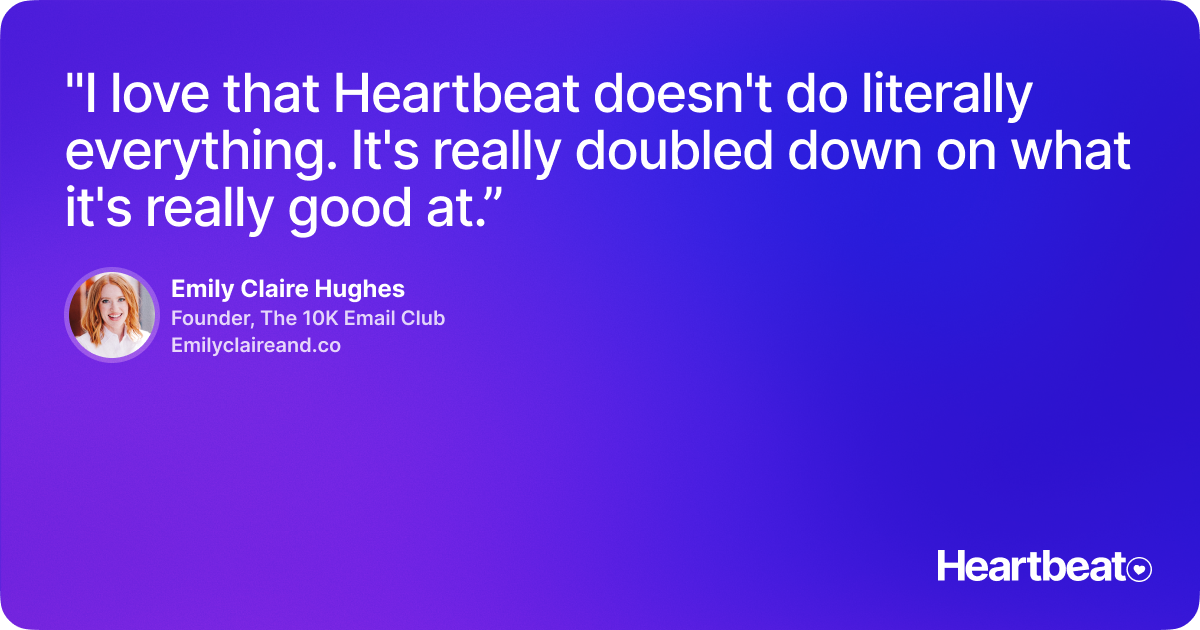
The two things that decided it: public events she could run for non-members as a lead generation channel (Circle's external RSVP options were limited), and the ability to build a community that looked and felt like hers. Heartbeat's design system let her make it pink :)
Which should you choose?
Choose Heartbeat if your community is the business. You monetize through memberships, courses, events, or a combination of all three. You need pricing flexibility: multiple tiers, free and paid access in the same community, cohort pricing, or grandfathered rates when you raise prices. You run events and want to price members and non-members differently. You want AI that builds your community alongside you, not a bot that answers support tickets. You need workflows and automation before you're ready to spend $199/month on a platform subscription.
Choose Circle if your brand is built around premium visual aesthetics and Circle's design language is a genuine selling point with your audience. You want a standalone email marketing module more than deep monetization flexibility. Your buyers are enterprise teams where Circle's reference customers (Obama Foundation, Harvard) carry weight. You're planning to grow to Circle's Plus tier ($649+/month), where the Email Hub and highest limits are included.
The fundamental difference is which layer each platform optimizes for. Circle optimizes for the experience layer: how the platform looks, feels, and presents to members. Heartbeat optimizes for the business layer: how community builders charge, retain, and grow the revenue underneath. Both are legitimate bets. The question is which one your business needs more.
Frequently asked questions
Is Heartbeat cheaper than Circle?
Yes, at comparable feature levels. Heartbeat's Grow plan ($149/month) includes unlimited workflows, the affiliate program, and API access. Circle requires upgrading to Business ($199/month annual) for the same features: $50/month more for an equivalent capability set. At entry level it's $49/month on Heartbeat Build vs. $89/month annual or $129/month on Circle Professional.
On processing fees: both platforms charge a fee on top of Stripe's 2.9% plus $0.30. Heartbeat's rate drops as your community grows: 5% on Build, 2.5% on Grow, 1.25% on Scale. Communities doing real payment volume belong on Grow or Scale, which is also where Heartbeat's retention toolkit kicks in: cancellation flows, grandfathered pricing, coupon offers, dunning recovery. Those tools protect revenue that fee differences never could. At the Grow tier, Heartbeat's 2.5% combined with a $50/month lower plan cost is competitive. At Scale, 1.25% is among the lowest platform fees in the category.
Does Circle have an AI tool?
Circle has two separate AI tools at two separate price points. Business ($199/month annual) includes a Content Co-pilot that helps admins draft posts (admin-facing only, no member interaction). Plus ($649+/month) adds AI Agents: a member-facing Q&A bot. Professional plans have no AI at all. Heartbeat's Pulse AI is architecturally different: it takes actions inside your product, building courses from raw transcripts, configuring paid offers, setting up workflows, and drafting landing pages through a conversation. It doesn't generate text for you to copy and paste. It builds the thing. Pulse is included on every Heartbeat plan starting at $49/month. No upgrade required.
Can you run cohort-based courses on Circle?
Not properly. Circle supports self-paced and drip courses, but cohort-based courses (independent modules, lessons, assignments, pricing, and member rosters per cohort) require structural workarounds that break down at scale. In Heartbeat, each cohort is a completely independent learning instance. When cohort 4 launches, cohort 3 stays live and intact. Members who joined cohort 3 don't see cohort 4's content or pricing. If you run live programs with defined start dates, cohort-specific pricing, and group accountability, Heartbeat is built for that model. Circle is not.
Which platform has better event ticketing?
Heartbeat, and it's not close. You can set different ticket prices for members, non-members, and specific groups, which means your event becomes a lead generation tool, not just a member benefit. Bring non-members in at a higher price, let them experience the community, convert them to members. Circle charges a flat ticket price to all attendees, which forfeits that entire lever. On logistics: Heartbeat integrates directly with Zoom. Links auto-generate, recordings sync, attendance is tracked. On Circle, you paste an external URL and manage everything else yourself.
Can you migrate from Circle to Heartbeat?
Yes, and the migration is handled for you. Heartbeat's team moves members, content, and subscription data. The process has been run for communities switching from Circle, Skool, Mighty Networks, and others. Self-serve migration is available on all plans. A dedicated onboarding rep who manages the full migration is available on Scale ($849/month). The harder question isn't whether the migration is possible. It's how long you want to stay on the wrong platform.