
Intro
Kajabi is the most feature-complete creator platform in the category. Heartbeat goes deeper where it actually matters: community, monetization architecture, and AI that builds your business rather than generating text for you to act on yourself.
| Heartbeat | Kajabi | |
|---|---|---|
| Best for | Subscription communities where monetization depth is the priority | Creators who want courses, podcast, newsletter, coaching, and community in one admin |
| Entry price | $49/mo | $179/mo |
| Cancellation flows | ✅ $149/mo (Grow) | ❌ Not available |
| AI | ✅ $49/mo (Pulse, takes actions) | ⚠️ All plans (generates text only) |
| Platform fee | 5% / 2.5% / 1.25% | 2.9% (Kajabi Payments) |
Both platforms start from a real problem: creators stitching together Stripe, Teachable, Mailchimp, Squarespace, and Zoom into a "business" that breaks every quarter. Both try to consolidate it. Where they diverged is in which layer they decided to own. Kajabi went wide. Heartbeat went deep.
Where Heartbeat wins
Payments
This is not a feature gap. It is a structural one, and it costs Kajabi users real money.
Kajabi's most surprising limitation: you cannot offer monthly and annual pricing side by side in a single product. To give your members both options, you create two separate offers and manage them independently. When a member wants to upgrade from monthly to annual, there is no self-serve flow. The admin must cancel their monthly subscription and manually send them a new checkout link for the annual plan.
Annual subscriptions are the single highest-impact retention tool a subscription community has. Kajabi makes converting monthly members to annual a manual process that requires a conversation. Most conversions that would have happened automatically don't happen at all.
| Capability | Heartbeat | Kajabi |
|---|---|---|
| Monthly + annual pricing on same product | ✅ All tiers | ❌ Two separate offers required |
| Self-serve monthly to annual upgrade | ✅ All tiers | ❌ Admin must cancel and resend link manually |
| Cancellation and retention flows | ✅ Grow+ | ❌ Not available at any plan or price |
| Native paid event tickets | ✅ All tiers | ❌ Events are free-only at every tier |
| Different ticket prices by member type | ✅ All tiers | ❌ |
| Early bird pricing and quantity limits | ✅ Grow+ | ❌ |
| Offer quantity limits | ✅ Grow+ | ❌ |
| Pay-what-you-want pricing | ✅ All tiers | ❌ |
| Paid waitlist (native) | ✅ All tiers | ❌ |
| Bank account required before first paid offer | ❌ | ✅ (required upfront, including full SSN) |
| Abandoned signup email recovery | ✅ All tiers | ✅ |
| Grandfathered pricing on price changes | ✅ All tiers | ✅ |
| Free trial (custom day count) | ✅ All tiers | ✅ |
Cancellation flows deserve a closer look. On Heartbeat (Grow+), when a member tries to cancel a subscription, they hit a multi-step retention sequence before they leave: a coupon offer, a tier downgrade option, a cancellation reason survey, and an in-app modal. Kajabi has no cancellation flow at any price point. When a Kajabi member cancels, they cancel. The revenue difference at any meaningful scale adds up fast.
The bank account friction is a smaller but real operational pain. To create any paid product in Kajabi, you must submit your full SSN and connect a bank account upfront, before you've seen how the checkout works or confirmed it fits your business. Heartbeat lets you configure paid offers, see exactly how they'll look, and only requires Stripe connection when you're ready to go live.
Events
Kajabi has events. They call them "Meetups." You can schedule them, invite members, and run live sessions. What you cannot do, at any plan and any price point, is charge for one.
There is no native paid event ticketing in Kajabi. No workshop pricing, no paid masterclass tickets, no "members pay $10, non-members pay $30" split. Events are free-only, period. To monetize an event, you build a workaround: create a separate course product representing the "event," charge for it, and point the checkout to a calendar link. This is the kind of friction that kills the use case.
For communities where events are a revenue stream or a lead generation channel, this is a disqualifying gap.
| Capability | Heartbeat | Kajabi |
|---|---|---|
| Native paid event tickets | ✅ All tiers | ❌ Cannot charge for any event |
| Ticket prices by member type | ✅ All tiers | ❌ |
| Early bird pricing and ticket quantity limits | ✅ Grow+ | ❌ |
| Events as course lessons | ✅ All tiers | ❌ |
| Events as paid entry point into community | ✅ All tiers | ❌ |
| Live rooms | ✅ Native | ✅ Whereby (third-party) |
| Zoom integration | ✅ Native | ⚠️ External link only |
| Recurring events | ✅ All tiers | ✅ |
| RSVP management | ✅ All tiers | ✅ |
| Calendar sync | ✅ All tiers | ✅ (add-to-calendar link) |
One note on Kajabi's live rooms: the live video inside Kajabi is powered by Whereby, a third-party video tool. For a platform at $179–$499/month positioning itself as all-in-one, outsourcing live video infrastructure is a meaningful signal about where product investment has gone.
Pulse AI
Kajabi markets their AI as "your co-founder." The actual product is a chatbot that drafts copy, suggests a course outline, and generates pricing recommendations as text.
What Kajabi's AI cannot do: create a course, configure a paid offer, set up a workflow, build a landing page, or take any action inside the product. After you finish talking to it, you still have to go build everything yourself.
Heartbeat's Pulse is architecturally different. It takes actions inside your community through conversation: builds courses from raw transcripts, configures paid offers, sets up automated workflows, drafts landing pages, creates automated groups, and invites members. Pulse is available on every Heartbeat plan, including the $49/month Build tier.
| Capability | Heartbeat Pulse | Kajabi AI |
|---|---|---|
| Takes actions inside the product | ✅ All tiers | ❌ |
| Builds courses from your source material | ✅ All tiers | ❌ |
| Configures paid offers | ✅ All tiers | ❌ |
| Sets up automated workflows | ✅ All tiers | ❌ |
| Drafts landing pages | ✅ All tiers | ❌ |
| Creates automated groups | ✅ All tiers | ❌ |
| Generates text and copy | ✅ All tiers | ✅ All plans |
| Available at entry plan | ✅ $49/mo | ✅ $179/mo |
The difference in orientation matters. Kajabi's AI generates more content for you to manage. Pulse builds the infrastructure so you manage less. If you're already going to build a Kajabi course outline and then go build the course manually afterward, a vanilla ChatGPT session would give you roughly the same output at lower cost.
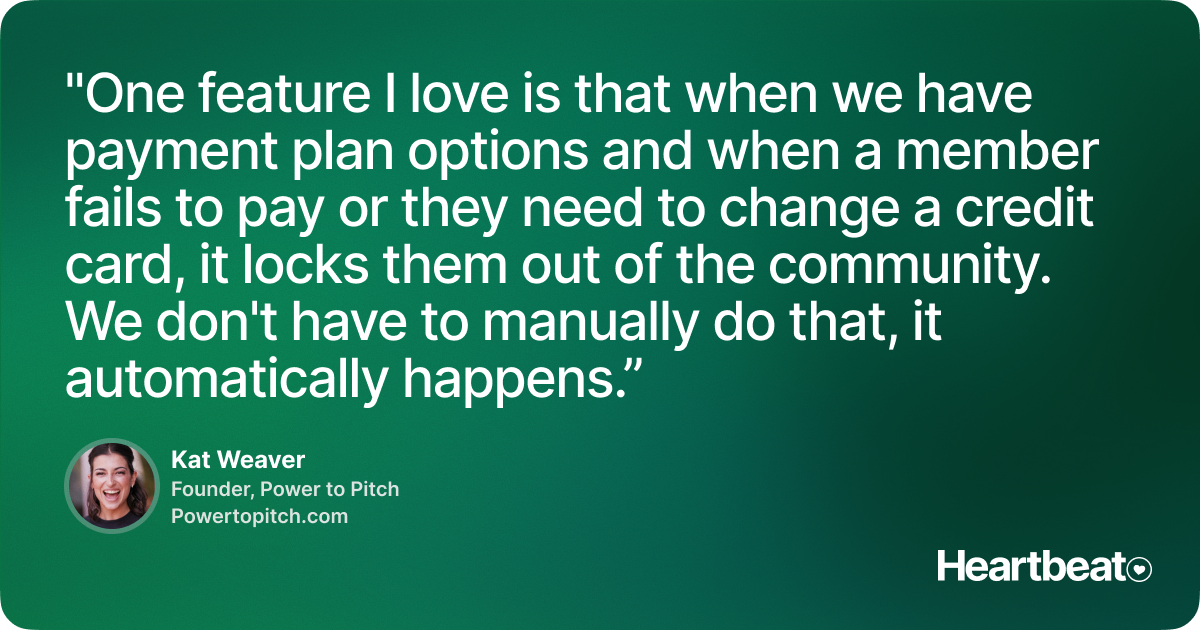
Kat Weaver runs Power to Pitch, a coaching community that helps women land PR features, speaking gigs, and media opportunities. Her programs run from $2K to $15K, with $1M+ in lifetime revenue. Her community operates at a level where platform infrastructure either makes the business easier to run or becomes the constraint that limits growth.
Community
Kajabi has a community product. After a full product walkthrough, the honest assessment: the community does not feel like a product that gets primary investment. No member onboarding flow that guides new members through what to do first. No subgroups for segmentation. No automated groups that update based on member behavior. No matchups for member networking. No search with permalinks for community content.
| Capability | Heartbeat | Kajabi |
|---|---|---|
| New member onboarding flow | ✅ All tiers | ❌ |
| Subgroups | ✅ All tiers | ❌ |
| Automated groups (filter-based, hourly eval) | ✅ All tiers | ❌ |
| DM rules (control who messages whom) | ✅ Grow+ | ❌ |
| Auto-responder DMs | ✅ Grow+ | ❌ |
| Community search and permalinks | ✅ All tiers | ❌ |
| Thread to document conversion | ✅ All tiers | ❌ |
| Matchups (automated member networking) | ✅ All tiers | ❌ |
| Custom roles beyond admin/moderator | ✅ All tiers | ❌ |
| Gamification and points | ⚠️ Partial | ✅ Via Challenges |
| Challenges (structured sequences) | ❌ | ✅ |
| Thread channels | ✅ All tiers | ✅ |
| Chat channels | ✅ All tiers | ✅ |
| Direct messages | ✅ All tiers | ✅ |
| Member directory | ✅ All tiers | ✅ |
| Announcements | ✅ All tiers | ✅ |
Kajabi's community does have an advantage in one area: Challenges, a structured sequence product that came through their Viably acquisition. For communities built around accountability programs with gamified progress tracking, this is a genuine edge. Heartbeat doesn't have a direct equivalent.
But for subscription communities where the community itself is the product, the missing onboarding flow, absent subgroup architecture, and lack of automated member segmentation create operational gaps that compound as the community scales.
Courses
Both platforms support self-paced and cohort-based courses. The difference is how tightly the course integrates with the rest of the community, and whether a few critical course features exist at all.
| Capability | Heartbeat | Kajabi |
|---|---|---|
| Free preview lessons (native) | ✅ All tiers | ❌ Requires a separate free preview course |
| Events as course lessons | ✅ All tiers | ❌ |
| Course integrated with community feed | ✅ All tiers | ❌ Siloed |
| Searchable video transcripts | ✅ All tiers | ❌ |
| Live session participant limit | Unlimited | 200 participants |
| Assignments: Public, Private, External | ✅ All tiers | ✅ (file uploads, reflections, external) |
| Quizzes | ❌ | ✅ |
| Completion certificates | ❌ | ✅ |
| Drip release by enrollment date | ✅ All tiers | ✅ |
| Self-paced courses | ✅ All tiers | ✅ |
| Cohort-based courses | ✅ All tiers | ✅ |
| Native video hosting | ✅ | ✅ |
Free preview lessons are worth calling out specifically. In Heartbeat, you mark specific lessons as "free preview" and non-enrolled users can access them as a course teaser, with a checkout prompt when they hit gated content. Kajabi has no native equivalent. To give prospects a preview, you build a separate free course and link to it externally. That workaround is functional. It's also four times more work, requires managing two course objects, and creates a disjointed experience for the prospect.
The course-community silo is the deeper issue. In Heartbeat, course activity surfaces in the community feed, course completions can trigger workflows, and events can be embedded directly as course lessons. In Kajabi, courses and community are separate product surfaces with minimal integration between them. For cohort-based programs where peer accountability and group discussion are part of the curriculum, this matters.
Kajabi does win clearly on two course features: quizzes and completion certificates. If your course audience expects a quiz-gated progression or a credential at the end, Kajabi has it and Heartbeat doesn't.
Where Kajabi wins
Credible comparisons start with honesty about the competition.
Product breadth. Kajabi has six product types: courses, community, coaching (with a built-in Calendly-style scheduler), podcasts, newsletters, and digital downloads. Heartbeat covers two of them. For a creator who wants their course library, podcast, newsletter, and coaching practice all in one admin with one login, Kajabi is genuinely the most complete option in the category. The coaching scheduler alone, with Google Calendar sync, session tracking, and integrated payments, is a real product that coaches would otherwise pay separately for.
Email marketing depth. Full email sequence builder, broadcast emails, funnels, abandoned cart recovery, and automation tied to sequences. Heartbeat's outbound email capabilities live inside the workflow system, which is more powerful for behavioral triggers but less complete as a standalone marketing tool. If email nurture sequences are core to your business, Kajabi's email infrastructure is meaningfully more developed.
Instagram and Facebook DM automation. Kajabi's Universal Inbox can send automated DMs to Instagram and Facebook followers as a workflow action. No other platform in the category has this at all. For creators with large social followings who want to convert social engagement into community memberships through automated DM sequences, this is a unique capability with no equivalent on Heartbeat.
Affiliate auto-payouts. Kajabi Payments enables automatic affiliate commission payouts. Heartbeat's affiliate program is manual payouts only. At any scale of affiliate activity, automatic payouts are an operational time-saver that Kajabi delivers and Heartbeat doesn't yet.
Course completion certificates. Kajabi issues completion certificates. For professional development programs, compliance training, or any course where a credential matters to the student, this is a concrete gap on Heartbeat.
Full feature comparison
| Feature | Heartbeat | Kajabi | Notes |
|---|---|---|---|
| Starting price | $49/mo | $179/mo | Kajabi is 3.6x more expensive at entry |
| Members at entry tier | 350 | 2,500 contacts | HB Build: member cap; Kajabi Basic: contact cap |
| Courses | ✅ All tiers | ✅ All tiers | Both at entry |
| Free preview lessons | ✅ All tiers | ❌ | Kajabi requires separate free course |
| Cohort courses | ✅ All tiers | ✅ All tiers | |
| Quizzes | ❌ | ✅ | Kajabi wins |
| Completion certificates | ❌ | ✅ | Kajabi wins |
| Searchable video transcripts | ✅ All tiers | ❌ | |
| Live session limit | Unlimited | 200 participants | |
| Events and paid tickets | ✅ All tiers | ⚠️ Free events only | Kajabi cannot charge for events |
| Ticket prices by member type | ✅ All tiers | ❌ | |
| Monthly + annual on same product | ✅ All tiers | ❌ | Kajabi requires two separate offers |
| Self-serve monthly to annual upgrade | ✅ All tiers | ❌ | Manual admin process on Kajabi |
| Cancellation and retention flows | ✅ Grow+ | ❌ | Not available on any Kajabi plan |
| Pay-what-you-want pricing | ✅ All tiers | ❌ | |
| Offer quantity limits | ✅ Grow+ | ❌ | |
| Affiliate program | ✅ Grow+ (manual) | ✅ (auto payouts) | Kajabi auto-payouts via Kajabi Payments |
| Pulse AI (takes product actions) | ✅ All tiers | ❌ | Kajabi AI is text-only |
| Coaching scheduler | ❌ | ✅ | Built-in; Heartbeat has no equivalent |
| Podcast hosting | ❌ | ✅ | Kajabi product type |
| Newsletter product | ❌ | ✅ | Kajabi product type |
| Digital downloads | ❌ | ✅ | Kajabi product type |
| Email sequences and funnels | ⚠️ Via workflows | ✅ Native | Kajabi email marketing is more complete |
| Instagram/Facebook DM automation | ❌ | ✅ Growth+ | Unique to Kajabi in the category |
| Workflow branching logic | ❌ | ✅ | Kajabi has if/else conditional logic |
| Send single email via workflow | ✅ All tiers | ❌ | Kajabi only supports email sequences |
| Send push notification via workflow | ✅ All tiers | ❌ | |
| In-app popup action | ✅ All tiers | ❌ | |
| Automated groups | ✅ All tiers | ❌ | Hourly filter evaluation |
| New member onboarding flow | ✅ All tiers | ❌ | |
| Matchups (member networking) | ✅ All tiers | ❌ | |
| Community search and permalinks | ✅ All tiers | ❌ | |
| Challenges | ❌ | ✅ | Kajabi acquired Viably |
| Subgroups | ✅ All tiers | ❌ | |
| Native video hosting | ✅ | ✅ | Kajabi included; Heartbeat $19/mo add-on on Build |
| Live video infrastructure | ✅ Native | ✅ Whereby | Kajabi uses third-party |
| Website and landing pages | ✅ All tiers | ✅ All tiers | Kajabi's website builder is more complete |
| Blog (built-in) | ❌ | ✅ | Kajabi has native blog |
| Custom domain | ✅ All tiers | ✅ All tiers | Both at entry |
| Branded mobile app | ✅ Scale ($849) | ✅ (+$200/mo add-on) | Kajabi cheaper for this specific feature |
| API access | ✅ Grow+ ($149) | ✅ Pro+ ($499) | HB API at $149/mo; Kajabi Pro at $499/mo |
| Platform fee | 5% / 2.5% / 1.25% | 2.9% | Kajabi 0% requires using their payment stack |
Builders who switched
Kat Weaver runs Power to Pitch, a coaching community that helps women land media features, speaking gigs, and PR opportunities. Her programs range from $2K to $15K, with $1M+ in lifetime revenue generated through the community.
Heartbeat handles the full revenue stack for her programs: tiered membership pricing, paid course add-ons, and event-based upsells, all within a single community that members experience as one product. The monetization depth that would require workarounds on Kajabi, or a separate Stripe integration on a platform without native subscription management, runs natively inside Heartbeat.
Her community growth is tied directly to how the platform handles subscription retention: when members consider canceling, they're met with a structured flow, not a one-click exit. That infrastructure protects the revenue base that makes programs at this price point sustainable.
Which should you choose?
Choose Heartbeat if community and subscriptions are your primary business model. You charge for membership access, run paid events, offer multiple pricing tiers, or need the monetization infrastructure that turns a community into a durable revenue engine. You want AI that builds your community rather than describing what you should build next. You need cancellation flows, automated member re-engagement, and behavioral workflows from day one, not as an enterprise upgrade.
Choose Kajabi if you're building a creator stack beyond community and courses: a podcast, newsletter, or coaching practice that you want in a single admin. You want built-in email marketing funnels as a first-class product, not a workflow output. You need Instagram and Facebook DM automation at scale. You're coaching 1-on-1 or in small groups and want an integrated scheduler with payment without stitching in Calendly separately.
The core difference is what each platform optimized for. Kajabi optimized for creator breadth, covering more product types than any competitor in the category. Heartbeat optimized for subscription depth: the monetization architecture, community infrastructure, and AI primitives that let a community-first business actually run and grow. If your community is the business and subscriptions are how it makes money, the breadth Kajabi offers beyond community and courses isn't what you need. The depth you need is what Kajabi is missing.
Frequently asked questions
Is Heartbeat cheaper than Kajabi?
Significantly. Heartbeat starts at $49/month on the Build plan, which includes courses, events with paid ticketing, unlimited channels, community, and Pulse AI. Kajabi starts at $179/month, more than 3x as much, for a plan with tighter contact limits and no cancellation flows or retention infrastructure at any tier. At comparable feature levels, Heartbeat Grow ($149/month) includes unlimited workflows, API access, cancellation flows, and the affiliate program. Kajabi's Pro plan ($499/month) is where API access unlocks. On processing fees: Kajabi charges 0% if you use Kajabi Payments, their Stripe Express wrapper (you'll still pay 2.9% to Stripe). If you use another payment provider, Kajabi's platform fee is 2.7% on Basic down to 0.5% on Pro. Heartbeat's platform fee is 5% on Build, 2.5% on Grow, 1.25% on Scale. For communities doing real subscription volume, Heartbeat's retention toolkit at Grow and above, cancellation flows, grandfathered pricing, and dunning recovery, protects revenue that fee percentages never could.
Does Kajabi have an AI that can build things?
No. Kajabi's "AI co-founder" generates text: course outlines, email copy, pricing recommendations. It cannot create a course, configure a paid offer, set up a workflow, or take any action inside the product. After the conversation, you go build everything yourself. Heartbeat's Pulse AI does the building. You describe what you want through conversation and Pulse configures the offer, creates the course structure, sets up the automation, and drafts the landing page. It's included on every Heartbeat plan starting at $49/month. The difference isn't features. It's whether the AI saves you time or generates more work for you to manage.
Can Kajabi handle monthly and annual subscriptions side by side?
No, and this is Kajabi's most consequential monetization gap. To offer both billing intervals, you create two separate products and manage them independently. When a member wants to switch from monthly to annual, you, the admin, must manually cancel their monthly subscription and send them a new checkout link. There is no self-serve upgrade path. Annual subscriptions dramatically improve retention and cash flow. Kajabi turns every monthly-to-annual conversion into a manual admin task. Most members who would have upgraded automatically won't email you to ask you to do it manually. Heartbeat handles monthly and annual on the same product with a self-serve upgrade path on every plan.
Which platform is better for running events?
Heartbeat, and the gap is complete: Kajabi cannot charge for a single event at any plan or price point. Events are free-only. If you want to run a paid workshop, a paid masterclass, a paid live session, or charge non-members a different rate than members for any event, Kajabi has no path to do it natively. Heartbeat has paid event ticketing on every plan, including different prices by member group, early bird pricing on Grow+, and quantity limits. On the logistics side, Heartbeat integrates natively with Zoom: auto-generates links, syncs recordings, and tracks attendance. Kajabi supports pasting in an external URL. Kajabi's live rooms use Whereby, a third-party video tool.
Can you migrate from Kajabi to Heartbeat?
Yes. Heartbeat's team handles member, content, and subscription data migration. Self-serve migration support is on the Grow plan ($149/month). A dedicated onboarding rep who manages the full migration is on Scale ($849/month). The migration question is rarely the real question. The real question is: how much revenue are you leaving on the table while your annual upgrade path is a manual admin task and your cancellation flow is no flow at all?