How to use email marketing to fill your community
Email's job is not to nurture subscribers until they're ready to buy. That framing produces newsletters full of helpful tips and very few members, because helpful tips don't create urgency. What creates urgency is the feeling that something specific is happening inside a community right now, and you're not there.
The email that fills communities makes non-members feel like they're missing something: a conversation that would have helped them, a connection they should have made, a moment they weren't part of. The content of your newsletter isn't filler between promotional emails. It's evidence that the community is active, specific, and worth being inside, evidence delivered at regular intervals to the exact people who have the problem your community solves.
Everything else, list-building tactics, welcome sequences, conversion funnels, serves this central job. Write email that makes the right person feel like they should already be in your community.
What to write about
The easiest shortcut: write about what's actually happening inside your community.
Every live event generates questions worth sharing. Every member breakthrough is a story worth telling. Every thread where members help each other solve a real problem is a window into what membership looks like. You don't need to manufacture newsletter content from scratch when your community is producing it for you every week.
The format is simple: one thing that happened inside the community this week, why it matters, and an invitation to join if they're not already inside. Keep it short. The newsletter isn't supposed to satisfy the reader's curiosity. It's supposed to surface it. A subscriber who finishes your email thinking "I want to be part of that conversation" is ready to become a member. A subscriber who finishes it feeling fully informed is not.
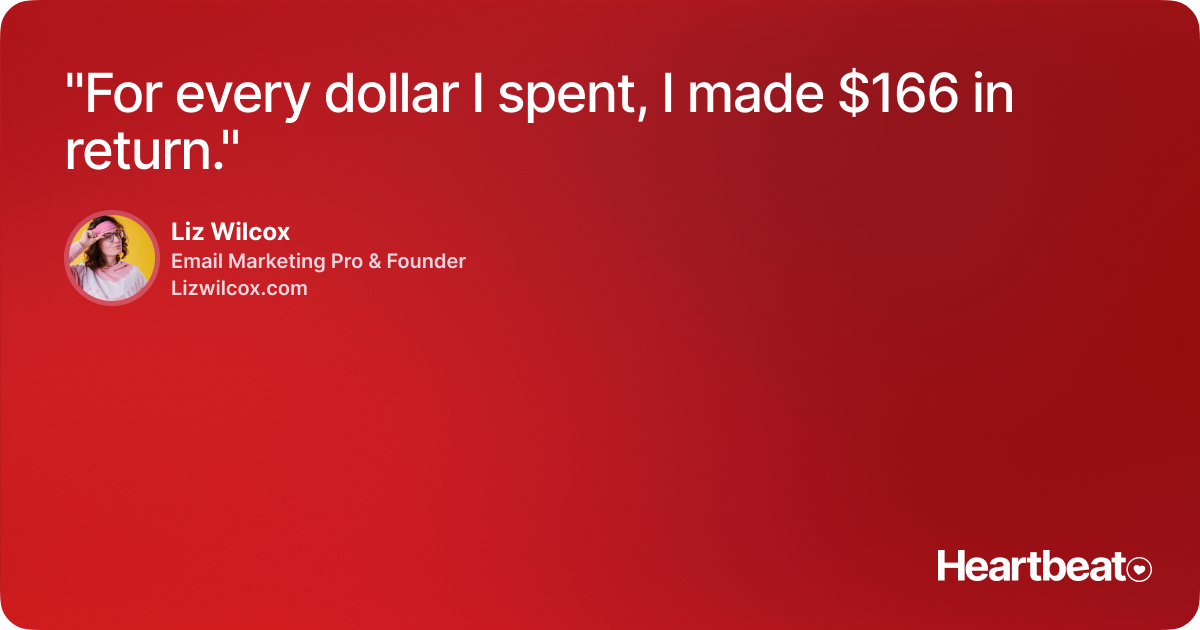
Liz Wilcox, a renowned email expert who's generated $166 for every dollar she's invested in email marketing, frames this as the distinction between showing investment and delivering information. Investment means demonstrating that you've thought about your reader's specific situation before you hit send. Information just fills space. The newsletter that converts is the one that shows the reader you understand their problem and that people inside your community are actively solving it.
Write in plain text, first person, conversational voice. Not a newsletter template, an email from a person. Community builders who switch from designed email templates to plain-text personal-voice emails typically see open rates jump 10-15 points. The inbox is a personal space. Write for it.
The welcome sequence
The welcome sequence sets the tone for everything that follows. Its job is not to educate new subscribers. It's to make them feel like they found the right person.
Liz's structure for a four-email welcome sequence: set expectations in email one (what you send and how often), show personality in email two (a story or belief that signals who you are and what you stand for), share your vision in email three, and include a trip wire in email four, a low-cost, low-commitment paid product that filters for buyers early. The subscriber who buys a $9 template in the first week is significantly more likely to join your $97/month community than the subscriber who has been on your list for three months without ever purchasing anything.
The most important element of email one: the yes/no question in the postscript. "PS, Do you already have a paid community, or are you still in the planning stage? Hit reply with a yes or no." Easy to answer, signals you care about their situation, and generates replies that tell your email platform the message was wanted, which improves deliverability for every email you send afterward.
Reply rate is the metric that matters more than open rate. A reply is a signal that you wrote something worth responding to. It improves deliverability. It gives you qualitative data about what your subscribers actually care about. And it starts a conversation that can convert to membership faster than any automated sequence. Design every welcome email to generate at least one reply.
If you want to see exactly what this looks like, Liz offers her complete welcome sequence as a free download at lizwilcox.com. The hot pink button gets you a pre-written four-email sequence, three newsletter examples (one designed to drive clicks, one replies, one purchases), and 52 subject lines. She also runs a $9/month template club with ongoing material. The fastest way to learn what a high-converting welcome sequence actually looks like is to sign up and watch it run on you.
This approach works best if you're already writing regularly and plan to keep it up. If consistent writing feels like a grind, or you'd rather build something once and let it run, there's a different model.
The conversion window
For community builders who don't want to commit to weekly writing as the primary conversion engine, Lisa Princic, membership strategist and founder of Scaling Deep, teaches a different model. Where Liz's approach rewards builders who write consistently and build a relationship over time, Lisa's is a system you set up once and run on autopilot, better suited for builders who think in projects rather than ongoing content creation. You can also use both: run Lisa's funnel first for new subscribers, then lean into Liz's newsletter approach for those who don't convert.
The model creates urgency without requiring a live launch every time: the Limited Evergreen Funnel.
The funnel triggers automatically when someone joins your list. Days 1-3: a free resource that demonstrates the transformation your community produces. Days 4-8: an invitation to join at a lower price than the standard rate, available for a defined window. The offer expires genuinely. Not a fake countdown timer, but a system that enforces the price change automatically. Days 9-11: regular content, no pitch. Days 12-18: a second, final invitation at the standard rate.
The logic: most subscribers need multiple touches before they're ready to buy, but they resent being pitched indefinitely. The Limited Evergreen Funnel concentrates the selling into two defined windows, gives subscribers clear signals about when the opportunity closes, and returns to relationship-building immediately after. It converts subscribers who are ready without burning the relationship with subscribers who aren't.
Lisa's benchmark: if fewer than 1% of warm-traffic visitors convert through the funnel, the problem is the offer or positioning, not the email sequence. Fix the offer before optimizing the funnel.
Building the list
My approach for early list growth: connect with 10-20 targeted people on LinkedIn daily, start genuine conversations about the problem your community solves, and manually invite the people who express real interest to join your list. This is slower than a viral lead magnet but produces subscribers who already trust you, which means they convert at dramatically higher rates when you invite them to join the community.
The metric targets for a healthy community-builder email list: 40%+ open rates (achievable when writing to a specific niche), 10%+ click-through rates, and under 0.5% unsubscribe rate per send. These are better than typical email benchmarks because you're not blasting a mass list, you're writing to a specific person with a specific problem. The specificity is what does the work, and it starts with who you're inviting to subscribe.
One rule: commit to a sending cadence you can maintain for a full year before increasing frequency. Consistent, weekly emails to a small engaged list outperform sporadic, high-production emails to a large unengaged one by every measure that matters, open rates, replies, and conversions to membership.
The email-community loop
The connection between your email list and your community runs both directions. Your email list converts subscribers into members. Your community generates the insights, conversations, and breakthroughs that make your email list worth subscribing to.
In Heartbeat, you can configure automated email notifications that keep members engaged between live events and bring lapsed members back in. Apply the same principles: personal voice, consistent cadence, reply-driving prompts. A community email that feels like it came from a person rather than a platform performs dramatically better than a generic notification.
Every newsletter should include one line pointing to something happening inside the community that week, a live event, an active thread, a member win. Subscribers who aren't yet members see the community as active and worth joining. Members who receive the email are reminded to come back. The email and the community make each other more valuable.
FAQ
How often should I email if I'm also running a community?
As often as you can reliably maintain. If once a month or every two weeks is what you can actually stick to, that's better than committing to weekly and burning out after six sends. Consistency matters more than frequency: a subscriber who opens your email every other week for two years is more valuable than one who opens daily for a month and then never sees your name again. Prove you can hold a cadence, then ramp up. The community doesn't replace the email list, it depends on it. Use your community's best moments as newsletter material. The overlap is the strategy, not a problem to manage.
What email platform should I use?
The platform matters less than the habit. Pick one with good deliverability, set up DKIM and SPF authentication, and spend your energy on the writing. Don't switch platforms when your list is growing, the platform isn't the problem.
How do I re-engage members who've gone quiet?
Send one short, personal email: "I noticed you haven't been around, is everything okay? Is there something we could do differently?" This consistently outperforms multi-email reactivation sequences. The goal isn't to announce a promotion. It's to start a conversation.
Should I build my email list before launching the community?
Yes. Even 200-300 genuinely interested subscribers on launch day significantly reduces the cold-start problem. Subscribers who've followed your newsletter for six months convert to founding members far more easily than people you reach through cold outreach. Start the list before the community is ready.
How long should my welcome sequence be?
Four to six emails over the first two weeks. The exact length matters less than the trip wire offer and the quality of each email. End with the subscriber knowing what to expect from you, why you're worth their attention, and what they can do right now, which may include joining the community.