
You're ready to launch a paid community when two things are true: you have one person who has committed to paying, and you have a date for your first live event. Everything else, the full content library, the polished brand, the elaborate welcome sequence, can be built after launch. Building it before launch is the single biggest reason community builders never launch at all.
This sounds like an argument for cutting corners. It's the opposite. Waiting for the community to be "ready" means waiting for certainty you can only get from having real members inside. Every month you spend building before launch is a month you're making decisions without the information that only real members can give you. The four-week framework below gets you to launch fast enough to get that information while your momentum is still intact.
Week 1: Three answers, not a plan
The first week has one job: answer three questions that everything else depends on.
Who is this for, specifically? Bri Leever, community consultant and growth specialist, gives a simple test: can you write a one-sentence description that makes some people say "that's me" and others say "that's not me"? If you can't, you don't have a clear enough picture yet. "Freelancers who want to grow" doesn't pass the test. "Freelance designers who've been stuck under $5,000/month for more than a year" does. Specificity here is the difference between founding members who join with accurate expectations and founding members who churn before month two.
What does success look like for a member? Name the transformation concretely. Not "a supportive community for coaches" but "a path from solo practice to $10K months, with specific milestones along the way." The more concrete the promise, the easier every subsequent decision, pricing, content, events, becomes. If you can't name the transformation, you aren't ready to charge for it.
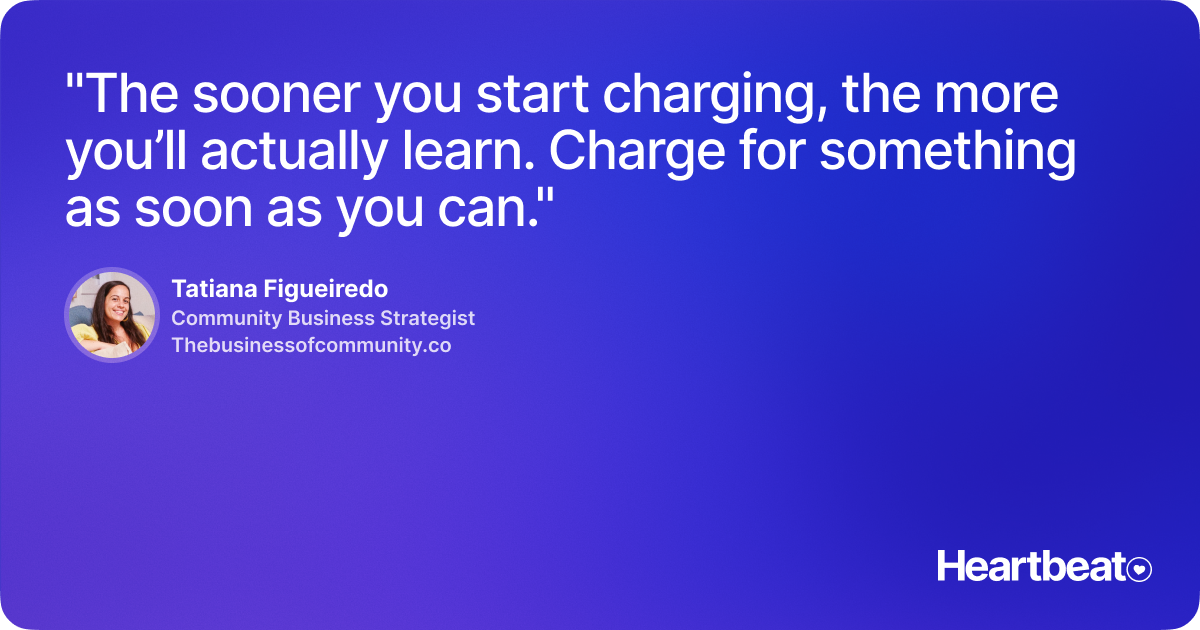
What's the price? Tatiana Figueiredo, Community Business Strategist, is direct: the sooner you start charging, the more you'll learn. Charging produces committed members who show up and tell you what they actually need. Free communities attract everyone, including the majority who will never engage. Set a founding member price you'd feel comfortable raising in six months, because you will raise it once you have the proof to justify it.
Week 1 is the only week where you're not building anything. After you have clear answers to these three questions, everything in Week 2 takes less than a day.
Week 2: Four things, nothing else
Week 2 has significant platform work. The goal is not a finished community. It's a functional one.
Four things must exist before any member arrives: a paid offer, a welcome message, a "Start Here" space with one clear first action, and one live event on the calendar. That's it. Build only these four things in Week 2.
Build the paid membership offer first. Before you create a single piece of content, there should be a way for someone to pay you. In Heartbeat, this takes about 5 minutes with Pulse: tell Pulse the exact offer you want, connect Stripe, and Pulse builds it for you. Name, price, billing interval, member access. Everything else is built around this, not before it.
Build a paid waitlist if an empty room on launch day is holding you back. A paid waitlist in Heartbeat is just a second offer where access is gated until you choose to open it. People pay to reserve their spot. You know exactly how many committed members you're bringing into the community before the Welcome Party happens. No guessing, no hoping the outreach was enough. Run the waitlist through Week 3 alongside your personal outreach, close it when you hit your target number, and launch to a room that isn't empty. The payments also do something that free signups can't: they confirm willingness to pay before you've built anything. Someone who hands over money to get on a waitlist is a founding member. Someone who gives you their email address is not.
"Create a paid waitlist offer called '[Community Name] Founding Member Waitlist' at $39/month. Write a description explaining that this is limited founding-member access, what they'll get when we open, and that the price locks in permanently at this rate. Gate the access so I can admit members manually once we hit our launch number."
Add some content before members arrive. An empty community feels like a waiting room. A few posts, a simple document, or a short video give founding members something to react to and signal that the community is active. This doesn't have to be a production exercise. Take a past coaching call, a workshop recording, or notes from a client session, drop it into Pulse, tell it to maintain your voice and anonymize any client-specific details, and Pulse turns it into a post, guide, or course module in minutes. Three pieces of content ready when members arrive is the difference between founding members who browse and founding members who engage.
"Here's a transcript from a past coaching session: [paste transcript]. Maintain my voice and perspective. Anonymize any details that could identify the client. Turn it into a useful post for my community about [topic]. Two to three paragraphs, practical and direct."
Skip the elaborate spaces structure, polished brand assets, and long welcome email sequence. None of these determine whether a founding member stays. What determines whether they stay is the live event you're planning for Week 4 and the personal attention you give them in their first two weeks. Build Week 2 in a day and move on.
Week 3: Go to them
The hardest psychological problem in launching a paid community is the empty room. Week 3 is specifically designed to solve it before it becomes real.
Bri's top 3 strategy: identify the three people most likely to be your first members, former clients, warm leads, engaged social followers, professional contacts who have the exact problem you're solving. Don't broadcast to them. Reach out personally, one at a time, and invite them to join as founding members at a lower early-access price before the public launch.
The key word is "personally." A personal message is not a link blast. It's a message that references something specific about that person, explains what you're building and why you thought of them, and makes a direct ask. Three sentences. The ask at the end is specific: "Would you want to be part of this as a founding member?"
These three people serve two purposes. They validate your offer with real payments before the public launch. And they give your broader outreach something to say: "We already have founding members inside." The community goes from something you're asking people to bet on to something that's already happening.
Promotion calendar for Week 3:
| Day | Action |
|---|---|
| Day 1 | Personal outreach to top 3 potential members |
| Day 3 | Launch announcement to email list |
| Day 5 | Social channels with founding member framing |
| Day 7 | Personal follow-up with anyone who showed interest but hasn't joined |
End Week 3 with at least one paying founding member. If you don't have one after personal outreach to ten people, go back to Week 1 and sharpen either the audience definition or the promise.
Week 4: The Welcome Party
The Week 4 centerpiece is the Welcome Party, the first live event, designed specifically for founding members, that creates the first real community experience.
The Welcome Party is not an onboarding webinar. It's a celebration. Its job is to make every founding member feel like they made the right decision, and to create the first real connections between members before any of them have had a reason to interact.
The Welcome Party structure: a warm opening where the founder acknowledges each founding member by name, a brief statement of the community's purpose said out loud, a structured introduction round where every member shares what they're working on, and a founder moment where you share why you built this and what you're hoping to build together. Then: the next event, on the calendar, before anyone leaves.
A founding member who leaves the Welcome Party having met one person they want to talk to again is a founding member who'll still be there at month six. That connection is the purpose of the event. Everything else is ceremony.
In Heartbeat, set the Welcome Party event to display as a popup when members log in for the three days before. No founding member should miss the first meeting because they didn't see it.
The 4-week checklist
| Week | Phase | Tasks |
|---|---|---|
| Week 1 | Clarify | Write a one-sentence ideal member description. Write the transformation promise. Set the founding member price. |
| Week 2 | Build | Create the paid offer. Optionally create a paid waitlist offer. Add 2–3 pieces of content via Pulse. Set up a Start Here space with welcome message and intro thread. Record a 2–3 minute welcome video. Schedule the Welcome Party. |
| Week 3 | Warm | Personal outreach to top 3 potential members. Launch announcement to email list. Launch announcement to social channels. Personal follow-up with everyone who expressed interest. |
| Week 4 | Launch | Run the Welcome Party. Acknowledge every founding member by name. Schedule the next event before the party ends. DM every attendee within 24 hours. |
What comes after week 4
The 4-week framework gets you to launch. The next 90 days determine whether the community survives.
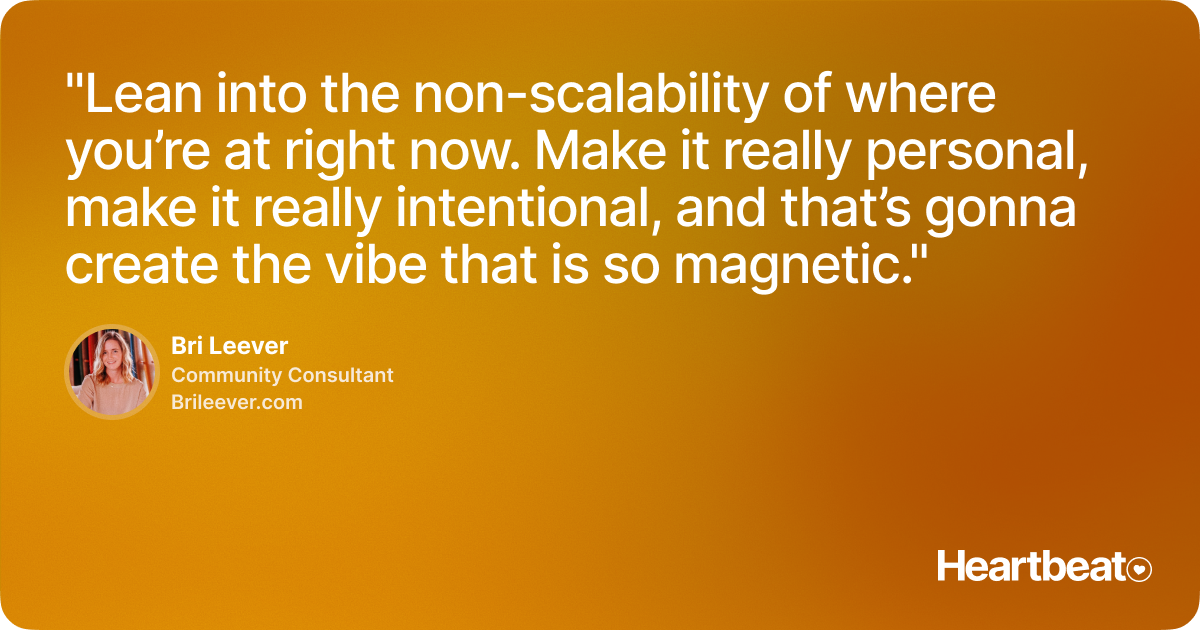
Bri Leever's rule for the first 90 days: lean into the non-scalability of where you are. Every founding member gets a personal DM within their first week. Every event gets a personal follow-up to anyone who attended. Every contribution gets a specific acknowledgment. At 20 members, this is sustainable and essential. At 200 members, systems handle most of it. At 20 members, you are the system.
The founders who survive the first 90 days are the ones who keep treating the community like it's still in launch mode, personal attention, consistent events, active facilitation, long past the point when they feel like it should be running on its own. It's never running on its own that early. The members are still deciding whether they made the right call. Every personal interaction you make in the first 90 days is evidence that they did.
FAQ
Do I need a large audience to launch?
No. Five paying founding members from personal outreach validate the model. If you can't get five members through direct conversations with people who have the problem you're solving, you either have an audience problem or a positioning problem. Personal outreach surfaces which one it is faster than any amount of pre-launch preparation.
Should I offer a discount for founding members?
Set a founding member price that's lower than your eventual price, but don't call it a discount. "Founding pricing locks in at $49/month, which increases to $79 when the founding period closes" is a better frame than "$79/month but $49 for the first 30 days." The first creates urgency without conditioning members to wait for sales.
Should I run a paid waitlist before launching?
If the fear of launching to an empty community is delaying your launch date, yes. A paid waitlist solves the cold-start problem by collecting real payments from real people before you open. Build a gated offer in Heartbeat, run outreach in Week 3 to drive signups, and set a target number before you open access. When you hit the number, you flip the switch. The Welcome Party in Week 4 becomes a celebration for people who've already committed rather than an event you're hoping strangers show up to. The waitlist also gives you a concrete deadline to share with potential members: "We open when we hit 20 founding members." That urgency closes faster than "join whenever."
What if no one joins in Week 4?
If personal outreach to ten people produces no paid members, go back to Week 1. Sharpen either who this is for or what the promise is. One round of five conversations with potential members will tell you which one is off. Don't run more outreach with broken positioning.
What should the community look like after Week 4?
Five to fifteen founding members, one event in the books, one upcoming event on the calendar, a Start Here space updated based on what founding members actually asked about, and at least three member-to-member connections you facilitated personally. That's a successful launch.