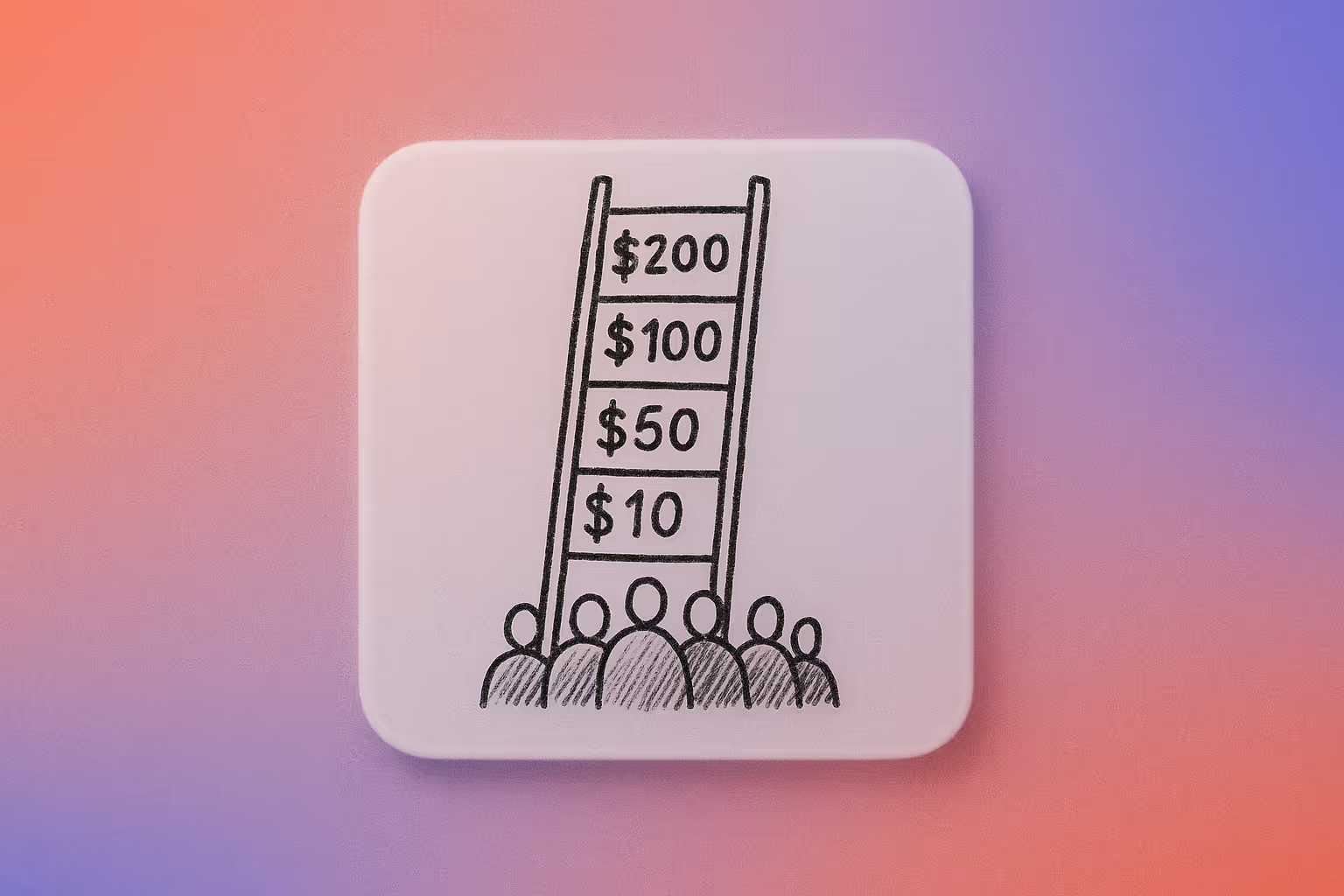

Start with one tier, not three. Most community builders overcomplicate their pricing by launching with multiple tiers before they understand what any single tier should include. The right approach is to reverse-engineer your revenue goal, design one offer that delivers real value, and add tiers only when you have data showing members want different levels of access. If you're just getting started, a single well-priced membership is almost always better than a confusing menu of options.
The community builders we work with at Heartbeat who get pricing tiers right tend to follow a similar process. They start simple, listen to what their members actually want, and add tiers based on demand rather than guessing. Here's the framework.
The reverse-engineering method
Before you think about tiers, start with a number: how much do you need to earn?
Doc Williams, CEO & Founder of Brand Factory who's built communities for ESPN, VaynerMedia, and the NBA's Summer League, teaches a four-step process that starts here. Take your annual revenue goal. Divide by 12. Account for taxes and expenses. Now you have your monthly target.
From there, work backward. If your monthly goal is $5,000 and you price at $49/month, you need approximately 102 paying members. If you price at $149/month, you need 34. If you price at $297/month, you need 17.
The math changes the conversation. Most community builders pick a price first and then hope for enough members. Reversing the order forces you to evaluate whether the price and the member count are both realistic. Can you attract 102 members at $49? Maybe. Can you attract 17 members at $297 who get personalized value? Also maybe. But the delivery model for each is completely different, and that's the point. Your price determines your delivery model, not the other way around.
Doc recommends setting three revenue goals: good, better, and best. A "good" goal is the minimum that makes the community worthwhile. "Better" is where the business becomes comfortable. "Best" is the stretch target. This framing avoids all-or-nothing thinking and gives you permission to start before you've hit the dream number.
Painkillers vs vitamins
Once you have your revenue target, the next question is: what are you actually selling?
Doc teaches a distinction that applies directly to tier design: painkillers vs. vitamins. A painkiller solves an urgent, specific problem. A vitamin is nice to have. Communities that solve painkiller problems command premium pricing. Communities that offer vitamin benefits get cancelled first when members tighten their budgets.
This matters for tiers because each tier should solve a progressively more urgent or specific problem. Your base tier might be access to the community and async content (a vitamin for some, a painkiller for people who need connection and peer support). Your premium tier might include direct coaching, live feedback, or structured programs (a painkiller for people who need specific results fast).
If you can't articulate the painkiller for a tier, that tier probably shouldn't exist.
| Vitamin | Painkiller |
|---|---|
| General community access | Direct expert feedback |
| Content library | Structured programs with deadlines |
| Monthly newsletter | Accountability partnerships |
| "Nice to have" perks | Specific outcome guarantees |
Painkillers command premium pricing. Vitamins get cancelled first.
The 4 pricing categories
Lisa Princic, a Business Strategist & Membership Expert who's worked with hundreds of membership owners, breaks community pricing into four categories. Each category has different delivery expectations, different margins, and different scaling dynamics. Understanding which category you're in determines how your tiers should work.
Micro memberships (under $15/month). These work for large audiences with low-touch delivery: a content library, a simple forum, automated resources. The math requires volume. At $9/month, you need 556 members to hit $5K/month. The upside is that cancellation hurts less (members don't think hard about $9). The downside is that engagement is typically low, and members don't take the community seriously enough to participate actively.
Low-ticket ($15-$97/month). This is where most community builders land. The delivery is more hands-on: live calls, curated discussions, resource drops, maybe a light course. Lisa notes that this range works well when you're building trust and growing your audience, but it can become unsustainable if you're delivering high-touch value at low-touch prices.
High-ticket ($100-$500/month). At this level, members expect structured programs, direct access, measurable outcomes, and accountability. You're selling transformation, not information. The delivery model shifts from "access to a space" to "a guided experience." Fewer members, higher revenue per member, more personal involvement from you.
Premium ($500+/month or program pricing). This is consulting-level community: application-based, small groups, intensive delivery. Lisa is clear that premium pricing requires premium proof. You need case studies, testimonials, and a track record. But the business model is the most sustainable because a small number of high-paying members generates significant revenue with manageable delivery.
The mistake is offering micro-level pricing with high-ticket-level delivery. If you're doing weekly live calls, personal feedback, and curated introductions for $19/month, you're in the wrong category. Either raise the price to match the delivery, or reduce the delivery to match the price.
When to add a second tier
Most community builders add tiers too early. The right time to add a second tier is when you have clear evidence that a segment of your members wants something you're not offering at your current price.
Three signals that it's time:
Your best members keep asking for more. They want deeper access, faster results, or more personal attention. They've outgrown what the base membership offers, and they'd pay more for the next level. This is a demand signal, not a guess.
You have a clear value gap between tiers. The base tier offers X. The premium tier offers X plus Y, where Y is something specific and valuable: direct coaching, live feedback sessions, a structured cohort, done-with-you work. If you can't clearly articulate what makes the premium tier worth 2-3x the base price, you don't have a real second tier. You have a confusing pricing page.
You can deliver without overextending. Adding a tier means adding delivery. If you're already at capacity with your current membership, adding a premium tier that requires more personal time will burn you out faster. Scale the base tier first. Add premium when you have the bandwidth or when the premium revenue funds additional support.
Tatiana Figueiredo, Founder of Friendly Nooks, puts it simply: more specific is better. The more specific the promise of each tier, the more engaged the members will be. Vague tiers ("Silver, Gold, Platinum") with marginal differences don't work. Specific tiers tied to specific outcomes do.
How to structure tiers
If you've decided it's time for multiple tiers, here's a structure that works consistently:
Tier 1: Community Access ($29-$97/month). The core membership. Access to the community, async discussions, a content library or resource vault, and participation in community-wide events. This is your volume tier. It serves the most members with the least per-member effort. The value comes from the community itself: peers, connections, shared knowledge.
Tier 2: Guided Experience ($149-$497/month). Everything in Tier 1, plus structured elements: live group coaching, workshops, cohort-based programs, feedback sessions, office hours. This tier is for members who want more direction and accountability. The price premium reflects your direct involvement and the structured path to results.
Tier 3: Premium/VIP ($500+/month or program pricing). Everything in Tiers 1 and 2, plus direct personal access: one-on-one sessions, VIP days, done-with-you work, priority support. This tier serves your most committed members and generates the highest revenue per person. Cap enrollment to protect quality and your time.
The critical rule: each tier should be a complete experience on its own. Tier 1 shouldn't feel like a teaser for Tier 2. Members at every level should get real value. The higher tiers add depth and speed, not the core value itself.
In Heartbeat, all three tiers live inside one community. Access groups gate the Tier 2 and Tier 3 channels from Tier 1 members, but the locked icons are still visible. Every Tier 1 member can see that premium channels exist; they just can't open them without upgrading. That ambient visibility does passive selling continuously. Skool runs a single price for every member in the community. Circle's approach to tiers requires separate spaces, which fragments the community. One community, multiple price points, with the upsell always in view.
Doc teaches that confidence in presenting these tiers matters as much as the structure. If you present your $297 tier with hesitation, qualifiers, or immediate discount offers, you undermine the value signal. Practice saying the price. State it clearly. Let the member decide.
Testing before committing
You don't need to guess your way to the right price. Both Doc and Tatiana teach validation-first approaches.
Doc recommends a simple method: set a price, sell it, and every time you sell it again, bump the price up slightly. At a certain point, people start saying no. That's your ceiling. It sounds crude, but it's direct market signal instead of guessing in a spreadsheet.
Tatiana advocates for a beta approach. Run a small version of your community (5-15 founding members) at a price you feel good about. The simplest way to execute this: set up a waitlist for the new tier, add a member cap, and publish it. Demand gets captured before you've built the full experience, and the cap creates urgency without manufacturing it. Deliver the experience. Collect feedback. Adjust. Tatiana's rule: you usually have enough data after five to seven people to know whether the price, the delivery, and the audience fit together.
The key is that both methods require charging from day one. Tatiana is direct about this: always charge if you're building a paid community. If you do stuff for free, you're not validating the paid community. You're validating a free one, and those are two fundamentally different businesses.
Lisa adds a sustainability check: run your pricing through the four pillars. Is it profitable (revenue exceeds costs including your time)? Is it scalable (can you 10x members without 10x-ing effort)? Is it enduring (will this price still work in two years)? Is it satisfying (do you enjoy running this at this price)? If any pillar is weak, adjust before scaling.
FAQ
How many tiers should I start with?
One. Seriously. Start with a single tier at a price you've reverse-engineered from your revenue goal. Add a second tier only when members ask for more and you can clearly articulate the value difference. Three tiers is the practical maximum for most community builders. More than that creates decision paralysis for potential members and operational complexity for you. Multi-tier offers (free + basic + premium on a single sign up page, members can only sit in one tier at a time) are the tool you'll reach for once you have data on who wants what. They're not the starting point.
Should I name my tiers Silver/Gold/Platinum?
Avoid generic tier names. They tell the member nothing about what they get. Instead, name tiers based on the experience: "Community," "Coaching," and "VIP" are clearer than the classic Bronze/Silver/Gold. The name should immediately communicate the difference in value and access.
What if my lower tier cannibalizes my upper tier?
This usually means the tiers aren't differentiated enough, but the fix isn't just adding more features to the premium tier. The more sustainable fix is defining, for each tier, exactly who it's for based on where they are in their journey.
Think about it in terms of the member's stage and the outcomes they need at that stage. Your base tier might be right for someone who is brand new, building the habit of showing up, and needs peer connection and async resources. Your mid tier might be right for someone who has the basics down and now needs structured coaching, live feedback, and accountability to hit a specific milestone. Your premium tier might be right for someone at a more advanced stage who needs direct access, personalized strategy, and done-with-you work. When you can describe each tier in terms of outcomes and business stage (not just features), you also get a cleaner way to talk to prospective members. You should be able to hear someone's situation and know immediately which tier is the right fit for them. If you can't do that, the tiers probably aren't differentiated enough.
That clarity also fixes the language on your pricing page. Instead of listing features that look incremental, you're describing a journey that members recognize themselves in. The right people self-select into the right tier, and the cannibalization problem largely takes care of itself.
Should I offer monthly and annual pricing?
Yes, always. Annual pricing is one of the easiest levers you have for reducing churn, and most community builders underuse it. Communities that add an annual option often see 20-25% of their membership shift to annual within the first two months of offering it. That's a meaningful chunk of your base locked in for a year instead of churning at month three or four.
The math is obvious once you see it: annual pricing front-loads revenue and removes the month-to-month cancellation decision for your most committed members. The people who upgrade to annual are, almost by definition, your highest-retention members anyway. You're not trading churn risk for cash, you're eliminating it for the people most likely to stay.
The typical discount is around 15-20% off the monthly rate (roughly 2 months free). Present both options on the same offer page, with annual as the default or highlighted option. Monthly exists for people who want flexibility; annual rewards commitment.
One underused mechanic: once a member passes their first 90 days, send them a short note pointing out that they could lock in their rate for the year and save. You'll see a steady stream of monthly members migrate to annual over time, especially the ones who've gotten real value from the community and aren't thinking about leaving. It shifts your retention profile, front-loads revenue, and compounds: every annual member you add is one fewer cancellation email you're handling three months from now.
Lisa recommends pricing annual memberships slightly above your calculated member lifetime value to ensure profitability even if a member doesn't renew.
What about free trials instead of a free tier?
A time-limited trial (7-14 days) is different from a permanent free tier. Trials let people experience the community before committing. Free tiers create a permanent class of non-paying members who consume resources without contributing revenue. Trials work. Free tiers don't, and we wrote a whole article about why.