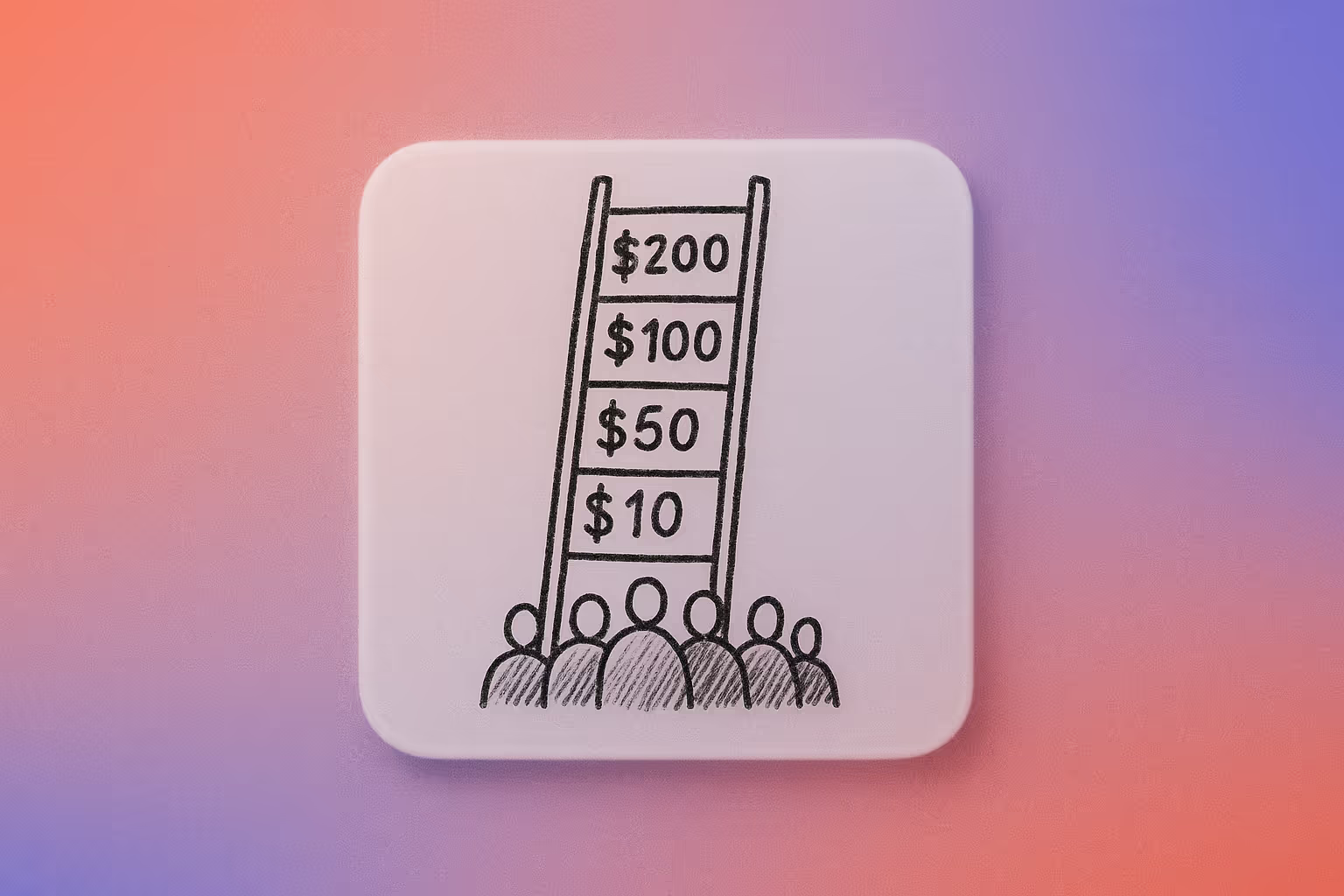

The biggest pricing problem community builders face has nothing to do with math. It's psychology. Your own psychology. Most community builders underprice because they're afraid to ask, afraid of rejection, or carrying beliefs about money that were formed long before they started a business. The fix isn't a better spreadsheet. It's understanding how price shapes perception for both you and your members, and learning to set numbers based on value delivered rather than comfort level.
We've hosted 85+ tutorials at Heartbeat where working community builders teach what they've learned. Pricing psychology comes up in almost every session about monetization, and the patterns are remarkably consistent. Here's what the experts teach, backed by what we've seen across thousands of communities.
Your money mindset sets price
Before any framework or formula, there's something more fundamental going on. Your beliefs about money are directly influencing how much you charge.
Lisa Princic, a Business Strategist & Membership Expert who's worked with hundreds of membership owners, is blunt about this. Value is subjective, and your own money mindset is one of the biggest variables in how you price. If you grew up in a household where talking about money was uncomfortable, or where charging a lot felt greedy, those beliefs follow you into your pricing decisions.
This shows up in predictable ways. You set your price at $29/month "because that feels right" instead of working backward from a revenue goal. You add a discount before anyone asks for one. You say "but it's totally fine if this isn't in your budget" during a sales conversation. You round down instead of up, every single time.
Lisa's framework for fixing this starts with awareness. Track your actual hours per member. Calculate your real cost. Most community builders who do this math for the first time realize they're earning below minimum wage for expertise that commands $200-$500/hour in a consulting context. That gap between what your time is worth and what you're charging is almost always a confidence gap, not a value gap.
Price is a boundary
Nivi Achanta, Founder of Soapbox Project and a community builder focused on climate action, reframes pricing in a way that changed how I think about it. Price is a boundary. The same way you set boundaries around your time, your energy, and your availability, your price is a boundary around your expertise.
Nivi ran her community at $5/month for a long time. She was doing weekly workshops, curating action plans, running events. The effort was enormous. The price didn't reflect any of it. When she raised to $250-$350 per cohort, two things happened. First, the people who joined were dramatically more engaged. They showed up, did the work, and got results. Second, Nivi stopped burning out, because the revenue justified the effort she was putting in.
The "what's okay / what's not okay" exercise Nivi teaches applies directly to pricing. Write two columns. "What's okay" might include: charging a price that reflects my expertise, raising my price as my delivery improves, saying no to people who want free access. "What's not okay" might include: earning below minimum wage for my time, offering unlimited access for $15/month, discounting without being asked. When you see it on paper, the boundaries become obvious.
| What's okay | What's not okay |
|---|---|
| Charging a price that reflects my expertise | Earning below minimum wage for my time |
| Raising my price when delivery improves | Discounting before anyone asks |
| Saying no to requests for free access | Unlimited access for $15/month |
Why higher prices work
This is the most counterintuitive pricing insight, and it comes up in almost every tutorial we host. Higher prices don't just generate more revenue per member. They generate better members.
Doc Williams, CEO & Founder of Brand Factory who's built communities for ESPN, VaynerMedia, and the NBA's Summer League, sees this pattern constantly. During one of his tutorials, a community builder named Drew shared his experience testing three price points for a niche health community: $29/month, $9/month, and an annual plan. The $9 tier performed worst. Not just on revenue. On response. Fewer people signed up. Less engagement. More churn.
The psychology behind this is well-documented. Price signals value. When something costs $9/month, the market interprets that as "this probably isn't that important." When something costs $79 or $149/month, the signal is: "this is for people who are serious about getting results." And the people who respond to that signal are, by definition, more committed.
It creates a virtuous cycle. Higher price attracts more committed members. More committed members engage more. More engagement makes the community more valuable. A more valuable community justifies the higher price. And the cycle continues.
The reverse is also true: low price, low engagement, empty-feeling community, more churn, keep the price low to attract replacements. That's the death spiral of underpriced communities, and I've watched it play out hundreds of times.
The investment effect
Here's the subtler mechanism. When someone pays real money for something, their behavior changes. Not because the content is different, but because the act of investing changes how they engage.
Lisa describes this from personal experience: when she was investing $2,000 a month in her own professional development, she showed up differently. She was immersed. She was paying attention. She was doing the work. The investment created the engagement, not the other way around.
This is why free tiers don't work for communities (we wrote a whole article about that). A free member has invested nothing. They clicked a button. There's no friction, no commitment, and no skin in the game. A member who pays $49 on day one has made a decision. That decision changes how they engage from the very first moment.
Kat Weaver at Power to Pitch tested this directly. She offered $10K worth of free coaching to a group. Only 20% showed up. Her paid programs? Full attendance, full engagement, measurable results. Her rule: "People who pay, pay attention. There is not one free spot."
The implication for pricing: if your members aren't engaging, the first question shouldn't be "what content should I add?" It should be "am I charging enough for them to take this seriously?"
The fear of asking
Doc Williams tells a story that stuck with me. He had a student who said: "I understand everything you said. It makes total sense. But I'm not going to do it because I'm afraid of rejection."
That's the single most common reason communities are underpriced. Not because the builder doesn't know the math. Not because the market won't bear it. Because asking for money feels vulnerable, and rejection hurts.
Doc's advice: practice the ask. Get on calls with potential members and say the number. Don't add qualifiers. Don't apologize for it. Don't immediately offer a discount. Just say the price and stop talking.
The first few times will feel terrible. That's normal. But every conversation where you name your price and someone says yes builds the confidence muscle. And every time someone says no, you get data about how to refine your offer.
Here's a pricing discovery method Doc recommends: set a price, sell it, and every time you sell it again, try to bump the price up. At a certain point, people tell you no, and that's your price point. That's exactly where you live. It sounds crude, but it's pure signal from the market instead of you guessing in a spreadsheet.
Tatiana Figueiredo, Founder of Friendly Nooks, makes the same point from a different angle. The sooner you start charging, the more you learn. Every free beta, every "I'll launch when I'm ready," every "let me just get a few more features built" delays the one piece of validation that matters most: will people pay for this?

Specificity commands premium pricing
There's one more psychological lever that matters: specificity. The more specific your community's promise, the more you can charge.
"A community for entrepreneurs" could be worth $15 or $500. Who knows? The promise is so vague that the market can't assign value to it. But "a community for DTC founders doing $1M-$5M who want to scale without raising venture" is worth $200/month to the right person. They know immediately whether it's for them, and the specificity signals expertise.
Tatiana teaches that specificity also creates a sense of magic for members. When someone joins a community and realizes everyone else has their exact same problem, their exact same background, their exact same goals, it feels like they've found their people. That feeling of belonging is what makes communities stick. And it starts with being specific enough that the right people self-select.
This is where the connection between pricing psychology and community design becomes clear. A vague community attracts vague members at vague prices. A specific community attracts specific members at premium prices. Your niche isn't a limitation. It's your pricing power.
How anchoring does the work
Here's a piece of pricing psychology that most community builders miss, even once their money mindset is straight. The price you show doesn't exist in isolation. It exists relative to the other prices on the page.
This is the anchoring effect, one of the most-studied principles in behavioral economics. When someone sees a $49 price by itself, they evaluate it against nothing. Put a $29 option next to it and the $49 looks expensive. Put a $149 option next to the $49 and suddenly the $49 looks reasonable. The number didn't change. The surrounding context did all the work.
The practical implication: if you want buyers to land on a specific price, show them a more expensive option next to it. Three tiers work well. A basic tier that signals the floor. A middle tier that's your actual target. A premium tier that anchors the high end. Most buyers pick the middle, which is usually the behavior you want.
This isn't permission to invent fake tiers for manipulation. Each tier still has to deliver real value. But the structure of how you present your pricing is itself a psychological lever. A single tier says "this is the price, take it or leave it." Three tiers say "here's a range, most people choose this one in the middle." Same underlying offer, very different psychological framing.
One important caveat: don't launch with three tiers on day one just to get the anchoring effect. Start with one, validate the core price, then add tiers once you know what your best members want more of. Anchoring is a tool for when you have data, not a workaround for when you don't.
The setup that makes anchoring actually work: multi-tier membership offers where all three options live on the same sign-up page, side by side. In Heartbeat, all your pricing tiers display on a single sign-up page by default. The comparison happens automatically, and the middle tier gets the gravitational pull it's supposed to get. Three separate checkout links, which is what you get on most platforms, break the anchor because buyers never see the options together. When the tiers live on one page, the psychology runs itself.
Micro-signals that undermine
One more angle that rarely gets discussed. Even when you've set a confident price, there are subtle ways you leak insecurity that undermine the number in real time. Prospects pick up on these signals whether you realize it or not.
The common leaks:
Preemptive discounts. You mention the price and immediately follow it with "but I can do a payment plan" or "there's a founding member rate." You're answering an objection the buyer didn't raise. That tells them the price is negotiable before they've even evaluated it.
Apologetic framing. "The investment is $149 per month, I know that sounds like a lot, but..." The "I know that sounds like a lot" signals that you think it sounds like a lot. The buyer now thinks it sounds like a lot too.
Over-explaining the value. If you list fourteen reasons why the price is worth it, you're signaling that the price needs fourteen justifications. Two or three strong reasons, stated confidently, beat a long list every time.
Over-eager payment options. Offering installments, pay-what-you-want, and a sliding scale all at once tells the buyer you're willing to take any amount. That's different from offering installments as a thoughtful accommodation for a specific situation.
The fix is alignment between what you charge, how you present it, and how you respond when someone pushes back. Your sign-up page shows the price clearly and doesn't bury it. Your checkout doesn't frontload discount codes: Heartbeat's checkout surfaces the price and the value proposition, not a promo code field that signals "keep looking for a deal." Your onboarding assumes the member made a good decision rather than treating them like they just impulse-bought. When every surface of the experience reinforces that this is a real investment at a real price, the psychology compounds. When one surface leaks, the whole thing weakens.
Practical pricing exercises
If you're reading this and recognizing yourself in the patterns above, here are four exercises to start shifting:
Exercise 1: Track your real hourly rate. For one month, log every hour you spend on your community. Divide your monthly revenue by those hours. If the number makes you uncomfortable, you have your answer.
Exercise 2: Do the boundary exercise. Two columns: "what's okay" and "what's not okay" about how you charge, discount, and value your work. Put it somewhere you'll see it before every sales conversation.
Exercise 3: Name your price out loud. Practice saying "the investment is $149 per month" (or whatever your number is) to a mirror, a friend, or a recording. Don't add "but" or "if that works for you" or "I know it's a lot." Just the price and silence.
Exercise 4: Double it hypothetically. Take your current price and imagine charging 2x. What would you have to change about your delivery to justify it? Often, the answer is "not much." Which tells you everything about where your current price sits relative to the value you deliver.
FAQ
Is there a "right" price for every community?
No. Pricing is contextual. The same expertise can be worth $29/month or $1,500/month depending on the delivery model, the specificity of the audience, and the transformation being delivered. The "right" price is the one where you're profitable, your members are getting results, and the business is sustainable three years from now.
How do I know if I'm underpricing?
Three signals: (1) You're burned out from overdelivering relative to what you earn. (2) Members don't seem to take the community seriously (low attendance, low engagement, frequent cancellations). (3) You cringe when you think about your hourly rate. If all three are true, raise your price.
Won't a higher price scare people away?
Some people, yes. But those people weren't your best members anyway. The people who stay (or who join at the higher price) will be more committed, more engaged, and more likely to get results. That's the whole point.
How do I handle pushback on my price from potential members?
Don't defend your price. Explain the value and the transformation. If someone says "$97/month is too expensive," the response isn't to lower the price. It's to ask what outcome they're hoping to get and then show how the community delivers that outcome. If the value doesn't land, the problem is the offer, not the price.
Should I show my price on my landing page or only reveal it on a call?
For communities under $500/month, put the price on the page. Hiding it creates unnecessary friction and attracts people who'll be surprised and leave anyway. For high-ticket programs ($500+), an application or discovery call makes sense because you need to qualify fit in both directions.