
No. If you're building a paid community, don't offer a free tier. Freemium doesn't work for communities the way it works for software, and the reasons are structural, not philosophical. Free members and paid members have fundamentally different needs, different engagement patterns, and different expectations. Running both means you're building two separate communities that pull you in opposite directions.
This is a controversial take, but the data backs it up: free-to-paid conversion rates in communities are consistently low, free members rarely become your best paid members, and the time you spend managing a free tier is time you're not spending on the people actually paying you. This pattern comes up repeatedly across the community builders who've taught in our Heartbeat Tutorial Series.
The most fundamental problem: you're not testing willingness to pay
Before we get into the community-specific dynamics, there's a business problem that trumps everything else. When you offer a free tier, you skip the most important validation any business needs: will people actually pay for this?
You have no idea if the people who come in for free are ever going to swipe a credit card. You don't know if they're in the mindset to pay. You don't know if they can afford your prices. You don't even know if the offering at your price point works, whether you can deliver it, or whether it can scale into something real.
If you're building a business, testing willingness to pay is the first thing you need to do. Without it, every other assumption you make is built on sand. Your engagement metrics, your content strategy, your growth projections: all of it is wrong because you don't know whether people will actually pay. That's the most fundamental piece of your business, and a free tier lets you avoid confronting it entirely.
Why freemium works for software but not communities
SaaS freemium makes sense because the marginal cost of serving a free user is near zero. Dropbox gives you 2GB for free. It costs them almost nothing, and a percentage of free users predictably upgrade when they hit the storage limit. The product creates natural friction points (storage caps, feature limits, usage ceilings) that push free users toward paid plans.
Communities don't have those friction points. In a community, there's a lot going on: conversations, events, resources, people chatting. No member is ever going to use 100% of what's available. They're never going to max out conversations or engage in every single thread. Companies like Spotify create "pebble in your shoe" moments (ads between songs, shuffle-only playback, no offline mode) that make the free experience just annoying enough to drive upgrades. You can't create those moments in a community because members never hit a ceiling on the free experience. There's always more content than they can consume.
Meanwhile, every free member adds complexity: more conversations to moderate, more content to create, more people who expect your attention. The conversion math doesn't support it either. In software, freemium conversion rates of 2-5% are fine because the base can be massive. In a community, your base is smaller and the engagement model is more intensive. If you have 500 free members and convert 2%, you've got 10 paid members and 490 people who dilute the experience for everyone.
Free and paid members are different people
This is the part most community builders miss. The people who join a free community and the people willing to pay for one are often at different stages, with different levels of commitment, and interested in different things.
Free members tend to be earlier in their journey: curious, browsing, not yet ready to invest. Paid members have identified a specific problem and are ready to commit resources to solving it. When you put both groups in the same space, you're trying to serve two audiences with conflicting needs. The conversations that engage your paid members bore your free members, and vice versa.
Tatiana Figueiredo, Founder of Friendly Nooks, taught our most-attended tutorial on community business models and is blunt about this. She calls free communities a "red herring." Your free community might feel active and successful, but if the people in it aren't the same people who will pay, you're optimizing for the wrong metric. Activity isn't revenue. Engagement with free content doesn't validate a paid offering.
And this circles back to the willingness-to-pay problem. Your free members might love the community. They might be engaged, active, and grateful. But none of that tells you whether they'd pay $49/month for it. Those are completely different questions, and a free tier lets you avoid answering the one that actually matters.
The investment problem
Here's a subtler issue: when someone joins a free community, they haven't invested anything. They clicked a button. There's no friction, no commitment, and no skin in the game. That means they're less likely to show up consistently, less likely to engage deeply, and less likely to get real value.
Compare that to someone who pays $49/month from day one. They've made a decision. They've committed money, which is a proxy for committing attention. They're more likely to introduce themselves, attend live sessions, ask questions, and actually use what the community offers.
The counterintuitive result: paid members at a higher price point often get more value than free members, not because the content is different, but because the act of paying changes how they engage. Investment drives behavior. When you give it away for free, you remove the very mechanism that makes communities work.
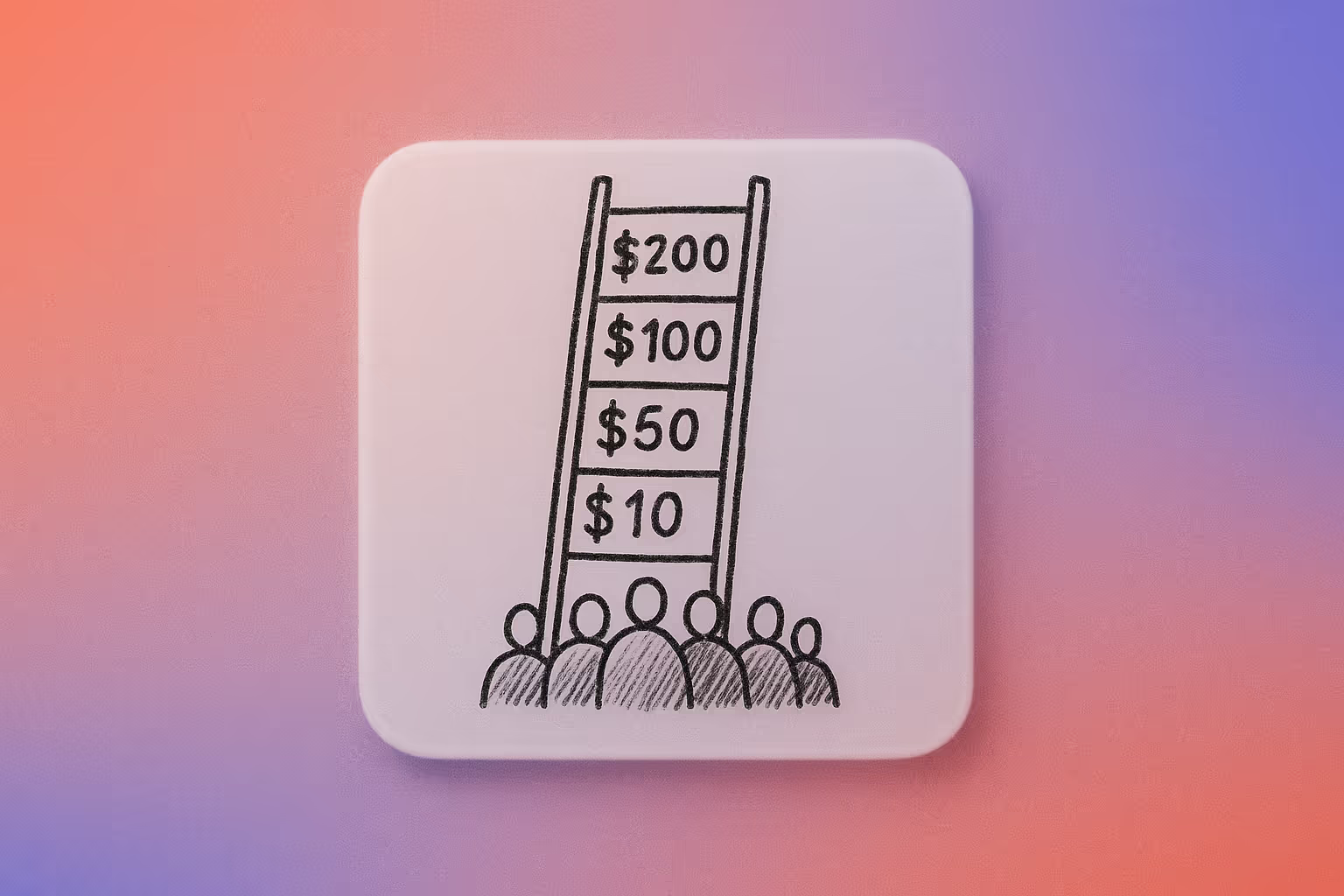
Nivi Achanta, Founder of Soapbox Project who runs a climate action community and taught a Heartbeat tutorial on boundaries for community builders, experienced this shift firsthand. She moved from $5/month to $250-$350 cohort pricing, and the result was exactly what you'd predict from everything above. Fewer members, dramatically higher engagement. Nivi realized she'd been putting in enormous effort, and the price people were paying simply didn't reflect that.
"But how will people try before they buy?"
This is the most common objection, and the framing is wrong. People don't need to experience your community for free to decide if it's worth paying for. They need to understand the transformation you deliver, see evidence that it works, and trust that you're the right person to guide them.
That's what content marketing, social proof, and testimonials are for. Not a free tier.
If you want to let people sample your community, there are better mechanisms than freemium:
A paid beta or founding member rate. Charge a lower price to your first cohort (not free). This validates willingness to pay, attracts committed members, and gives you a group that's invested in helping you improve. Tatiana is emphatic on this point: even your beta should be paid, because free testing doesn't validate that people will actually pay. You can always raise the price for future cohorts.
A limited-time cohort. Run a 3-4 week paid experience instead of an open-ended free tier. Time-bounded programs create urgency, give you a clear feedback loop, and let potential long-term members experience the value without you maintaining two parallel communities.
Free content outside the community. Your YouTube videos, blog posts, newsletters, and social media are your free tier. They demonstrate your expertise and build trust. The community itself is the premium product, the place where people get direct access, accountability, and connection with peers. Keep that boundary clean.
One-on-one conversations. If you have a small audience (under 30 people), just talk to them. Get on calls. Ask about their problems. Listen to their language. Then invite them to pay for the solution.
What about free trials?
Free trials are slightly better than freemium, but still not ideal for communities. The onboarding experience matters more for communities than almost any other product. You want a new member's first interaction to feel special, like they're walking through a doorway into something meaningful.
A free trial reduces that moment to "I clicked a button and now I'm in." There's no investment, no ceremony, no commitment. The very feature that makes free trials work for Netflix (low friction) undermines what makes communities work (high commitment).
If you do offer a trial, keep it short (7 days max), require a credit card upfront, and make the onboarding experience so good that canceling feels like leaving something behind. But you're better off just charging from day one and offering a money-back guarantee if someone's not satisfied.
The bottom line
Every hour you spend managing free members is an hour you're not spending on the people who pay you. Every free member who joins and disengages makes your community look less active. Every "but is it worth upgrading?" decision you force on free members is friction you created for yourself.
Charge for your community from day one. Use scholarships, sliding scale, or parity pricing if inclusivity matters to you (it should). Tatiana recommends these as ways to be inclusive without undermining your business. But don't lower your price to zero and call it a growth strategy. That's a distraction from building something people value enough to pay for.
The communities that grow fastest are the ones where every member has skin in the game. That starts with a price tag.
Faqs
What if I already have a free community and want to add a paid tier?
Don't run both simultaneously. Launch the paid community as a separate experience and invite your best free members to join. Be direct about what's different: more access, more structure, more results. Then gradually wind down the free community or convert it to a content channel (like a newsletter or YouTube) that feeds the paid experience. You can also use this as a beta test: instead of just adding a paid tier, build a 3-week cohort-based course that members pay for. Make it a one-time payment but a serious amount (north of $200) so you're actually testing whether people will swipe a credit card for real money.
Is $0 ever the right price for a community?
Only if the community isn't your business model. If you're a SaaS company and the community is a customer success tool, free makes sense because the members are already paying for the product. But if the community IS the product, charging $0 means you have no business.
How do I validate my paid community idea without offering it for free?
Have 10-15 one-on-one conversations with potential members. Ask about their problems, what they've already tried, and what they'd pay for a solution. Then sell your first cohort at a beta price: reduced, but not free. If people pay, you have validation. If they don't, the price wasn't the problem. The value proposition was.
Won't I grow faster with a free tier?
You'll get more signups, but not more growth. Growth for a community means engaged, paying members who stick around, not a large number of inactive accounts. A community of 50 committed members at $79/month is a better business and a better community than 500 free members and 15 paid ones.
What about "freemium with a paywall on premium content"?
This muddies the waters. You're doing two things at once: running a free community AND running a paid community. If you have the team and the resources to manage both, it can work. But if you're running a one-person business or just getting started, it's really hard to do both well. The easier option: build them as completely separate spaces. On Heartbeat, you can use separate access groups so free and paid members are in the same community space but don't see each other or constantly interact. That keeps the experiences clean without doubling your workload.
Free vs. paid members – quick comparison
| Dimension | Free members | Paid members |
|---|---|---|
| Stage in journey | Curious, browsing | Identified problem, ready to commit |
| Engagement pattern | Sporadic, low investment | Consistent, high investment |
| Conversion math | 2–5% upgrade rate (in best case) | Already converted |
| Effort to serve | High (large base, low ROI) | Lower per-dollar |
| Validates willingness to pay? | No | Yes |