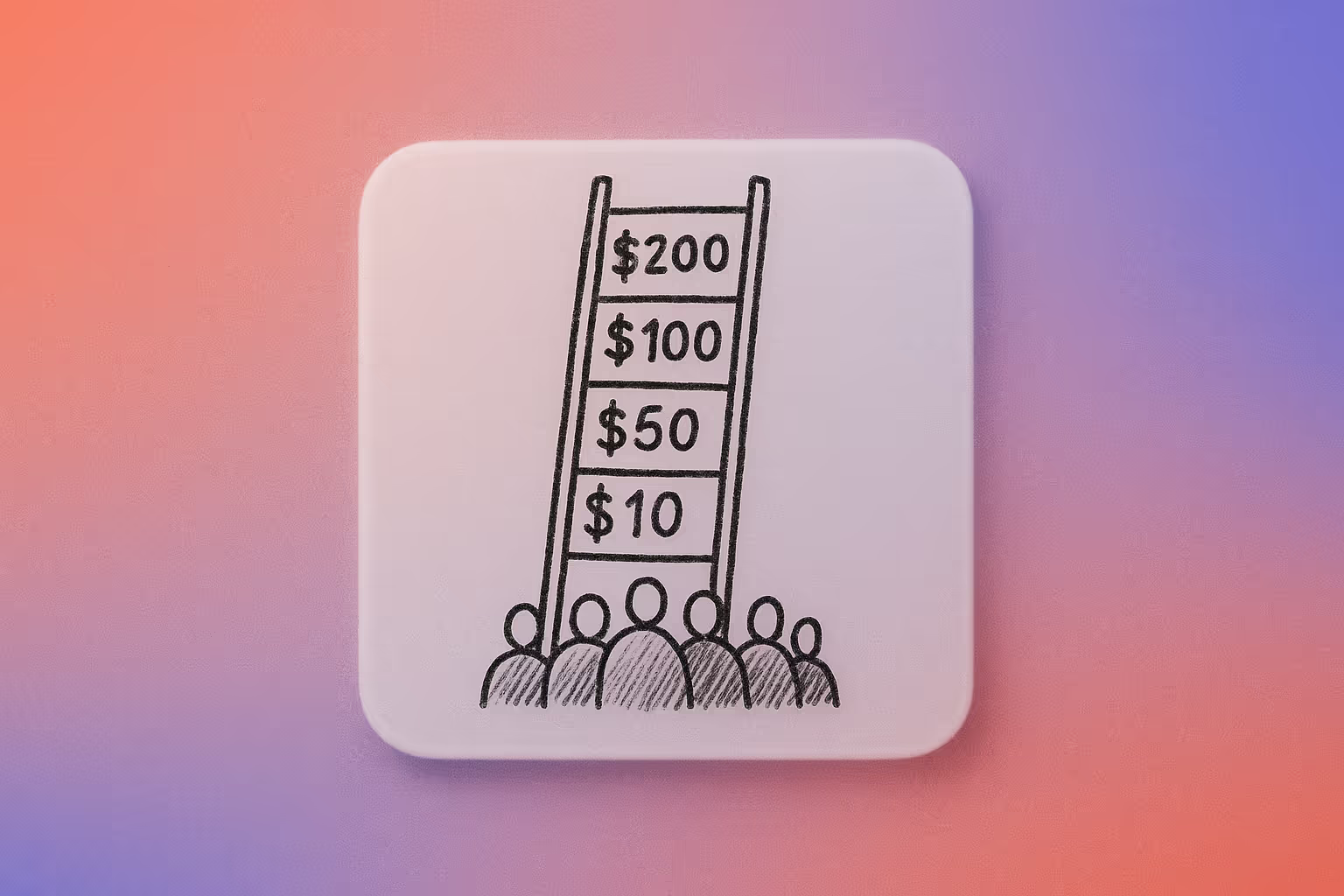

A community business model is a story you can tell in five sentences: who your members are, the problem you solve for them, what your solution looks like, where you find your members, and how you make money. If you can fill in those five sentences with specifics, you have a business. If you can't, you have a hobby that costs you time, and no amount of engagement tactics will fix that.
The good news is that filling them in takes about 10 minutes, and getting them roughly right changes everything downstream. Decisions come faster. Your landing page writes itself. You start hitting your revenue goals, your first $50K, then your first $100K, because you know exactly who you're building for and what they're paying for.
We've hosted 85+ expert-led tutorials at Heartbeat where working community builders teach what they've learned running real businesses. On business models, the clearest teacher we've had is Tatiana Figueiredo, a community business strategist and founder of The Business of Community, who has helped hundreds of founders scale values-driven community businesses. Her framework is the backbone of this article.
The Five-Sentence Business Model
Tatiana's definition is disarmingly simple: "a business model is just a story about how your business works and makes money." Not a canvas, not a spreadsheet. A story with five slots:
| Slot | The question it answers | Example |
|---|---|---|
| Members | Who is this for, specifically? | Ambitious, values-driven women entrepreneurs |
| Problem | What are they struggling with (and what becomes possible)? | Growing their businesses without a network |
| Solution | What actually happens inside your community? | Visibility through PR opportunities + peer networking |
| Channels | Where do your members come from? | Referrals from existing members |
| Revenue | What do they pay, and how often? | $225/quarter membership |
That example row is Dreamers & Doers, one of the two businesses Tatiana teaches with. Read it back as a story: Dreamers & Doers helps ambitious, values-driven women entrepreneurs grow their businesses by providing visibility through PR and networking; members come from referrals; they charge $225 a quarter. Five sentences, and you understand the entire business. They've nearly doubled that price since she first gave the talk.
Her second example runs the same shape at a different price point: Building a Second Brain helps busy productivity nerds get organized and expand their creative output through a cohort-based course with an ongoing community, fueled by member referrals, at $1,500 a year.
Write yours the same way, in plain sentences that sound like you. As Tatiana puts it, the story is for your clarity, not your marketing.
Make the Member Sentence Uncomfortably Specific
The first slot is where most models go soft. "Entrepreneurs" is not a member. "New moms of twins" is a member. "Nerdy dog parents" is a member.
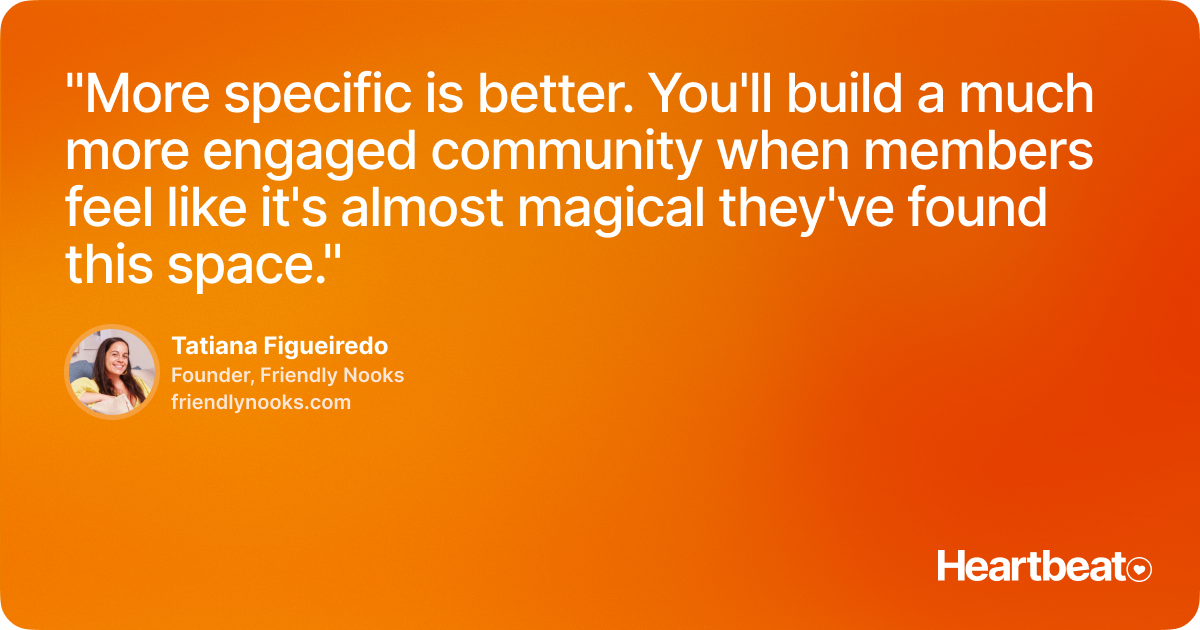
Specific also beats big. A 100-200 person community charging a fair price is a viable full-time business, and it usually outperforms a large, loosely-defined one on both engagement and revenue. If that surprises you, the math is worked through in how to price your community membership and why charging more gets you more members.
Two Quality Checks Before You Build Anything
Tatiana gives a working test for whether your five sentences are ready:
- You could execute it with what you already have, within 6 to 8 weeks. If your model needs an audience you don't have or content you haven't made, it's a fantasy, and fantasies don't validate.
- "It should feel a little bit scary because it should be exciting. You should be like, I don't know, can I do this? But with eight weeks maybe."
A model that passes both is small enough to test and ambitious enough to matter.
Validate With Payment, Never With Politeness
Here's where most first-time builders get burned: they ask people "would you join something like this?" and hear yes. Polite enthusiasm costs nothing. So Tatiana's validation rule is blunt:
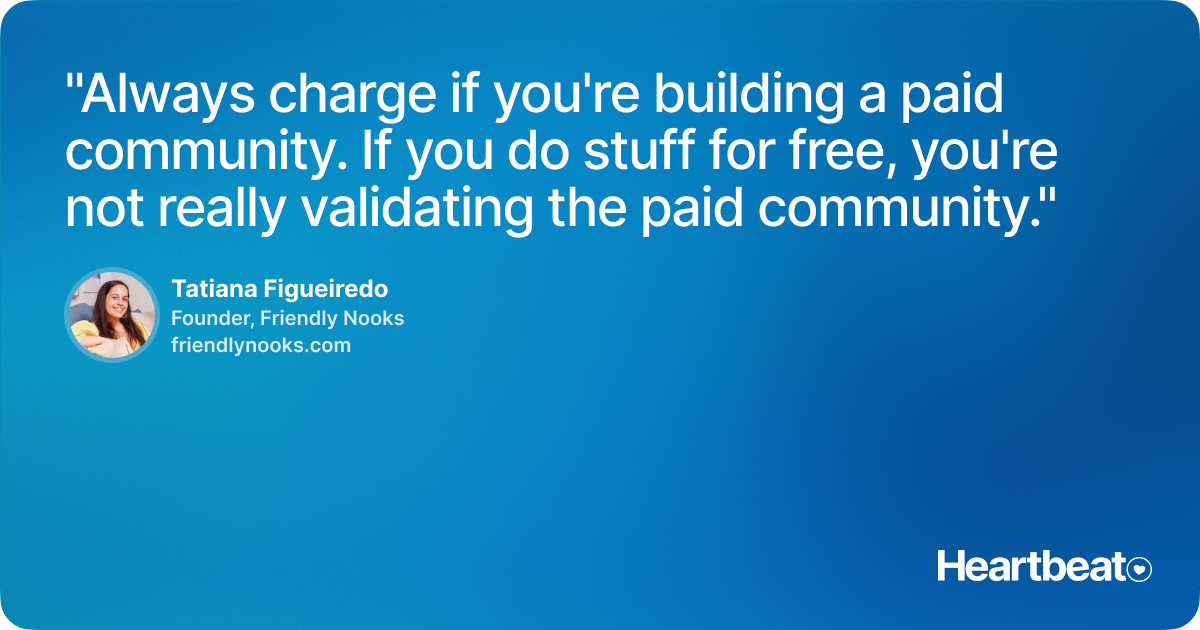
That applies to betas too. Run the smallest contained version of your vision (a weekend workshop, a 3-week program), charge for it, and treat it as an experiment: name your riskiest assumption, write down what result counts as a pass, run it, then edit the story and go again. Pivots at this stage are 5-to-10-degree adjustments, and every one makes the model more yours.
This is also why a permanent free tier is a trap for a new community: free members never validated the thing you're actually building, and you end up running two communities with different needs. The full argument lives in should you offer a free tier. If accessibility matters to you (it should), Tatiana's answer is scholarships, sliding scale, or geographic parity pricing, never a lower price for everyone.
Pick One Channel and Go Deep
Slot four trips up builders who try to be everywhere. Most community businesses get 80 to 90% of their members from a single channel. Dreamers & Doers runs on member referrals. Your community might run on your newsletter, a podcast, or one social platform where your people already gather. Pick the one with the most of your members in it, and give it a real month of effort before you judge it.
What This Looks Like When It Compounds
Kat Weaver ran the five slots tightly from day one: founders who need to raise capital (members), pitching and investor readiness (problem), live coaching and grant support (solution), a viral pitch video and the community itself (channels), premium programs (revenue). She started with $99 courses and 2 paying members. Today Power to Pitch retails programs at $2,000 to $15,000, has served 400+ paying members, and has crossed $1M in lifetime sales, profitable every single month since inception.
The model came first. The revenue followed it.
Getting Started
Block off 10 minutes. Write the five sentences: members, problem, solution, channel, revenue. Read them out loud. If a sentence sounds like marketing, rewrite it until it sounds like you explaining your business to a friend. Run the two quality checks. Then put a price on it and ask someone to pay, because that's the only validation that counts.
When your community, your membership payments and billing, your waitlist, and your landing page live in one system, testing the model is an afternoon of setup: publish the page, open a paid waitlist, and watch who commits.
FAQ
What is a community business model?
A community business model is the story of how your community makes money, told in five parts: who your members are, the problem you solve, your solution, where members come from, and what they pay. Tatiana Figueiredo teaches it as five plain sentences you should be able to say out loud.
Do I need a big audience to start a paid community?
No. A 100-200 person community at a fair price is a full-time business, and most communities fill from one channel anyway. Specificity substitutes for scale: the tighter your member definition, the less audience you need.
How do I validate my community idea before building it?
Charge for the smallest version of it. Name your riskiest assumption, design a small paid experiment (a workshop, a short program, a paid waitlist), and define a pass/fail result before you run it. Free interest doesn't validate a paid community.
Should my community have a free tier?
Almost never at the start. A free tier builds a second community with different needs and delays the only validation that matters, payment. Use scholarships or sliding-scale pricing for accessibility instead. Full breakdown: should you offer a free tier in your community.
How much should I charge for my community?
Work backward from your revenue goal: divide what you want to earn by the members you can realistically serve, then check the result against your delivery model. The full framework, with four pricing categories and real numbers, is in how to price your community membership.