

Most online communities fail because the founder is measuring the wrong thing. Activity goes up, posts, comments, reactions, daily active members, and the founder optimizes for more of it. More prompts. More events. More content drops. The activity metrics keep climbing and the community quietly stops producing anything for anyone.
Members don't cancel because they're unhappy with the activity level. They cancel because nothing changed for them. The community was entertaining, but it wasn't producing outcomes. And when budgets tighten or life gets busy, subscriptions that entertain get cut before ones that produce.
The failure isn't a content problem or a moderation problem or a platform problem. It's a measurement problem. Fix what you're measuring and the rest becomes diagnosable.
The engagement trap
Rosie Sherry, who founded Ministry of Testing, led community at Indie Hackers, and has been building communities for over 15 years, identifies the engagement trap as the most common failure mode: the founder starts tracking posts and reactions, starts optimizing for those numbers, and eventually builds a community with high activity and no value.
The trap works because activity is visible and outcomes are not. You can count posts in real time. You can't easily count member transformations. So you optimize for what you can count, and gradually the community becomes very good at producing posts and not very good at producing results.
Rosie's test for whether a community is in the engagement trap: ask yourself when a member last reported a meaningful outcome they got because of the community. If you can't answer that, if all you can say is "members seem to enjoy it", you're measuring the wrong thing. "Enjoy" doesn't retain members when budgets tighten. "Changed" does.
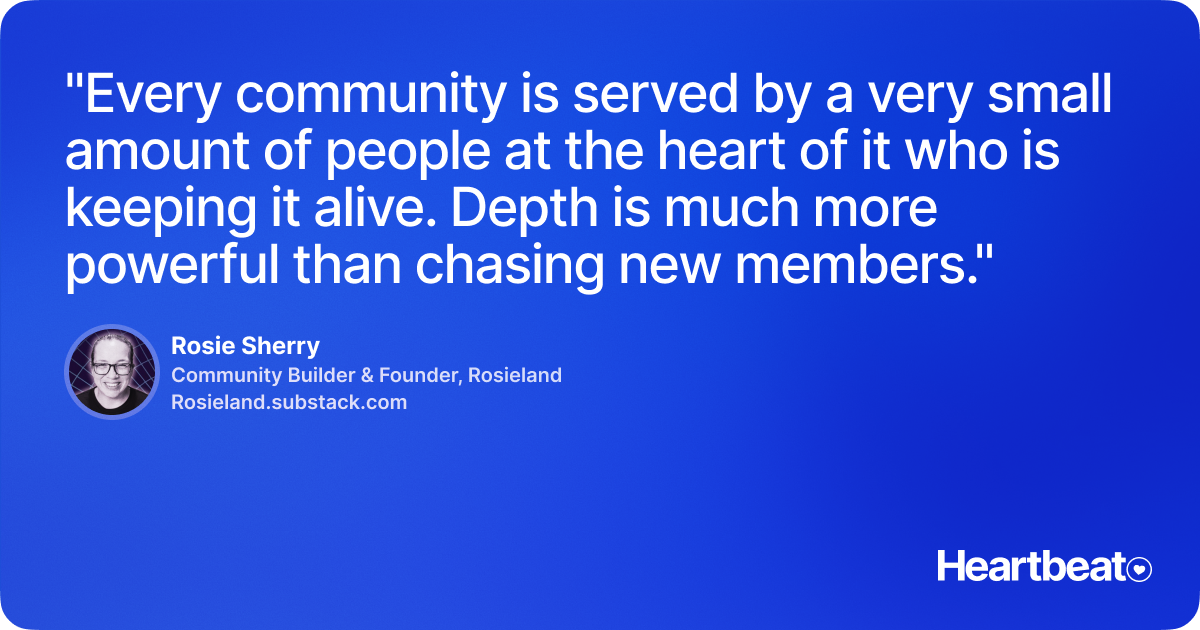
The reframe Rosie teaches: stop optimizing for conversations and start optimizing for depth. A community where members collaborate on real problems, share hard-won knowledge, and hold each other accountable will look quieter in the activity feed. It will retain at a dramatically higher rate. "Every community is served by a very small amount of people at the heart of it who is keeping it alive," she says. "Depth is much more powerful than chasing new members."
The failure modes that follow
Once you know to look for the measurement problem, the specific failure modes become readable. Each one is a predictable consequence of optimizing for the wrong thing.
Vague culture. Shana Lynn Bresnahan, Community and Retention Strategist at Community Cultivated, teaches that every community creates a culture whether or not the founder designed one. When founders optimize for activity, they can't be intentional about culture. They're too busy keeping the feed populated. The result is a community where no one can articulate what makes it different, what members believe in common, or what behavior is expected. Members who happen to fit the emergent culture stay; everyone else drifts out. "If you're not careful about what you want to create, your community will create a culture for you, and you may not like what that culture is." Culture requires active definition: beliefs the community holds, behaviors expected of members, and lines that won't be crossed.
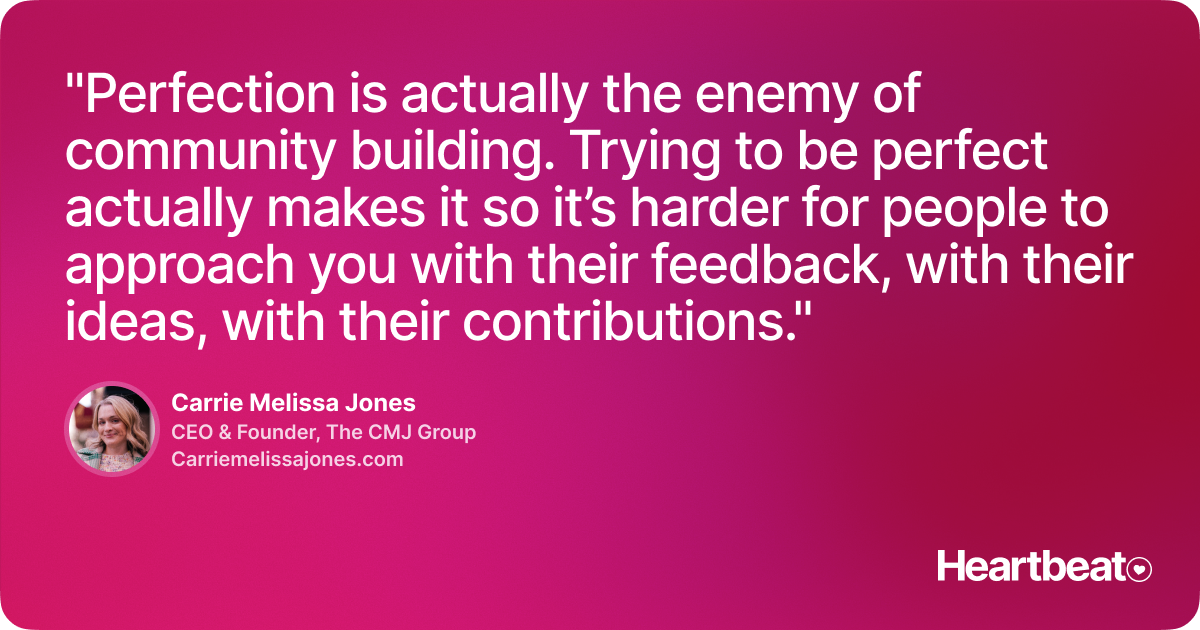
Founder dependency. Carrie Melissa Jones, community builder and co-author of Building Brand Communities, identifies this as a leadership problem. When the founder is the single point of failure, posting daily, answering every question, setting every tone, the community is structurally brittle. Members came for the founder. When the founder burns out, they leave with the founder. The sustainable alternative is deliberately developing other leaders: giving members formal roles, asking others to answer questions instead of answering yourself, inviting expertise into the spotlight. "Perfection is actually the enemy of community building," Carrie teaches. A polished, founder-controlled community trains members to be passive consumers rather than active participants.
The behind feeling. Laura Zug, Community Strategist, identifies a failure mode that almost never appears in cancellation surveys: new members joining an active community, encountering months of context they don't have, and quietly deciding they'll never catch up. They don't write "I felt behind." They write "it wasn't the right time." The underlying cause is emotional, not structural, and it requires deliberate entry points: a monthly new member orientation, a "start here" space that doesn't assume shared history, welcome threads that let anyone begin fresh. Make it easy to join the community at the moment a new member arrives, not at the moment the community was founded.
A broken model. The most overlooked failure mode is structural. A community can be well-designed, genuinely valuable, and still unsustainable because the numbers don't work. A founder charging $29/month with 200 email subscribers needs either 100+ members or a higher-priced adjacent offering to generate revenue that justifies the effort. Most communities die not because they failed their members but because the founder got discouraged before reaching the volume that made the math work.
What to measure instead
The shift from measuring activity to measuring outcomes requires a different set of metrics.
Member outcome rate. Once a month, pick five members at random and ask whether you can name one specific thing that changed for them because of the community. If you can answer that question for four out of five, the community is producing outcomes. If the answer is "I know they enjoy it," it isn't.
30-day belonging score. Survey new members at 30 days with one question: "Do you feel like you belong here?" Members who say yes at 30 days rarely cancel. Members who say no or aren't sure almost always leave within 90 days. This single survey question catches culture failures and behind-feeling failures before they become churn.
Member-to-member conversation rate. What percentage of posts in your community are replied to by someone other than you? A community where the founder responds to every post is a broadcast channel. A community where members regularly reply to each other's posts is building the relationships that drive retention.
In Heartbeat, you can set up a "Start Here" space that gives new members a fresh entry point regardless of when they joined, a welcome post, a community purpose statement, and an intro thread that doesn't assume prior context.
FAQ
At what size do communities usually fail?
The highest-risk period is the first 90 days after launch. Most members who are going to leave do so in this window, they joined with expectations the community hasn't yet had time to meet. The second high-risk period is the 12-month mark, when founding energy wears off and the systems either carry the community or don't. Both crises are predictable. Build for them in advance.
How do I know which failure mode I'm in?
Look at when you're losing members. Under 30 days: culture or onboarding failure. Days 30-90: connection failure or engagement trap. At renewal: outcome failure or model failure. The timing of the exit maps almost directly to the failing system.
Can a failing community recover?
Yes, but not by adding more content or running more events. Find your five most recently active members and build outward from them. One re-engaged cluster of members who have real relationships with each other is more valuable than a broadcast re-engagement campaign to everyone who's gone quiet.
Is there a way to catch culture problems early?
The 30-day belonging survey catches most of them. Members who don't feel they belong at 30 days will churn, but if you know that at day 30 rather than day 90, you can intervene personally. One conversation with a member who's on the fence converts more often than any automated re-engagement sequence.
What's the difference between a slow period and actual failure?
Activity dips happen in every community, seasonally, after a founding cohort moves through a lifecycle stage, after a major event ends. The distinction is whether your core members have gone quiet alongside the broader community. If your most engaged members are still participating and the dip is everyone else, it's cyclical. If your most engaged members have also pulled back, investigate immediately.