
Onboarding has one job: reduce time-to-value.
Not to orient new members to the platform. Not to deliver a welcome video or run them through a tour of your spaces. The job is to get each new member to something useful as fast as possible. If that happens in their first session, the probability they're still a member at month three goes up dramatically. If it doesn't, all the welcome sequences and orientation content in the world won't save them.
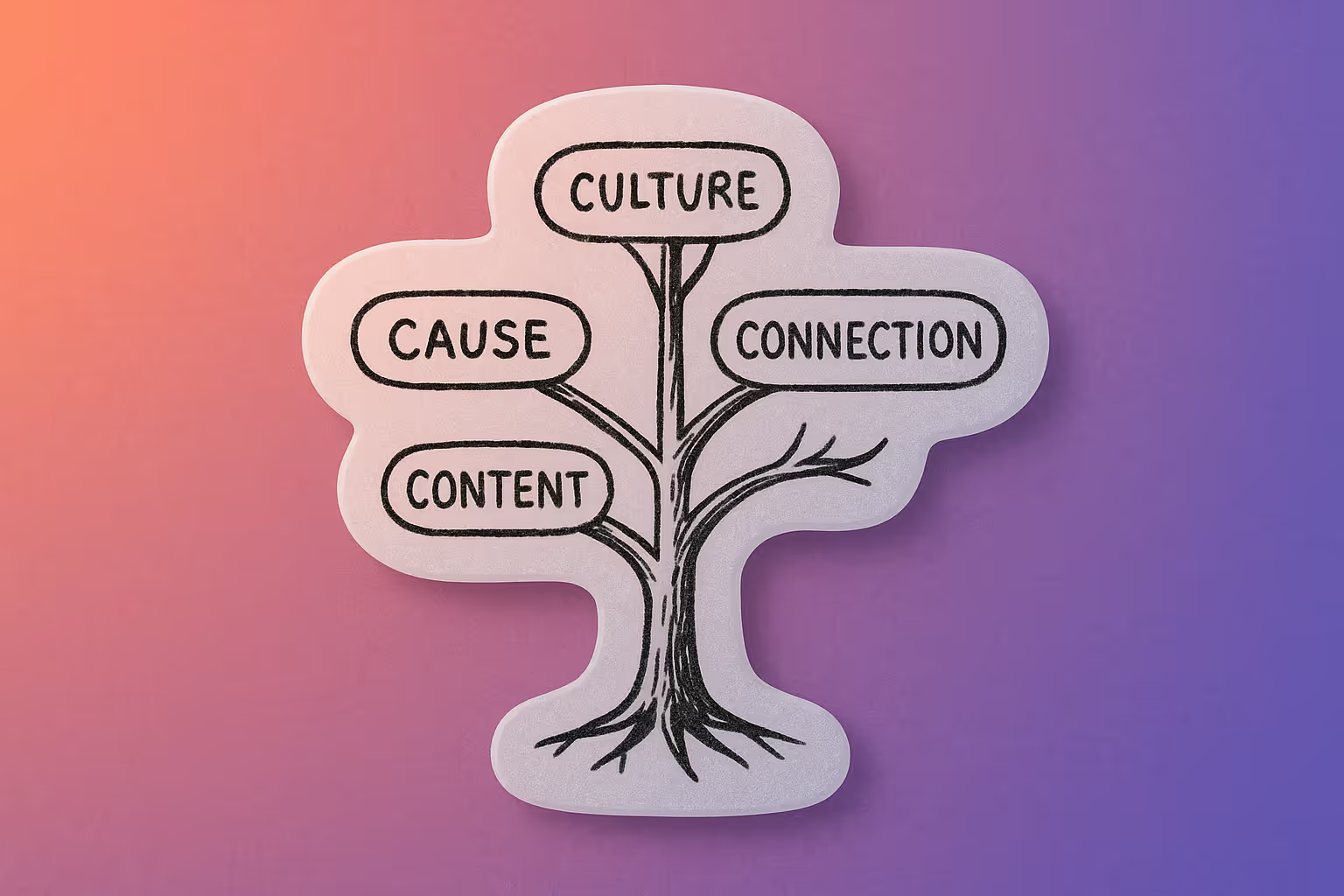
What counts as value depends on your community, but there's a ladder. A relevant document or piece of course content is value. The right channel, where the right people are having the right conversation, is value. An event worth showing up to is value. And at the top: a genuine connection with another member who's working on the same problem.
Connection is the highest form of value because it's the only one that compounds. A resource gets consumed once. An event ends. A relationship keeps paying. Doc Williams, community strategist for ESPN, VaynerMedia, and the NBA's Summer League, points to research showing that players who made just two meaningful connections inside the league were 70% more likely to still be working in it. The number translates directly. A member who makes one genuine connection in week one has a reason to come back that no amount of content can manufacture.
But connection takes time to facilitate. Most new members aren't ready for an introduction on day one. They need to understand what the community offers before they can recognize who they'd want to talk to. Skipping the lower rungs and going straight for connection is why so many onboarding sequences feel awkward. Deliver value first. Then route people toward the member who delivers it best.
The value ladder
Every community has a set of value areas. The job of onboarding is to route each new member toward at least one of them in their first session.
Take The Hearth, Heartbeat's own community for community builders. The Hearth is built around three distinct areas of value: a #ask-the-community channel where members get advice from hundreds of community builders, live workshops every two to three weeks featuring some of the most accomplished community experts in the industry, and a Tutorial Recordings library with over 100 hours of searchable community building knowledge.
Each area serves a different time horizon. Someone who needs an answer today goes to the channel. Someone building a skill shows up for the workshop. Someone doing deep research searches the library. Onboarding at The Hearth is designed to point every new member toward at least one of these areas in their first session. Not all three. One. The right one, based on what they said they came to do.
Map your own value areas before you design your onboarding. What can a new member get in the first 10 minutes? The first 24 hours? The first week? Your onboarding sequence is just the path between "just joined" and "just got something useful."
The first action problem
New members arrive in a fragile state. They've paid money, raised their hand, and now they're evaluating: did I make the right call?
Every barrier between them and their first meaningful action increases the probability they decide no. And the most common barrier isn't confusion about how the platform works. It's not knowing what to do first. Most community builders give new members too many options. A list of channels, a welcome video, a pinned post with everything they need to know. The result is paralysis.
Bri Leever, community consultant and founder growth specialist, applies BJ Fogg's "Tiny Habits" research to community onboarding. The core insight: for every action you want a new member to take, there should be a 30-second version of it.
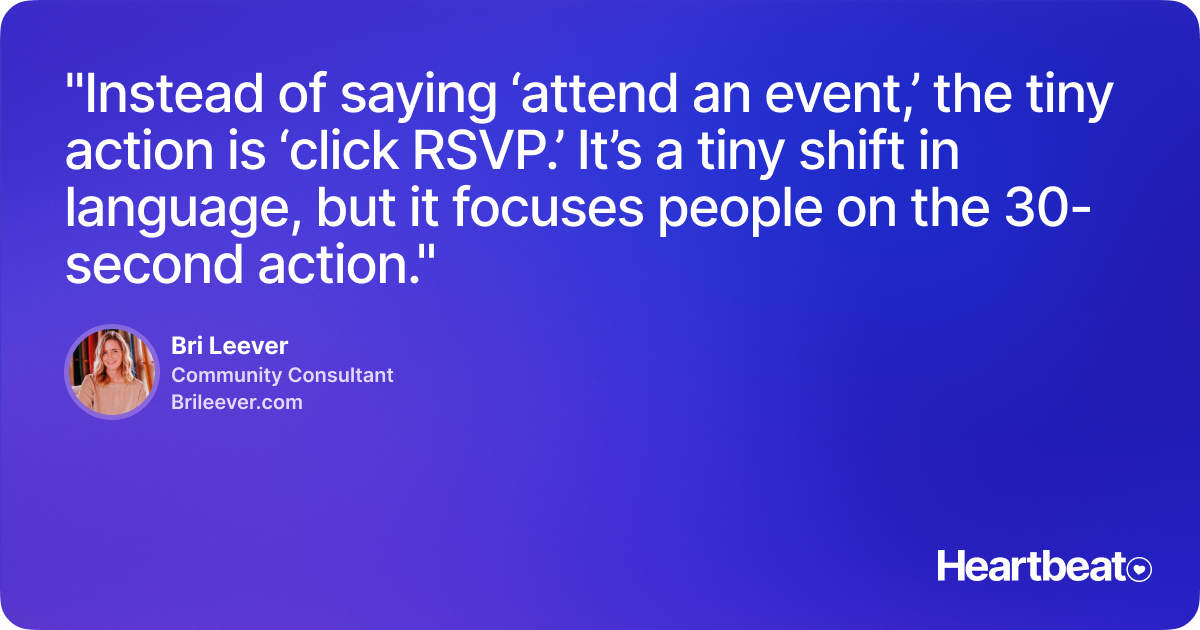
Instead of "introduce yourself to the community," the tiny action is "reply with your name and one sentence about what you're working on." Instead of "attend an event," it's "click RSVP." The tiny action isn't just easier. It's achievable for someone who's still deciding whether they belong. You don't need them to go deep on day one. You need them to take one step.
More importantly: what is that first step oriented toward? Not platform familiarity. Not a list of channels. The first action should route them toward one specific area of value. Their answer to your welcome DM tells you which rung of the ladder to point them toward next.
Why connection still wins
Most onboarding frameworks aim to get new members oriented, comfortable, and active. Those aren't wrong goals, but they're proxies for the thing that actually determines retention: whether the new member has someone in the community they want to talk to again.
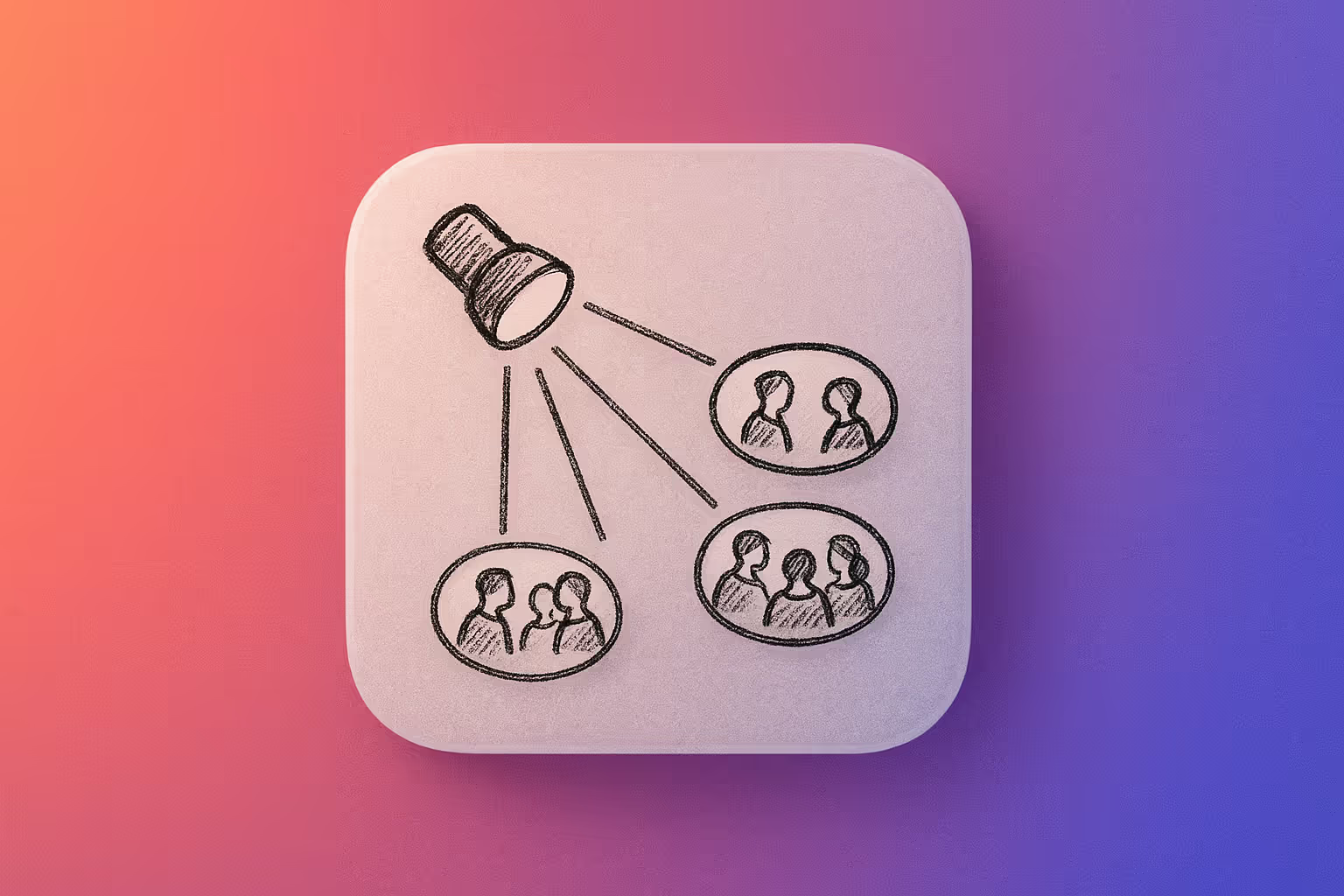
Laura Zug, Community Strategist, teaches that the friendships that last aren't made at the big group events. They're made in the smaller, more focused moments, the equivalent of a club or a class rather than a pep rally. The main community space builds identity. Small subgroups and specific introductions are where lasting connections form.
This has a direct design implication. Your onboarding should route new members toward smaller, more specific moments as quickly as possible. Not the town hall event. The breakout conversation. Not the general welcome thread. The introduction to one specific member working on the same thing.
When a new member joins, your job in the first 24 hours is not to tell them about everything the community offers. It's to answer one question for them: "Is there someone here who gets what I'm trying to do?" If you can answer that concretely, with a name and a reason, you've delivered the highest form of value onboarding can produce.
The onboarding video
The gap between "just joined" and "I know exactly where to start" used to take days. A short onboarding video collapses it to 30 seconds.
A one-to-two minute talking-head video, often recorded in Loom, walks a new member through exactly where to go on day one. Not a tour of the platform. Not a list of features. A specific answer to: "Here's the first thing I want you to do, and here's why it's going to be useful." When this video appears automatically at join, the new member gets orientation before they've had a chance to feel lost.
The video works because it delivers value before the member has taken any action. They understand the community's value areas without having to explore. When the Day 1 introduction DM arrives, they already have enough context to recognize why that specific member is worth talking to.
In Heartbeat, an onboarding video can be added directly to your community welcome experience. It appears when a new member joins, before they see the feed. A minute-and-a-half of your face, saying "here's what to do first and why it matters," reduces time-to-value faster than any amount of static orientation content.
The seven-day sequence
Here's what the first seven days look like when they're designed around reducing time-to-value.
Day 0: Onboarding video + one action. Your welcome experience should include a short video orienting the member to one specific area of value, followed by a single CTA in your welcome DM: "Reply here with your name and what you're working on right now." Their answer tells you where to route them next.
Day 1: Make the introduction. Based on what they wrote, send a DM introducing them to one specific member: "I want you to meet [Name]. They're working on [same thing]. You two should talk." This is the most important thing you'll do in onboarding, and it takes three minutes. Do it manually for every new member. The connection you facilitate in week one is the one that makes them stay in month three.
Day 3: One event invite, made specific. Not "we have events, check the calendar." "We have [event name] this Thursday at 2pm. It's specifically relevant to what you told me you're working on. Click RSVP." The specificity matters. Members attend events that feel like they were planned for someone like them.
Day 7: Check in. "How's your first week going? Did you connect with [Name]? Anything you haven't found yet?" This message fires automatically, but it reads like a personal note. The goal is to surface what isn't working before it becomes a churn decision, and to invite a reply you can act on.
In Heartbeat, the entire sequence runs as an automated onboarding workflow chain: join trigger fires the onboarding video and welcome DM, a three-day delay queues the event invite popup, a seven-day delay sends the check-in DM. Day 1 stays manual. That's the introduction, and it should feel personal. Everything else runs automatically.
The recognition shortcut
Bri's research across years of community work surfaces a consistent finding: the most effective thing you can do for new member retention isn't delivering more content. It's recognition.
A public acknowledgment, "Welcome [Name], so glad you're here, they're working on X and I think they're going to bring a lot to this community", does something automated content can't. It answers the question "do I belong here?" with evidence instead of words. The member's peers saw the acknowledgment. They'll respond. A conversation starts.
This matters because the member who feels publicly welcomed in week one is building the social context that will make week two feel comfortable. The member who quietly joined, read some threads, and got a welcome email doesn't have that. When week two gets busy and something has to give, they know which subscription to cut.
FAQ
How much onboarding is too much?
If new members are ignoring your onboarding messages, you're sending too many or timing them wrong. One touchpoint per day for the first seven days is the maximum. Each message should contain one CTA, not a list. If your welcome message has five links and three instructions, cut it to one.
Should I automate onboarding or do it manually?
Automate the rhythm, do the relationship manually. Days 0, 3, and 7 all run automatically: the welcome experience, the event invite, and the check-in DM. The Day 1 introduction stays manual. That's the moment that determines whether a member feels like a person to you or a subscriber, and it can't be templated.
What if members skip the intro thread?
Some will, and that's fine. Don't wait for them to participate in the thread before making an introduction. Reach out anyway. "I noticed you just joined, what are you working on?" puts the ball in their court without requiring the public action first.
How do I onboard into a community that already has lots of history?
Create a separate new member pathway: a "start here" channel that doesn't assume shared history, a new member event that's explicitly for recent joiners, and an introduction practice that doesn't require context from past conversations. History is intimidating to newcomers. Give them a current entry point.
What should my onboarding video cover?
One to two minutes. Your face, your voice, one specific answer to "where should I go first and why." Don't tour the platform. Don't list features. Say: "Here's the first thing I want you to do to get value out of this community today." End with a single action. Members who finish the video with one clear next step are far less likely to bounce than members who finish it with five options.