

The first 50 paying members come from direct, personal conversations with specific people who have the specific problem your community solves. Not from ads. Not from content marketing. Not from an email sequence. Conversations.
This isn't a temporary limitation you need to work around until you can afford real marketing. It's the right approach for a community at this stage. The members who will stay, refer others, and build the culture are the ones who came through a personal relationship, someone who knew who you were, heard what you were building, and decided to bet on you before there was social proof to rely on. No ad will ever produce that quality of founding member.
The path from zero to 50 follows a sequence: revenue math to outreach to founding member close to referral. Each step sets up the next.
Revenue math before member math
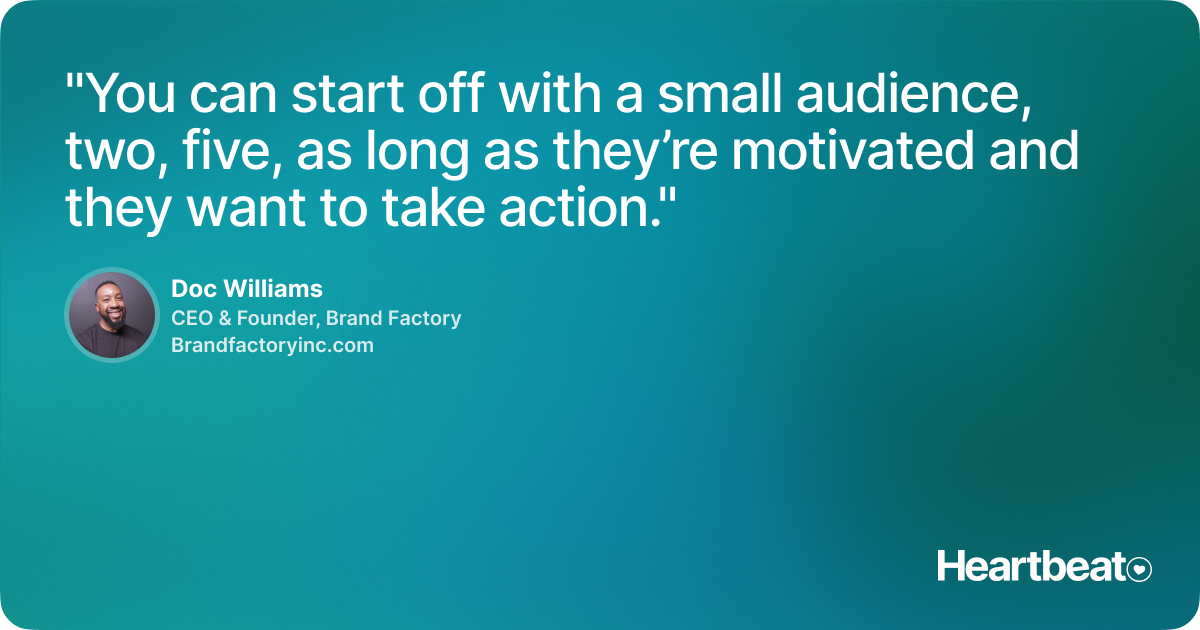
Doc Williams, community strategist for ESPN, VaynerMedia, and the NBA's Summer League, starts here with a reframe that changes everything: stop setting member targets and start setting revenue targets.
"I want 50 members" is a number with no strategy attached. It could mean 50 people paying $9/month or 50 people paying $97/month. The member count is the same; the business is completely different. Start with the monthly revenue number you need to justify the effort, then work backward to the price and the member count required.
Doc's framework: set three monthly revenue milestones, a "good" number you could hit in 30 days with focused effort, a "better" number that represents real traction, and a "best" number that would feel like proof of concept. For most communities starting from a small audience, that might be $1,000 / $2,500 / $5,000. The "good" target tells you the minimum activity required to keep going. The "best" target tells you what success looks like.
The math matters because it determines how many conversations you need to have. If your price is $49/month and your "good" target is $1,000/month, you need 21 members. That's achievable through personal outreach in 30 days. If your price is $19/month, you need 53 members, which requires either a larger audience or a longer timeline. Run the math before you run the outreach.
The outreach script
Before landing pages, before email sequences, before any marketing infrastructure, talk to people. Not to pitch them, but to find out whether the problem you're solving is real and urgent enough to pay for.
Doc's pirate ship outreach script has three components: a specific reference to something you have in common or know about that person, a brief statement of what you're building and who it's for, and a simple yes-or-no question about whether they'd be interested in learning more. No pressure, no link, no pitch. An invitation to a conversation.
What you're testing in these conversations: does the person describe their problem the way you've been thinking about it, or differently? What have they already tried? What would a community need to do to be worth paying for, in their words?
10 conversations will tell you more about your positioning than six months of analytics. And two or three of those ten people will be ready to become founding members when you ask, which requires knowing how to frame the ask correctly.
The founding member close
I sold Heartbeat before writing a line of code and have closed over $1M in community platform sales since. My approach to the founding member ask is built on two principles: be honest about where you are and be direct about what you're asking for.
The founding member frame works because it's true. You're asking people to join before the community is at its full vision. That context sets expectations correctly, founding members don't expect a finished product, they expect a direct relationship with the founder and the opportunity to shape what gets built. Those are real advantages, and they deserve to be the center of the ask.
A founding member offer that works has three elements: a specific price and a specific deadline (founding pricing closes when you hit X members or at the end of the month), a clear statement of what founding members get that later members won't (the locked-in price, direct access to the founder, influence on what gets built), and a personal delivery, a message, not a link. A founding member who received a personal invitation feels differently about the community than one who clicked a button.
In Heartbeat, you can create a founding member offer with a custom lower price point on your community landing page and set it to expire automatically when you hit a member count or a date. Once the founding period closes, the standard tier launches at the higher price. Members who joined during the founding period keep their locked-in rate permanently.
The sales discipline
The first 50 paying members require the founder to do the selling. This is not a failure state. It's how it's supposed to work, and the founders who embrace it build a buyer understanding that informs every decision they make for the next two years.
My approach to founder-led sales is built on one rule: get to a yes or no in every conversation. A "maybe" or "I need to think about it" is almost always a soft no that wastes everyone's time. A clear no is more useful: it either tells you this person isn't the right fit, or it surfaces an objection you can address in your positioning.
The math that makes this manageable: if you have 20 conversations and convert 4, your conversion rate is 20%. To get 10 members, you need 50 conversations. Activity targets follow directly from that math. You're not waiting for something to click, you're running a defined number of conversations per week until you hit your target.
One practical rule: the conversation is for understanding first, selling second. If you lead with what the community offers before understanding what the person needs, you're doing it wrong. Ask about their situation. Listen to how they describe the problem. Then explain what the community does in their language, not yours.
When you hit 50
At 50 members, you have four things you didn't have at zero: what your best members have in common, what they actually use the community for versus what you expected, what would make them refer a friend, and what would make them cancel.
The first referral ask should happen at 30 days with your most enthusiastic founding members, once they've had enough experience to be genuinely enthusiastic about it. Keep it simple: "Is there one person you'd want to bring into this community? I'd love to reach out to them personally." A founding member referral converts at dramatically higher rates than any cold outreach, because the trust transfers with the introduction.
The mistake founders make at 50 members is pivoting to marketing too early. Ads and content marketing efficiently reach people who don't know you. The members who build your culture and stay through year one came through personal relationships. Reach 50 through founder-led sales and direct referrals, then layer marketing on top of what's already working. Not as a replacement for the relationship-based growth that got you here.
FAQ
How long should it take to get to 50 members?
Two to six months from a small but warm audience. Slower usually means either a positioning problem (the problem isn't urgent enough to pay for yet) or an activity problem (not enough conversations are happening). Founders who take longer than six months typically aren't doing the personal outreach consistently.
Should I run paid ads to get my first members?
Not yet. Ads require social proof and a conversion-optimized landing page. More importantly, they optimize for clicks rather than fit. Founding members from personal outreach are more engaged, more likely to refer others, and more forgiving of rough edges than members who clicked an ad.
What if people say they love the idea but won't pay?
Ask which one of three things is true: the price is too high for their budget, the timing is wrong, or the problem isn't urgent enough to prioritize. Most people will answer honestly, and the answer tells you more than any analytics report.
Where do I find people to have these conversations with?
Start with people who already trust you: former clients, email subscribers who have replied to past emails, engaged social followers who have commented on relevant content, professional contacts who have the problem you're solving. The people who already trust you are faster to convert than strangers, and they give more honest feedback.
Do I need to close everyone on a call?
For lower-priced memberships (under $50/month), a personal message and a link to pay is often enough. A call is most useful when the price is high enough to require deliberation, or when the person needs to understand the community before committing. Calibrate the process to the price point.