Skool Alternative: Heartbeat vs. Skool
Skool vs. Heartbeat: pricing, fees, features, and choosing the right platform for your community
Comparisons
Intro
Skool is built around one idea: keep it simple. Heartbeat is built around a different idea: give community businesses the tools they actually need to grow. Those bets produce fundamentally different platforms, and the gap becomes visible the moment you try to run any revenue model beyond "pay to join."
| Heartbeat | Skool | |
|---|---|---|
| Best for | Communities where revenue flexibility matters | Simple community memberships w/ gamification |
| Entry price | $49/mo | $9/mo (10% fee) / $99/mo Pro |
| Workflows unlock at | $49/mo (5 on Build) | Never (no workflows exist) |
| AI unlock at | $49/mo (Pulse, all tiers) | Never (no AI exists) |
| Platform fee | 5% / 2.5% / 1.25% | 10% + $0.30 (Hobby) / 2.9% + $0.30 (Pro) |
Both platforms target community builders who want to charge for what they know. The difference is how far they let you take that idea. Skool put a fence around the edge of the yard. Heartbeat left the yard open.
Where Heartbeat wins
Payments
Skool's payment architecture assumes one thing about your business: people pay to join, and that's it. One community, one price to enter. Want to charge separately for a course? You'll need a second Skool. Want a free community with paid courses inside it? Can't do it. Want to bundle a course with a membership in one checkout? Not possible.
On Skool, the payment options are: charge to join, maybe offer a second tier, and maybe run an affiliate program on Pro. That's the full list. Four business models out of the hundreds you might actually want to run.
| Capability | Heartbeat | Skool |
|---|---|---|
| Free community + paid courses in same space | ✅ All tiers | ❌ |
| Charge separately for a course | ✅ All tiers | ❌ |
| Cohort pricing (independent per cohort) | ✅ All tiers | ❌ |
| Bundled offers (course + membership in one checkout) | ✅ All tiers | ❌ |
| Pay-what-you-want pricing | ✅ All tiers | ❌ |
| Paid events | ✅ All tiers | ❌ |
| Promo codes | ✅ All tiers | ❌ |
| Abandoned signup email recovery | ✅ All tiers | ❌ |
| Waitlist with upfront payments | ✅ All tiers | ❌ |
| Legacy pricing on price increases | ✅ All tiers | ❌ |
| Cancellation and retention flows | ✅ Grow+ | ❌ |
| Offer quantity limits and expiration dates | ✅ Grow+ | ❌ |
| Time-limited access | ✅ Grow+ | ❌ |
The legacy pricing (grandfathered) gap is worth calling out specifically. When you raise prices on Heartbeat, the platform gives you a choice: keep existing members at their original price or migrate everyone to the new price. That's a first-class workflow for one of the most common real-business scenarios. Skool has no equivalent because Skool doesn't have that workflow concept at all.
Cancellation flows are the other gap that compounds fast. When a Skool member cancels, they cancel. When a Heartbeat member (Grow+) initiates a cancellation, they hit a multi-step retention sequence before they're removed: a coupon offer, a downgrade option, a cancellation survey, or an in-app modal. At meaningful transaction volume, the difference in saved monthly revenue easily exceeds the platform cost difference.
On transaction fees: Skool Hobby's 10% + $0.30 fee is punishing at any real revenue. At $10K/month in revenue, that's $1,000+ in platform fees alone, more than Heartbeat's entire Grow plan. Skool Pro drops to 2.9% + $0.30 per transaction all-in. Skool processes payments internally, so there's no additional Stripe fee on top. Per transaction, Skool Pro's 2.9% is cheaper than Heartbeat Build's 5% platform fee. The comparison shifts on Heartbeat Grow at 2.5%, and Skool Pro can't touch Heartbeat Scale at 1.25%.
But the fee comparison misses the bigger number: revenue you never lose in the first place. Heartbeat's retention tools (cancellation flows, legacy pricing, abandoned signup recovery) protect monthly revenue that a lower platform fee alone can't replace. A community doing $30K/month in recurring subscriptions and recovering 5% of attempted cancellations is making more money on Heartbeat Grow than it would on Skool Pro, even accounting for the fee difference.
Events
The most underrated capability in Heartbeat's event system: non-members can attend. Host a public event, let people outside your community show up, and let the live experience do the selling. They see your community in action, meet your members, feel the energy, then hit the paywall. That conversion funnel is native to every Heartbeat plan. Skool has no equivalent.
Skool has an event calendar. Every event is free. There's no way to charge for an event, run early-bird pricing, or open an event to non-members as a lead generation play. No Zoom integration: you paste a URL and that's the entire integration. No automatic calendar sync. No RSVP tracking beyond a simple attendee count.
| Capability | Heartbeat | Skool |
|---|---|---|
| Paid event tickets | ✅ All tiers | ❌ |
| Ticket prices by member type | ✅ All tiers | ❌ |
| Public events (non-members can attend) | ✅ All tiers | ❌ |
| Zoom integration (auto-link + attendance) | ✅ All tiers | ❌ |
| Auto calendar sync (Google / Apple) | ✅ All tiers | ❌ |
| RSVP management with attendee tracking | ✅ All tiers | ❌ |
| Location hidden until RSVP | ✅ All tiers | ❌ |
| Event reminders (Heavy / Medium / None) | ✅ All tiers | ❌ |
| Recurring events | ✅ All tiers | ✅ |
Heartbeat's event architecture works as both a revenue stream and a growth channel. Charge members $10 for an event and non-members $30, using the price difference to convert attendees into paying community members. Hide the location until RSVP. Auto-generate Zoom links, sync recordings, track who showed up. Use the RSVP trigger in a workflow to send a follow-up sequence.
None of that is possible on Skool.
Courses
Skool's course builder lets you add text, YouTube videos, Loom videos, dividers, links, and file uploads. That's the full list of content types. No iframes, no rich embeds, no widgets. Cohort-based courses are architecturally impossible.
| Capability | Heartbeat | Skool |
|---|---|---|
| Cohort-based courses (independent per cohort) | ✅ All tiers | ❌ |
| Drip release by enrollment date | ✅ All tiers | ⚠️ Limited |
| Assignments (Public, Private, External) | ✅ All tiers | ❌ |
| Rich content embeds (iframes, tools) | ✅ All tiers | ❌ |
| Free preview lessons | ✅ All tiers | ❌ |
| Scheduled lesson publish | ✅ All tiers | ❌ |
| Charge separately for a course | ✅ All tiers | ❌ |
| Course + membership bundle in one checkout | ✅ All tiers | ❌ |
| Course integrated with community feed | ✅ All tiers | ❌ |
| Level-unlocked access | ⚠️ Partial | ✅ |
| Self-paced courses | ✅ All tiers | ✅ |
Cohort-based courses deserve specific attention because they represent a structural architectural difference. On Heartbeat, every cohort is a fully independent learning instance: its own modules, lessons, assignments, pricing, and member roster. When cohort 4 launches, cohort 3 stays live and intact. Cohort 3 members don't see cohort 4's pricing or content. Heartbeat supports this natively. On Skool, it's architecturally impossible: one community, one course structure, one set of pricing rules.
Free preview lessons are the other gap with a direct revenue implication. Heartbeat lets you mark specific lessons as accessible to non-enrolled users as a course teaser, visible in the community feed, with a checkout prompt when they hit a gated lesson. Passive sales funnel built into the course itself. Skool has no equivalent: non-members see nothing until they've paid to join.
Pulse AI
Skool has no AI. Not a weak version, not a text generator, not a basic chatbot. Nothing. The "Help Me Write a Post" button in Skool's interface opens a template picker. That's templates, not AI.
| Capability | Heartbeat | Skool |
|---|---|---|
| Builds courses from raw content | ✅ All tiers | ❌ |
| Configures paid offers | ✅ All tiers | ❌ |
| Sets up automated workflows | ✅ All tiers | ❌ |
| Drafts landing pages | ✅ All tiers | ❌ |
| Creates automated groups | ✅ All tiers | ❌ |
| AI image generation | ✅ All tiers | ❌ |
| AI content drafting | ✅ All tiers | ❌ |
Heartbeat's Pulse is action-oriented AI: it builds courses from raw transcripts, configures paid offers, sets up automated workflows, drafts landing pages, and creates automated groups through a conversation. It doesn't generate text for you to copy and paste. It builds the thing. Communities that used to take two weeks to a month to set up are being built in hours with Pulse.
If Skool's pitch is "simple setup," Pulse eliminates that argument entirely. Available on every Heartbeat plan, including the $49/month Build tier.
Workflows and automation
Skool has zero native workflows. Any automation on Skool requires Zapier. That's it: Zapier is the entire automation layer.
| Capability | Heartbeat | Skool |
|---|---|---|
| Native workflows (triggers + actions) | ✅ 5 on Build, unlimited Grow+ | ❌ |
| In-app popup / modal action | ✅ All tiers | ❌ |
| Automated groups (hourly filter evaluation) | ✅ All tiers | ❌ |
| Automated emails | ✅ All tiers | ❌ |
| Automated DMs | ✅ Grow+ | ❌ |
| Cancellation and retention flow automation | ✅ Grow+ | ❌ |
| Time delays between chained actions | ✅ All tiers | ❌ |
| Zapier | ✅ All tiers | ✅ |
Heartbeat's in-app popup action is worth calling out: it's a modal with video, a GIF, a celebration animation, and a call to action that appears inside the community itself. That's a moment within the product experience, not a notification that lands in an inbox. There is no equivalent in Skool.
Automated groups are the other layer. Heartbeat groups update on an hourly evaluation of filter logic: post count, login date, group membership, events attended, email engagement. When someone enters or exits an automated group, a workflow can trigger. Re-engagement campaigns, achievement recognition sequences, content unlock progressions. All possible inside the platform without Zapier. All impossible on Skool.
Branding
Skool offers almost no customization. No control over brand colors. Sign-up pages are auto-generated using Skool's template with nothing adjustable. Custom domain is Pro-only. Every Skool community looks like a Skool community. The brand identity is Skool's, not yours.
| Capability | Heartbeat | Skool |
|---|---|---|
| Custom brand colors | ✅ All tiers | ❌ |
| Custom logo and community identity | ✅ All tiers | ✅ |
| Customizable sign-up / landing page | ✅ All tiers | ❌ Template-locked |
| White-label emails | ✅ Grow+ | ❌ |
| Remove platform branding | ✅ Grow+ | ❌ |
| Custom domain | ✅ All tiers | ⚠️ Pro only |
| Branded mobile app | ✅ Scale ($849) | ❌ |
Where Skool wins
Credible comparisons start with honesty about the competition. Here's where Skool is genuinely better or different. The same honesty requires saying: most of these advantages come with a ceiling that will eventually constrain your business.
Gamification. Leaderboards, points, and level-unlocked course access are Skool's original DNA and they're well-executed. Members see community rankings. Creators can gate content behind levels. This creates a specific engagement loop that works for education-heavy communities with a competitive dynamic. Heartbeat has badges and partial gamification, but Skool's leaderboard system is more developed. The caveat: gamification as a substitute for genuine connection is a crutch. If points are the only thing keeping people engaged, that's a signal about the community, not a feature advantage.
Public community discovery. Skool has a public directory where anyone can browse communities by topic. No other platform in the category has native organic discovery built in. In practice, Skool customers report the actual traffic from discovery is limited. Heartbeat's answer is Featured Communities, a curated directory of active communities rather than an open listing every community joins, so Skool still casts the wider net here.
Simplicity. Skool deliberately limits features. For a creator who wants to launch a basic membership in a weekend, Skool's setup is fast. That's genuinely useful for the right person. The problem: Skool's simplicity isn't just a design philosophy, it's a business model constraint. You get a small set of ways to charge for your community. If your business ever grows beyond "pay to join," Skool doesn't have a door to open. You have to leave. And most creators don't realize this until they're already stuck.
Price floor. $9/month is the lowest paid-tier entry point in the category. The 10% + $0.30 transaction fee erodes this advantage quickly at any real revenue. But for someone just testing a concept under $1K/month, the dollar cost of entry is lower.
Full feature comparison
| Feature | Heartbeat | Skool | Notes |
|---|---|---|---|
| Starting price | $49/mo | $9/mo | Skool Hobby has 10% + $0.30 transaction fee |
| Members at entry | 350 | Unlimited | HB Build cap; Grow unlocks 5,000 |
| Custom domain | ✅ All tiers | ⚠️ Pro only | |
| Custom brand colors | ✅ All tiers | ❌ | |
| Thread channels | ✅ | ✅ | Both included |
| Broadcasts (email all members) | ✅ All tiers | ⚠️ Limited | Limited broadcasts on Skool |
| Leaderboard / gamification | ⚠️ Partial | ✅ | |
| Public community discovery | ⚠️ Curated | ✅ | Skool lists any community; Heartbeat's Featured Communities is editor-picked |
| Member map | ❌ | ✅ | Skool-unique feature |
| Matchups (automated networking) | ✅ All tiers | ❌ | |
| Cohort-based courses | ✅ All tiers | ❌ | Structural impossibility on Skool |
| Drip release by enrollment date | ✅ All tiers | ⚠️ Limited | |
| Assignments | ✅ All tiers | ❌ | |
| Free preview lessons | ✅ All tiers | ❌ | |
| Paid events | ✅ All tiers | ❌ | All Skool events are free |
| Ticket prices by member type | ✅ All tiers | ❌ | |
| Zoom integration | ✅ All tiers | ❌ | Skool: manual URL only |
| Auto calendar sync | ✅ All tiers | ❌ | |
| Free + paid in same community | ✅ All tiers | ❌ | |
| Bundled offers | ✅ All tiers | ❌ | |
| Promo codes | ✅ All tiers | ❌ | |
| Cancellation / retention flows | ✅ Grow+ | ❌ | |
| Legacy pricing | ✅ All tiers | ❌ | |
| Abandoned signup recovery | ✅ All tiers | ❌ | |
| Affiliate program | ✅ All tiers | ✅ Pro | Both have it; different tiers |
| Native workflows | ✅ 5 / Unlimited | ❌ | No workflows on Skool |
| Automated groups | ✅ All tiers | ❌ | |
| Automated emails | ✅ All tiers | ❌ | |
| Zapier | ✅ All tiers | ✅ | |
| Pulse AI | ✅ All tiers | ❌ | No AI on Skool |
| Conversion tracking | ✅ Grow+ | ⚠️ Plugin only | Skool: separate plugins |
| Branded mobile app | ✅ Scale ($849) | ❌ | |
| Platform fee | 5% / 2.5% / 1.25% | 10% / 2.9% | Skool: Hobby / Pro, all-in |
Builders who switched
Dewayne Williams and Dr. Tee run MAC Enterprise Consulting, a business education company that teaches entrepreneurs the proper legal and financial structures to protect and grow their businesses. When they were choosing a platform, they put Skool and Heartbeat head to head.
They chose Heartbeat.
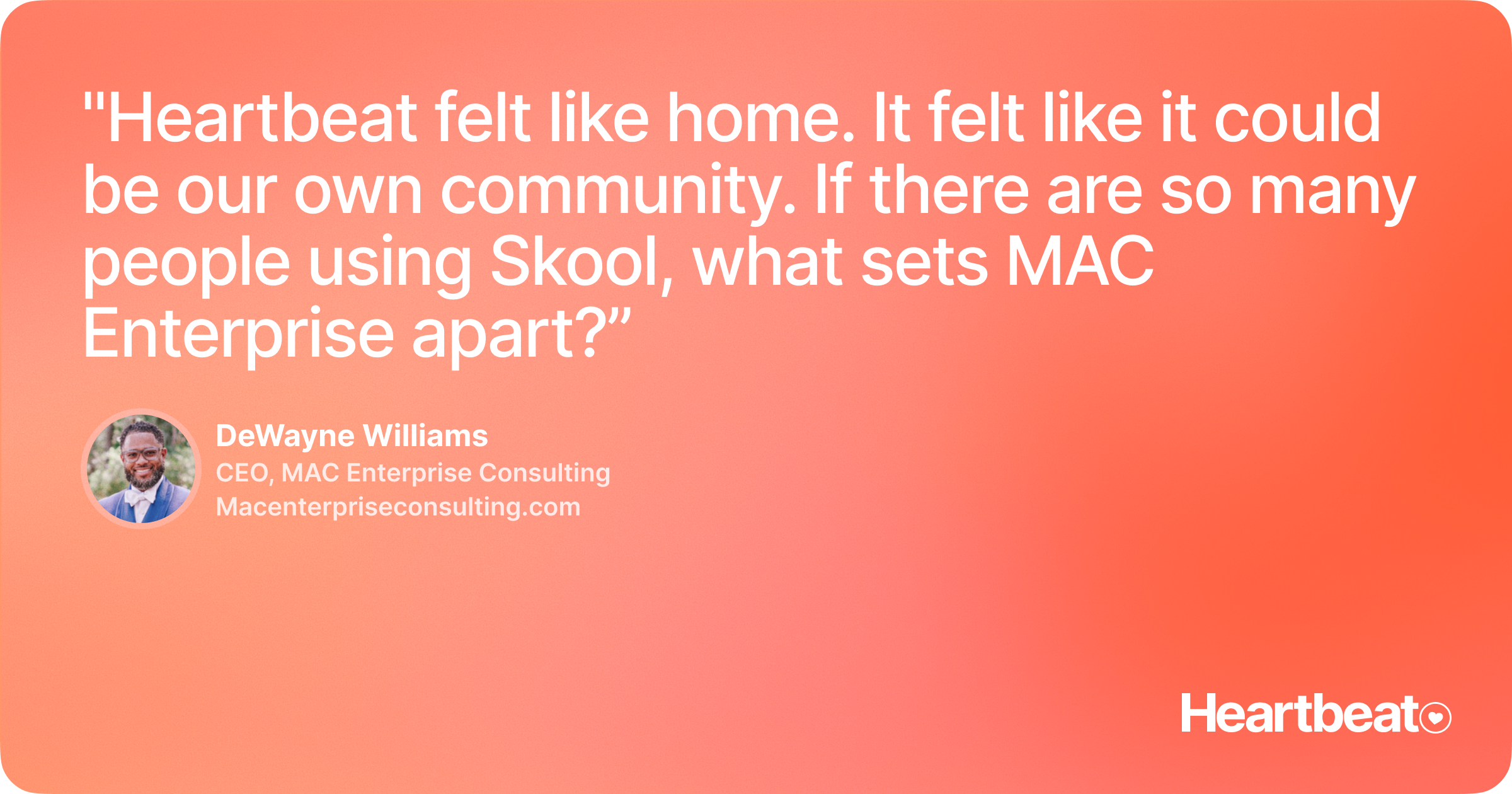
Dewayne: "We were literally determined: do we go with Skool or do we go with Heartbeat? Heartbeat felt like home. It felt like it could be our own community. If there are so many people using Skool, what sets MAC Enterprise apart?"
MAC Enterprise went from $200K/year to over $5M in less than 12 months after moving to Heartbeat. $700K of that revenue came directly from the Heartbeat platform. They now have 30+ people on their team.
What sealed it wasn't a specific feature. It was the ability to build something that looked and felt like theirs, a community their clients thought of as a MAC brand, not a Skool brand.
Which should you choose?
Choose Heartbeat if you're building a real community business. Your revenue model goes beyond "pay to join." You run events and want to charge for them, or use them to convert non-members into paying customers. You teach courses and want to sell them independently from your membership, or run cohort-based programs that need separate pricing per cohort. You want automation: member onboarding flows, re-engagement campaigns, cancellation retention, without wiring everything through Zapier. You want AI that builds things inside your platform, not a template picker. You want your community to look like your brand, not Skool's.
You don't have to be big. The $49/month Build tier gets you Pulse AI, 5 workflows, full course functionality, paid events, and complete payment flexibility. That's a real business foundation.
Choose Skool if your model is strictly "pay to join" and you genuinely have no plans for it to evolve. You want gamification and leaderboards as your core engagement mechanic. You want to minimize the time you spend configuring your platform. You accept that you're building a business in the shape Skool permits, not the shape your business actually wants to take.
That last part is what Skool's marketing doesn't say: Skool's simplicity is a constraint on your business model, not just your setup process. Every time a member asks "can I buy just the course without joining?" or "can I attend your event without subscribing?" or "do you offer a payment plan?", the answer on Skool is no. Skool assumes your business will always be simple enough to fit its four models. For a small set of creators, that bet pays off. For anyone building toward real revenue, multiple offerings, or a brand that needs to stand apart, Skool puts up a wall exactly where you need a door.
Frequently asked questions
Is Heartbeat cheaper than Skool?
At comparable capability levels, yes. Skool Hobby at $9/month runs a 10% + $0.30 transaction fee. At $10K in monthly revenue, you're paying $1,000+ in platform fees alone, more than Heartbeat's Grow plan ($149/month plus 2.5%). Skool Pro at $99/month drops the fee to 2.9% + $0.30 all-in. Skool processes payments internally, so there's no additional Stripe fee on top. Per transaction, Skool Pro's 2.9% is cheaper than Heartbeat at the Build tier.
But that's the wrong comparison. Heartbeat Grow at 2.5% closes the gap. And Heartbeat Grow also includes cancellation flows, legacy pricing (grandfathered), promo codes, abandoned signup recovery, and unlimited automation that Skool Pro doesn't have at any price. A community doing real transaction volume and using Heartbeat's retention tools typically comes out ahead on total revenue, not just platform fees, even where the per-transaction rate is higher.
Does Skool have any AI?
No. There is no AI in Skool. The "Help Me Write a Post" button in Skool's interface is a template picker, not AI. There's no AI for building courses, setting up offers, drafting landing pages, or anything else. Heartbeat's Pulse AI is architecturally different: it takes actions inside your product. It builds a course from a raw transcript, configures a paid offer, sets up a workflow, drafts a landing page, all through a conversation. It doesn't generate text for you to copy and paste. It builds the thing. Communities that used to take two weeks to a month to set up are being built in hours with Pulse. Available on every Heartbeat plan, including the $49/month Build tier.
Can you run paid events on Skool?
No. Every event on Skool is free. You can't charge for an event, you can't run early-bird pricing, you can't open an event to non-members as a lead generation play. You also can't integrate with Zoom: you paste a URL and that's the full integration. Heartbeat's event system lets you charge for events, set different ticket prices for members and non-members, run public events that non-members can RSVP to as a conversion funnel, auto-link Zoom meetings, sync attendance, and use RSVP triggers in automated workflows. If events are any part of your revenue model or growth channel, Skool eliminates them entirely.
Which platform is better for scaling past $10K/month?
Heartbeat, and the gap widens at scale. The tools you need to grow past $10K/month: cancellation flows to reduce churn, legacy pricing to protect revenue when you raise prices, promo codes to run promotions without leaving money on the table, waitlists with upfront payments to validate new offers, cohort pricing to charge independently per program. None of them exist on Skool. A community doing serious transaction volume on Skool is building without the basic retention infrastructure that every real subscription business needs. On Heartbeat Grow ($149/month), all of those tools are included, plus unlimited automation and white-label emails. The unit economics aren't close.
Can you migrate from Skool to Heartbeat?
Yes. Self-serve migration support is on every Heartbeat plan. Members, content, and subscription data move over as part of the process. A dedicated onboarding rep who manages the full migration is on Scale ($849/month). Heartbeat has run migrations from Skool, Circle, Mighty Networks, and others. The harder question isn't whether the migration is possible. It's how long you want to stay on the wrong platform.
Which is better, Skool or Circle?
They solve different problems. Skool is $9 a month on Hobby with a 10% transaction fee that already covers card processing, deliberately simple, and gets you live fastest. Circle is $89 a month on Professional billed annually and $199 on Business, with 2% and 1% fees, and is the more configurable product. On Skool Hobby you start cheap and pay more as you earn. If you want the depth without the $199 tier, Heartbeat's Build plan is $49 a month with a 5% fee on top of Stripe's 2.9% plus 30 cents, and includes workflows and Pulse AI.
What's better than Skool?
It depends what Skool is not doing for you. If you need cohorts with their own pricing, more than one way to charge, and automated onboarding and retention, Heartbeat covers those from the $49 Build plan. If you want more configurability, Circle does that at $199 on Business. If Skool's simplicity is the reason you chose it, nothing here is an upgrade.
Is Skool easier to set up than Heartbeat?
Yes. Skool is deliberately simple and gets you live quickly. Heartbeat takes more setup because there is more to configure: courses, cohorts, events, payments, and automation in one place.
When does a simple tool stop being enough?
When the community becomes the business. That is usually the point where you want a January intake priced differently from a March one, more than one way to charge, and something that catches a member before they cancel rather than a one-click exit. Heartbeat covers those from the $49 Build plan. Until you get there, simpler is genuinely better.