Life Coaching Packages: How to Structure and Price Them (With Examples)
Five package models, the pricing math, Heartbeat's coaching price data and 8 real coaches' packages
Guides

What is a coaching package?
A coaching package bundles a set amount of coaching (and optional services) under one price. Instead of booking and paying session-by-session, the client buys, say, six sessions over three months, plus any support or other services you include between those sessions.
Well-designed packages benefit both parties. The client pays a lower per-session rate and gets ongoing support. The coach gets revenue up-front, a predictable schedule, and the benefit of seeing their clients progress (and making adjustments as needed).
What goes into a package depends on what you're coaching, and what clients expect for the price you charge. A three-month package for someone changing careers might have six private sessions, an intake assessment, a short exercise after each call, and a progress review at the halfway point. A confidence coach might add email check-ins between sessions, because that's when clients run into the situations they're working on. Some coaches also include access to a private community where clients can talk to each other.
Write down everything the package includes before you sell it, and be specific – the more details, the better. A client might read "support between sessions" and expect instant replies to texts, when you meant an email or two per week.
Five ways to structure a coaching package
Most packages fit into one of these five structures. Choose one based on the client's expectations, the best cadence to help them progress, and your own capacity.
| Structure | Typical length | What's included | Best for |
|---|---|---|---|
| Single session | One appointment | Focused conversation and next steps | A specific issue |
| Fixed-length package | Several weeks or months | Sessions, exercises and progress reviews | A defined goal |
| VIP day | One intensive day | Extended coaching and an action plan | Focused work on one challenge |
| Monthly retainer or subscription | Ongoing, billed monthly | Regular sessions and agreed support | Continued guidance |
| Group program | Defined program period | Shared sessions and materials | People with similar goals |
Single-session coaching
A single session is for a client with one thing to work through, like preparing to ask for a raise or deciding whether to take a job offer. It also gives someone a cheap way to try working with you before they commit to three months.
Because you only get one hour, send two or three questions ahead of time so the client arrives with the background already written down. Afterwards, email a short recap of what you agreed they'd do next. If the goal is really a habit (speaking up in meetings, for example), tell them up front that one session will get them a plan, and that most people need several weeks of practice and check-ins before the habit sticks.
Fixed-length coaching package
This is the most common structure, and the one most of the coaches further down this page sell. You agree on the number of sessions and the time frame before you start, for example six sessions over three months, with a small exercise to do between each one.
Take a client who wants to speak more confidently in meetings. The first couple of sessions go to figuring out which meetings are hardest and why. In the middle sessions, you rehearse what they want to say and pick one real meeting to try it in. Each session after that starts with how it went.
Put the logistics in writing before the first session: how often you'll meet, how much notice they need to give to reschedule, whether missed sessions expire, and what happens at the end (a final review, an offer to renew, or nothing at all). Our 12-week coaching program template lays out what to cover in each session of a three-month package.
VIP day
A VIP day packs several hours of coaching into a single day on one problem. A common format is a questionnaire the week before, a morning of coaching, an afternoon of exercises, and a written action plan the client leaves with.
Clients tend to have questions once they start using the plan, not on the day itself, so many coaches add a follow-up call two or three weeks out, or a few weeks of email support.
VIP days work for clients who can clear a full day and want fast progress on one thing. They're a poor fit for goals that take weeks of practice, like changing how someone handles conflict at work. Those clients are better off in a fixed-length package.
Monthly retainer or subscription
With a retainer, the client pays every month for an agreed amount of coaching, often two sessions a month plus limited messaging. It suits clients who want to keep going after a first program, and clients whose goals change as they go, like a new manager who brings a different problem every few weeks.
The risk with a retainer is scope creep, so write down the limits. If clients can message you between sessions, say which days you answer and how fast (within one working day, for example). Also decide what happens to unused sessions, how much notice clients need to give to cancel, and whether the price can change when they renew. A two-session retainer with no limits on messaging can easily turn into a client who texts you every day.
Group program
A group program coaches several clients together on the same topic. You run the sessions and supply the exercises, and participants also learn from hearing each other's problems.
A career transition group, for example, might spend the first weeks on strengths, the middle weeks researching options, and the last weeks making a decision. Everyone follows the same plan, but a nurse and a software engineer will bring very different situations to each discussion.
Groups cost each client less while paying you more per hour, because one session serves eight or ten people. The trade-off is less one-on-one attention, so tell people exactly how much individual time they get (one private 30-minute call during the program, for example). Our guide to group coaching covers how to design and price a group.
How to price a coaching package
Coaches who price only the time on calls usually undercharge. Every package also takes preparation before sessions, notes and follow-up afterwards, time to make worksheets, and admin like scheduling and invoicing. Who pays matters too: an executive coach whose clients' employers cover the bill can usually charge more than a life coach whose clients pay out of pocket.
There are three common ways to land on a number, and most coaches use more than one.
Hourly back-out method
Start with what you want to earn per hour of work, then add up every hour the package takes, not just the calls.
Say the package is six one-hour sessions. You spend 30 minutes preparing for each one, plus about two hours in total on admin and follow-up emails.
| Work | Time |
|---|---|
| Six coaching sessions | 6 hours |
| Preparation | 3 hours |
| Administration and follow-up | 2 hours |
| Total | 11 hours |
At $100 an hour, that's an $1,100 package. If you'd priced only the six calls, you'd have charged $600 and done five hours of work for free.
The $100 is just for the example, not a recommended rate. Whatever hourly figure you pick also has to cover business costs like software, insurance, and taxes.
Value-based pricing
Value-based pricing starts from what the client is trying to achieve and everything you provide to get them there, instead of from the hours.
A career transition package might include six private sessions, a written action plan, and a month of email support after the last session. Once you know how long that takes you to deliver and roughly what your clients can afford, you could test a price like $1,200 and adjust it after the first few sales.
Describe the goal clearly in your sales copy, but don't promise results you can't control. You can help someone prepare for interviews and decide which roles to go after. You can't promise them the job.
Market-rate pricing
Looking at what other coaches charge tells you what clients in your market are used to paying. Just compare like with like, because prices move a lot with experience, niche, credentials, location, and how much support is included.
For a broad reference point, the International Coaching Federation's 2025 Global Coaching Study collected 10,035 valid responses from across the coaching profession (not just life coaches).1 Sage.Coach, citing that study, reports an average of $234 for a one-hour session among active coaches.2
At that average, six sessions come to $1,404 before any prep time or extra support. You don't have to match it, but if your package is far below that, check whether you've left out work you're actually doing.
When you look at other coaches' prices, pick ones who serve the same kind of client you do, and compare what's included as well as the price. A $1,500 package with twelve sessions and weekly email support is a very different offer from a $1,500 package with six.
What coaches charge for groups and programs on Heartbeat
If you also sell a group or a membership, Heartbeat's own data gives you a second reference point. Across 146 coaching and personal development communities on a paid Heartbeat plan, the median monthly membership price is $39, and the middle half charge between $25 and $63.50 a month. For one-time purchases like a fixed program or a course, the median price is $247, across 121 communities.3
Those numbers are far below 1:1 rates because a group or membership spreads your time across many clients. If you sell a monthly group alongside private packages, our membership pricing calculator suggests a price based on what similar communities charge.
Coaching package examples
These eight coaches show how real packages combine sessions, length, and payment options. We checked every price on November 12, 2026, but coaches change their offers often, so check the linked page before using any of them as a benchmark.
Tra Kirkpatrick
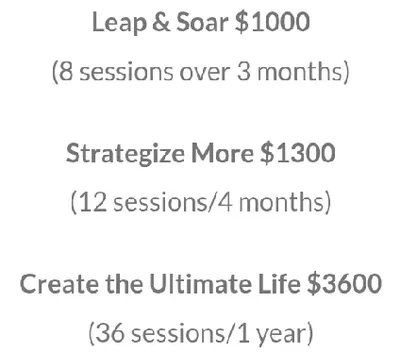
Tra Kirkpatrick's life coaching packages start with Leap & Soar at $1,000 for eight sessions over three months.4 Twelve sessions over four months cost $1,300, and a year of 36 sessions costs $3,600. Sessions run 45 to 60 minutes, with email check-ins in between, and every package is paid in full up front.
Andrea Scavelli
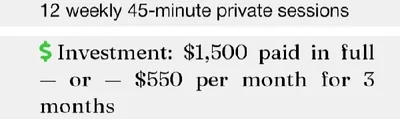
Andrea Scavelli's private coaching is for women going through major life transitions.5 It's twelve weekly 45-minute sessions, either $1,500 paid up front or $550 a month for three months. The monthly option ends up $150 more expensive, which is a common way to nudge clients toward paying in full.
Dr. Danielle Dowling
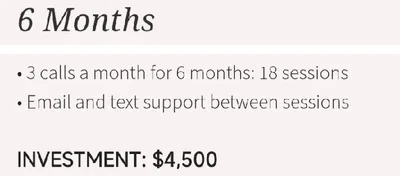
Dr. Danielle Dowling's private coaching costs $2,450 for three months with nine sessions and email and text support.6 Six months with eighteen sessions costs $4,500, which works out about 8% cheaper per session for clients who commit longer.
Allison Task
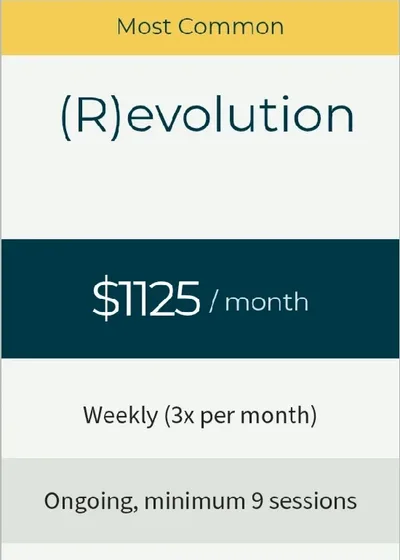
Allison Task's coaching programs are billed monthly.7 (R)evolution is $1,125 a month for three sessions, with a minimum of nine sessions, and comes with email support, priority scheduling, and recordings of each session. Slow & Steady is $895 a month for two sessions, with a minimum of six. Those minimums mean that, in practice, both plans work like three-month packages.
Elizabeth Cush
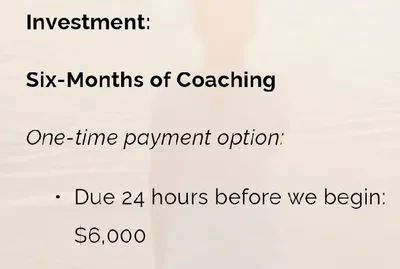
Elizabeth Cush's six-month coaching program costs $6,000 paid in full, or three installments.8 Clients get two 75-minute sessions a month, email prompts during the "integration weeks" between sessions, and email and text support.
Alexandra Archer
Alexandra Archer's Powerfully YOU program runs for three months and costs £675, paid at £225 a month.9 It mixes four long 2.5-hour sessions with eight 30-minute calls, then adds a one-hour follow-up three weeks after the program ends.
Dr. Jo Hartley
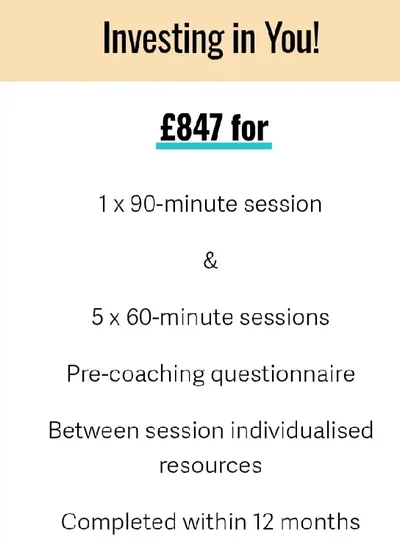
Dr. Jo Hartley's Making Changes package is for doctors thinking about a career or personal change.10 It costs £847 for one 90-minute session and five 60-minute sessions, plus a questionnaire before coaching starts and resources chosen for each client.
Kayla Scarborough
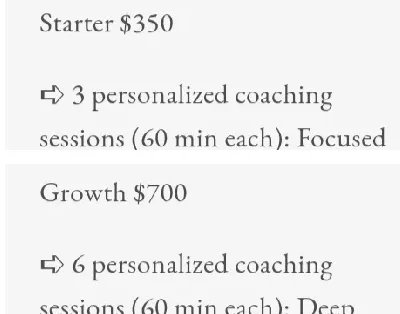
Kayla Scarborough's Forward Direction Coaching has three tiers:11 Starter at $350 for three sessions, Growth at $700 for six, and VIP at $1,400 for twelve. Every tier works out to the same per-session price, so the bigger tiers sell more time rather than a discount. Growth also adds a personal growth plan, worksheets, exercises, and three follow-up emails.
Treat these as a range of what's possible, not prices to copy. Your own price should come from your delivery time, your experience, and your clients. If you're still deciding who to coach, our guide for life coaches covers how coaches in different specialties price and sell.
Fixed packages vs monthly coaching
Both models work. The difference comes down to cash flow, how clients commit, and how predictable your calendar is.
| Consideration | Fixed coaching packages | Monthly coaching |
|---|---|---|
| Cash flow | Larger upfront payment or planned installments | Recurring income, but clients may cancel |
| Client commitment | Defined period and goal | Support continues as goals develop |
| Renewals | Client buys another package if needed | Client continues under agreed terms |
| Workload | Easier to plan for a set period | Requires ongoing scheduling and boundaries |
A fixed package suits a client with a clear goal and a deadline, like someone who wants to decide on a career change within three months. They know when the work starts and ends, and the last session gives you both a natural point to review progress.
Monthly coaching suits clients who want ongoing accountability or whose goals keep shifting. It gives you recurring income, but clients can pause or cancel in any month, which makes your income harder to predict. Be clear about the monthly fee, how many sessions it covers, and how to cancel.
Plenty of coaches offer both: a fixed package to start, then a monthly plan for clients who want to keep going once it ends.
How to present your packages
Someone reading your packages page should be able to tell which package fits them without emailing you first. That means each package needs to say who it's for, what's included, and what it costs.
Give each package a clear name
Tier names like Starter, Growth, and VIP show the levels of support at a glance. If you coach in one area, a descriptive name like Career Clarity or Confidence Coaching tells people the focus before they read anything else.
Under the name, add a sentence or two on who the package is for and what they'll work on. A name like "Unlock Your Potential" might sound good, but it doesn't tell anyone what they're buying.
Use three tiers to make choosing easier
Three options at different prices let clients pick how much support they want:
- Starter: fewer sessions, focused on one goal.
- Growth: regular sessions with exercises, progress reviews, and some support between sessions.
- VIP: more or longer sessions, extra check-ins, or priority scheduling.
The jump in price between tiers should match a jump in what the client gets, and they should be able to see it. If VIP costs twice as much as Growth, list the extra sessions or support that justify it. Also work out your hours for each tier, so the top tier doesn't end up paying you less per hour than the bottom one.
Explain the offer on your sales page
Your sales page should answer five questions:
- Who is it for? The client and the problem the package helps with.
- What's included? Sessions, resources, and any support between sessions.
- How long does it last? The length and how often you meet.
- What does it cost? The full price and any payment plan.
- How do clients start? Whether they book a discovery call, fill in an application, or pay straight away.
Add your cancellation, rescheduling, and refund policies, and if you offer email or messaging support, say when clients can reach you and how quickly you reply.
For the rest of the business setup, see our guides to starting an online coaching business and online coaching.
Use discovery calls to recommend the right package
On a discovery call, ask what the person wants to change, what's in the way, and what they've already tried. Their answers usually point to the right package. Someone who has read every book on the topic but never acted on it probably needs the accountability of a longer package more than a single session.
Go over the price, the time commitment, and what's included before you hang up. If none of your packages fits, tell them, and point them somewhere better if you can. Selling someone the wrong package can end in a refund request or a client who quietly stops showing up.
Frequently asked questions
What should a coaching package include?
At minimum, the number and length of sessions, how long the package lasts, and what the client will work toward. Many coaches add worksheets, action plans, progress reviews, or support between sessions. Only include extras you'll have time to deliver for every client.
How much should I charge for a coaching package?
Price the whole package, including prep, follow-up, and support between sessions, not just the time on calls. Sage.Coach, citing the International Coaching Federation's 2025 Global Coaching Study, reports an average of $234 for a one-hour session, so six sessions at that rate would be about $1,400. Use that as a reference point, then adjust for your experience, niche, clients, and what the package includes.
How many sessions should a coaching package have?
It depends on the goal. Preparing for one difficult conversation might take one to three sessions, while a bigger change like a career move usually needs regular sessions over three to six months. Most of the eight packages above fall between six and twelve sessions.
Should I offer monthly coaching or a fixed package?
A fixed package suits clients with a clear goal and time frame. Monthly coaching suits clients who want ongoing accountability or whose goals change. You can offer both, as long as you have time for the extra scheduling.
What is a typical coaching package length?
There's no standard length. Coaches sell everything from single sessions to year-long programs, but three months is the most common length among the examples on this page. Pick a length that gives clients enough time to practice and see progress on their goal.
Can I offer payment plans for coaching packages?
Yes. You can take full payment up front or split the fee into installments, like Andrea Scavelli and Elizabeth Cush do. Before the client signs up, spell out the total cost, the payment dates, and what happens if a payment is missed.
Sources
Checked 11/2026
- 1
2025 ICF Global Coaching Study: 10,035 valid responsescoachingfederation.org/…/global-coaching-study
- 2
$234 average one-hour coaching fee, attributed to the 2025 ICF studyblog.sage.coach/how-much-do-coaches-charge-per-…
- 3
Heartbeat coaching community prices, Oct 2026heartbeat.chat/…/membership-pricing-calculator
- 4
Tra Kirkpatrick package prices and detailstrakirkpatrick.com/life-coach
- 5
Andrea Scavelli package prices and detailsabetteryoulifecoaching.com/packages
- 6
Danielle Dowling package prices and detailsdanielle-dowling.com/private-life-coaching
- 7
Allison Task package prices and detailsallisontask.com/programs
- 8
Elizabeth Cush package price and detailselizabethcushcoaching.com/boundary-setting
- 9
Alexandra Archer package price and detailsimportanceofself.com/life-coach-uk
- 10
Dr. Jo Hartley package price and detailsdrjohartley.com/coaching
- 11
Kayla Scarborough package prices and detailsmsha.ke/fdcoaching