How to become a writer
The three kinds of paid writing, what each pays, which training is worth it, and how writers found their first clients

To become a writer, decide which kind of paid writing you want to do, write three to five samples of it, publish them on a page you can link to, and start pitching clients or editors. The word "writer" covers three different jobs, and each one pays in a different way: freelance and content work for clients, books, and writing for an audience you build yourself, such as a newsletter. You don't need a license for any of them. Salaried writing jobs usually ask for a bachelor's degree, but freelance clients and literary agents decide based on your samples or your manuscript.1
The timeline depends on which of those paths you pick. Writing samples and sending your first pitches can take a few weeks, but getting the first paid job often takes months. Elna Cain sent an estimated 40 or 50 pitches before she landed her first job,2 and Monique Danao earned her first $1,000 after two months of job boards and cold email.3 A book takes longer: Reedsy estimates two to four years from a finished manuscript to a traditionally published book, and three to eight months to self-publish.4 You can start a newsletter on Substack for free, and Substack takes 10% once you charge for subscriptions, plus Stripe's card fees.5
If you teach yourself, the only real costs are a computer and internet access. Courses run from $185 to about $1,300 each,67 and a year at a four-year college averages $12,290 in tuition and fees at an in-state public school.8
If you’re going to charge a premium and tell people you’re a high-touch experience, your member experience needs to reflect that.
 Emily Claire HughesFounder, The 10K Email Club · $0 → $160K a yearRead the story
What a writer does, and what they earn
Salaried writers and authors earned a median of $76,910 in May 2025.1 That median only covers people on a payroll. 65% of writing jobs are self-employed, and a self-employed writer's income depends mostly on which path they're on (client work, books or a newsletter), as the table below shows.1
The work day to day. Writers choose or are assigned a subject, research it, draft, and revise with an editor or client. The work includes articles, advertising copy, books, scripts and biographies.1 Freelancers also spend hours they don't get paid for on pitching, invoicing and record-keeping, and the Bureau of Labor Statistics (BLS) notes that self-employed writers can face the pressure of juggling several projects while looking for new work.1
Where they work. Of the 140,300 writer and author jobs counted in 2025, 65% were self-employed, 9% were in professional, scientific and technical services, and 8% were in the information sector, which includes publishing.1 Jobs are somewhat concentrated in California, New York, Texas and Washington, DC, though BLS says writers can work from almost anywhere.1
| Path | Paid by | Median pay | First pay | What it takes |
|---|---|---|---|---|
| Staff writer | Salary | $76,910 a year; technical writers $90,3901 | First payroll after you're hired | Bachelor's degree1 |
| Freelance articles and blog posts | Word or hour | 25 to 45 cents a word; $70 to $100 an hour for articles9 | After the first accepted job | Samples, outreach |
| Freelance marketing copy | Word or hour | 32 to 87.5 cents a word; $65 to $75 an hour9 | After the first accepted job | Samples from the client's industry |
| Books, all full-time authors | Advance, royalties, sales | $10,000 from books; $20,000 including other writing work, 202210 | 2 to 4 years after the manuscript if traditional4 | Manuscript, usually an agent |
| Books, full-time self-published authors | Sales, royalties | $12,800 from books; $15,000 including other writing work, 202210 | 3 to 8 months after the manuscript4 | Editing, cover, marketing |
| Newsletter | Subscriptions, sponsors | No survey data; Substack keeps 10%5 | When readers start paying | A regular schedule |
Freelance figures come from the Editorial Freelancers Association's 2026 chart, which reports members' median rates for work-for-hire projects done in 2025.9
Which path to start with
If you need income soon, start with freelance work. Of the paths in the table, it has the shortest wait between your first pitch and your first payment, and every finished job becomes a sample you can send the next client. If you want a steady paycheck and benefits, apply for staff jobs and use your freelance samples in the application. Books work best for people who have another source of income for several years, because a traditional deal can take two to four years to reach print after the manuscript is done.4 A newsletter works for writers who have a clear subject and can keep publishing on a schedule for months before readers start paying. On Substack, that means giving up 10% of subscription revenue, plus Stripe's fee of 2.9% and 30 cents per charge and 0.5% on recurring billing.5 You can do more than one at once. Many writers take freelance work to pay the bills while they write a book or grow a newsletter.
Book income
Most full-time authors can't live on book sales alone. The Authors Guild says most authors earn about half of their writing income from other work, such as editing, teaching, speaking, book coaching and copywriting.10 What you write also changes what you earn. Full-time romance and romantic suspense authors had a median book income of $31,725, while literary fiction authors had $5,000.10
BLS projects little or no change in writer and author jobs from 2025 to 2035, and names AI writing tools as one reason. It still expects about 11,900 openings a year, mostly from people leaving the field or changing occupations.1
Training: when it matters and what it costs
Training matters most if you want a salaried job, where employers generally expect a college degree in English, communications or journalism.1 Freelance clients and literary agents rarely ask about education. They decide based on your samples or your manuscript.
| Route | Typical cost | Time | Who expects it |
|---|---|---|---|
| Bachelor's degree in English, communications or journalism | $12,290 a year in tuition and fees at an in-state public four-year college, 2026-27; $46,350 at a private nonprofit8 | 4 years | Employers hiring salaried writers1 |
| MFA in creative writing | $0 a year at a fully funded program, which covers tuition and pays a stipend,11 up to $40,724 a year in tuition at The New School.12 Low-residency programs fall in between, such as $16,800 a year at Converse University13 | 2 to 3 years | Colleges hiring creative writing teachers; rarely agents or freelance clients |
| Course or workshop | $185 for a Gotham Writers Workshop intensive, $464 for its 10-week online workshop, plus a $25 registration fee;6 $1,290 plus a $35 registration fee for a Stanford Continuing Studies novel course7 | 1 day to about 10 weeks | No one requires it |
| Self-taught | $0 to the cost of a few books or webinars | Ongoing | Clients and agents judge the work itself. Anyone with internet access can start a blog and get practice1 |
When it's worth paying. Pay for a degree if you want a staff job at a company, agency, school or publisher, since that's where it's usually required. Consider an MFA if a program will fund you and you want two or three years to write a book, or if you want to teach writing at a college. Pay for a course when it teaches one specific skill, such as pitching or a type of copywriting, and you finish it with a piece you can send to clients.
What a beginner can skip
- An unfunded MFA. Literary agents decide whether to take you on by reading your manuscript, and they don't ask for a degree. The debt from paying full tuition is also hard to repay on a median full-time author income of $20,000.10
- Content writing and copywriting certificates. First clients don't ask for certificates. If a course has you write a sample in a client's industry, clients will look at that sample, not the certificate.
- Paid tools and job boards in the first month. A word processor and a simple portfolio page are enough to send your first pitches.
- Extra training in a topic you already know. BLS notes that writers may need training or experience in the subject they cover.1 If you already work in an industry, such as health or finance, you already have that training, so pitch clients in that industry first.
Choosing a niche
Picking a niche early makes pitching easier, because your samples are about the same subject as the work the client or reader wants. The table lists seven niches where people have built writing careers, with what each pays and a working writer or business in it.
| Niche | Who hires you | Typical pay | Working example |
|---|---|---|---|
| News and journalism | News sites, magazines, newspapers, trade publications | Reporters: median $62,200 a year1 | Jen A. Miller, a freelancer who writes for newspapers and trade publications on construction and technology14 |
| Marketing and content | Brands, agencies, software companies | 32 to 87.5 cents a word9 | Elise Dopson, a freelance writer for HubSpot and Shopify15 |
| Technical writing | Software, engineering and health companies | Median $90,390 a year1 | Tom Johnson, an API technical writer in the Seattle area16 |
| Books | Publishers, or readers directly | Full-time authors: median $20,000 total10 | J.F. Penn, a thriller and dark fantasy author17 |
| Ghostwriting | Executives, experts, public figures | Nonfiction books: 33 to 50 cents a word9 | Kevin Anderson & Associates, a ghostwriting firm18 |
| Newsletters | Paying subscribers, sponsors | No survey data | Lenny's Newsletter, on product management and growth19 |
| Teaching and coaching | Writers, schools, workshops | Coaching: $75 to $100 an hour9 | Author Accelerator, which trains and certifies book coaches20 |
Many writers work in more than one of these niches, and a lot of them teach as well as write. Editing, teaching, speaking and book coaching are among the work the Authors Guild counts as other author income.10
Writer income calculator
Start with your client work, then add a membership that doesn't need more of your hours. Your first 14 days on Heartbeat cost $0.
Profit after your free trial
$0/yr
| Line | Grow, per year |
|---|---|
| Revenue | $0 |
| Heartbeat plan | $149 |
| Heartbeat transaction fee | $0 2.5% |
| Stripe processing | $0 |
| Profit | $0 |
Your first 14 days are free, no credit card, with full Grow features.
Profit is revenue minus Heartbeat and Stripe fees (2.9% + 30¢ a charge), before taxes and other costs. The Heartbeat share is your plan plus its fee. Freelance clients are billed outside Heartbeat. Example numbers, not an income promise. See pricing.
What writers charge
Salaried writers and authors earned a median of $76,910 a year in May 2025.1 Freelancers set their own rates, and the 2026 EFA rate chart lists median work-for-hire rates of 25 to 45 cents a word for blog posts and articles, and $75 to $100 an hour for coaching.9 A membership lets you sell what you know about writing, pitching or publishing to many people at once, for a monthly fee. The Heartbeat range below is what creative communities on Heartbeat charge for one.
| Benchmark | Figure |
|---|---|
| Writers and authors, BLS median pay | $76,910 a year1 |
| Freelance articles and blog posts, EFA median | 25 to 45 cents a word9 |
| Writing coaching, EFA median | $75 to $100 an hour9 |
Creative & Arts memberships on Heartbeat
Typical $38/mo. The middle half charge $22 to $60, the bottom tenth $10 or less and the top tenth $130 or more.
64 paying communities. Stripe prices, October 2026. Every industry
Price your membershipThe offer ladder: 1:1, group, community, course
Most writers start out paid by the word, the article or the project, which means you only earn while you have an assignment. Once other writers start asking how you got your clients or your book deal, or readers ask for more of your time, you can charge them directly for what you know.
- 1:1. Manuscript feedback, book coaching or portfolio reviews. You can charge the most per hour for this, but you can only take as many clients as you have hours.
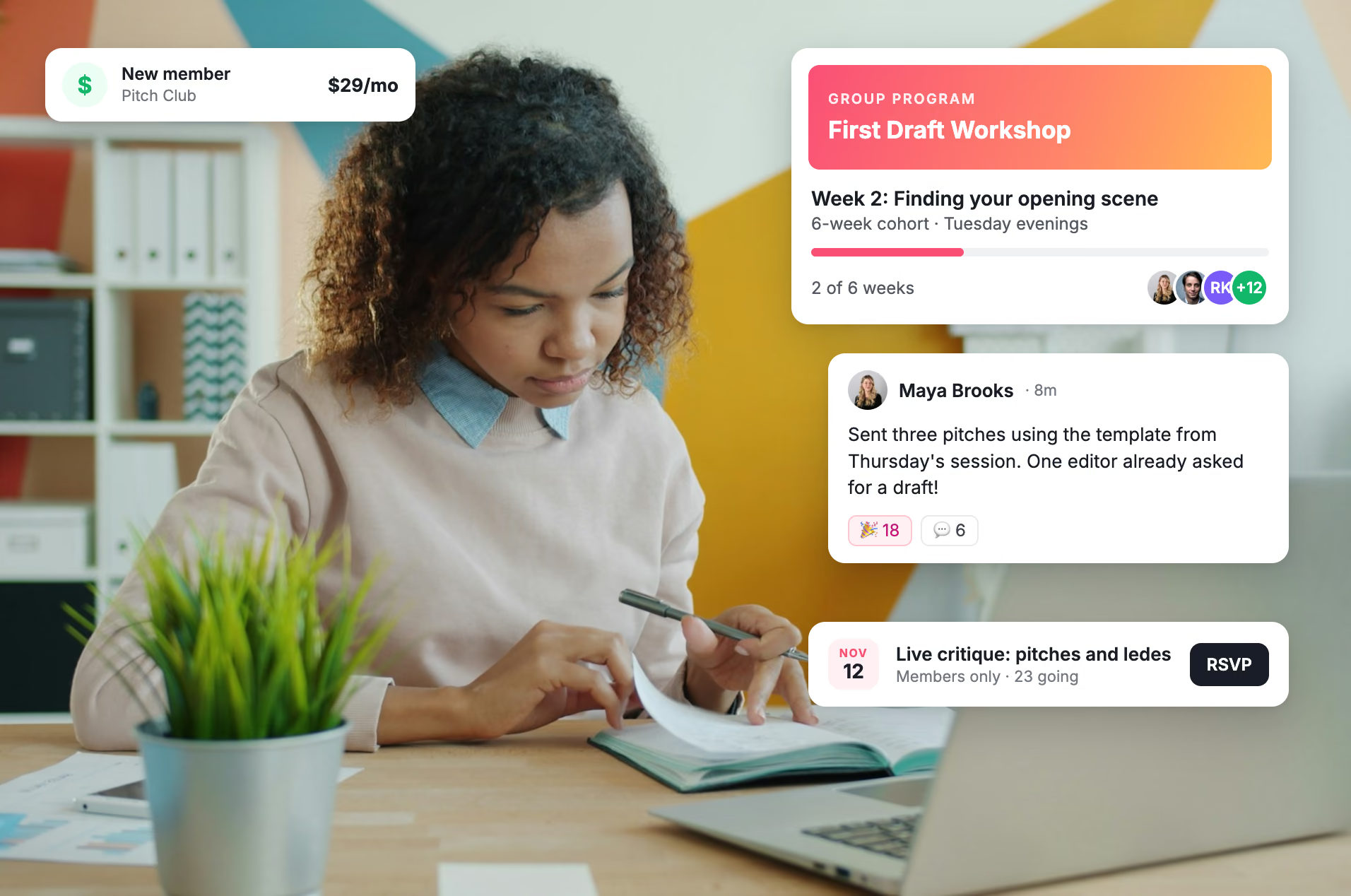
- Group. A small cohort working through the same program, such as a six-week workshop on a first draft or on landing freelance clients.
- Community. A paid membership with live writing sessions, critique, and a place for members to ask questions between sessions. Members pay every month, so the income continues between launches.
- Course. A self-paced program, like a pitching course with templates. You record it once, and people can buy and take it while you're busy with client work.
Many writers run several of these at once, for example a free newsletter, a membership for regular readers, and a few coaching clients at the highest price.
Your first 10 clients
In the stories below, most early work came from the writer reaching out directly: a pitch written for one listing, an email to the person who buys content, or a profile that a client found. Each of the six methods comes from a writer who used it.
Answer job listings with a specific pitch
Elna Cain got her first paid job with no relevant clips and no niche, after an estimated 40 or 50 pitches. She answered a listing for an automotive blogger. Her pitch pointed to her own blog and listed what each post would include, and it mentioned where she lived, since the listing asked for a woman blogger from Canada. That got her a phone interview, and then the job.2
Pitch editors at publications
Monique Danao built a simple site on her own domain, then found editors' email addresses and sent them article pitches. One online publication's editor liked her submission enough to take her on as a regular contributor, and that became her first client.3
Cold email the person who buys content
Danao then used LinkedIn to find companies in her niche and emailed the head of content or marketing, with two or three clips and a link to her site. One or two of every 100 emails turned into interested clients. Job boards brought in her second client, and together the two approaches earned her first $1,000 in two months.3
Send a letter of introduction, then follow up
A letter of introduction tells an editor about you and your background, instead of pitching one story. Jen A. Miller, by then a long-time freelancer, emailed the editor of a trade publisher's construction magazine with her construction background and links to her clips. She didn't get work from that magazine, but she kept in touch with the editor, and more than a year later that editor passed her name to the editor of the publisher's channel for CIOs, who gave her an assignment. The work paid her more than $10,000 in 2019.14 Miller already had years of clips when she sent it. A beginner can send the same kind of letter, as long as the samples linked in it are about the publication's subject.
Pitch companies that say they need content
Maya Capasso started freelancing at the end of 2020 and spent over a year with low-paying clients before she tried this. A former nanny, she filled in a survey from a nanny-matching service and saw that it planned to add much more content. She emailed the marketing manager about her childcare and writing experience and heard back within the hour. A call with the freelance coordinator followed the next week, and she got the work.21
Make yourself findable where clients look
Erika Gimbel set up a profile on a Chicago technology networking site after a contact suggested it, then forgot about it. A few weeks later, the CEO of a health website found the profile and asked if she could write for the company.22
What to have ready before you pitch
Before you send the first pitch, have three to five samples close to the work you're asking for, a page that links to them, and a one-line description of what you write and who you write it for. Keep a simple spreadsheet of who you've contacted, when, and what they said, so you know when to follow up. Then pick a number of pitches to send each week and stick to it, the same way you'd stick to a deadline. Cain and Danao both sent dozens of pitches or more before one turned into paid work,23 so a month with no replies is normal and isn't a reason to stop.
Tools, and where Heartbeat fits
You need very little to start: a word processor, a simple portfolio page and a way to send invoices. If you publish to your own audience, a newsletter tool handles the writing and the sending.
Heartbeat is for the paid offers you build around your writing, outside of client work. If you teach writing, coach writers, or want to give your most engaged readers more than a weekly email, you can run live sessions, recorded workshops, courses and a community in one place under your own brand. Evergreen and cohort courses sit next to the channels where members ask questions, and live sessions can run in Heartbeat or through the Zoom integration. Pulse, Heartbeat's AI, builds a landing page for your offer that goes straight to checkout, and a waitlist lets you collect sign-ups, or payments, before you open. If readers recommend you, the built-in affiliate program tracks their referrals.
More than 37,000 communities run on Heartbeat, and creators have been paid more than $27 million through it. Heartbeat has a 14-day free trial, with no card required to start.
Emily Claire Hughes started a travel blog between jobs singing on cruise ships and realized she could write. She took Upwork jobs to build her portfolio, moved into copywriting and marketing, and went freelance. Then she built the 10K Email Club, a membership that helps female founders turn their newsletters into a marketing channel, and it's on track for about $160K a year on Heartbeat. "If you're going to charge a premium and tell people you're a high-touch experience, your member experience needs to reflect that." Read her story.
Common questions
How do I become a writer with no experience?
Write three to five samples in the niche you want to work in, and publish them on a blog or portfolio page you can link to. You'll probably write your first samples for free, so make each one the same type of piece you want clients to pay you for, such as a blog post for a software company. Then start pitching. Elna Cain landed her first job with no relevant clips by pointing to her own blog and showing what she'd deliver.
Do you need a degree to be a writer?
No. Freelance clients, literary agents and newsletter readers judge your writing. Salaried jobs are the exception: BLS says a college degree in English, communications or journalism is generally required for them. A degree in another subject, such as science or nursing, helps when you pitch clients in that field, because it shows you know the topic.
How much do writers make?
Salaried writers and authors earned a median of $76,910 in May 2025. Freelancers usually charge by the word or project, and the 2026 EFA chart lists median work-for-hire rates of 25 to 45 cents a word for articles. Book income is lower. Full-time authors had a median of $10,000 from books and $20,000 from all writing work in 2022.
How do freelance writers find their first clients?
Mostly through direct outreach. Common methods include answering job listings with a tailored pitch, pitching editors at publications, and emailing the person at a company who buys content, with relevant samples. Most pitches won't get a reply at first: Monique Danao found one or two interested clients per 100 cold emails. Later on, clients may come to you when they find your portfolio or profile.
Can you make a living as a writer?
Yes, though most full-time writers combine income sources. The Authors Guild says most authors earn about half of their writing income from work other than their books, such as editing, teaching, speaking and copywriting. Salaried and freelance content work pays more steadily than books, and many authors keep a client business alongside their own projects.
How do I become a freelance writer?
Start with a niche where you already know the topic and the reader, such as software, health or travel. Write two or three samples for that niche and put them on a simple portfolio page. Then pitch specific clients every week, keep track of each pitch, and follow up. Follow-ups can pay off much later: Jen A. Miller's assignment came more than a year after her first email.
How do I become an author?
Finish a manuscript first, then choose a publishing route. For traditional publishing, you query literary agents and an agent pitches publishers, which Reedsy estimates takes two to four years from finished manuscript to publication. Self-publishing takes about three to eight months, but editing, design and marketing are your responsibility.
How long does it take to become a writer?
There's no exam or license, so the time it takes depends on which path you choose. Freelance income starts after the first accepted pitch, and Monique Danao earned her first $1,000 after two months of outreach. A newsletter can start this week for free on Substack. A traditionally published book usually takes two to four years after the manuscript is done.
Is an MFA in creative writing worth it?
It can be, if it's fully funded. Funded programs cover tuition and pay a stipend, which buys two or three years to write and a credential for college teaching jobs. An MFA you pay for yourself is harder to justify for a writing career, with tuition of up to $40,724 a year at The New School. Agents and freelance clients care about the work more than the degree.
Is writing still a good career with AI?
The number of writing jobs isn't expected to grow. BLS projects little or no change in writer and author jobs from 2025 to 2035, and it names AI writing tools as one reason. About 11,900 openings a year are still projected, mostly as people leave the field or change occupations. Writers who know a subject well, do their own reporting or have readers who follow them personally have something an AI tool can't easily copy.
What should a new freelance writer charge?
The 2026 EFA chart, based on more than 1,100 survey responses about 2025 work, lists median work-for-hire rates of 25 to 45 cents a word for blog posts and articles, and more for marketing, medical and technical work. Those are association members' rates, so treat them as a target rather than a beginner's rate. Once you know how long a typical piece takes you, quote a price per project instead of per word.
Should I self-publish or find a literary agent?
The answer depends on your genre and on how much of your own marketing you're willing to do. Self-published authors keep more control and move faster, and full-time self-published authors had a median book income of $12,800 in 2022. The Authors Guild found Kindle Unlimited especially effective for them. Traditional publishing pays an advance and handles production and distribution, but the process can take years.
Sources
- 1.BLS, writers and authors
- 2.Elna Cain, her first pitch
- 3.WritersWeekly, Monique Danao
- 4.Reedsy, how long publishing takes
- 5.Substack, paid subscription fees
- 6.Gotham Writers Workshop, prices
- 7.Stanford Continuing Studies, novel certificate
- 8.College Board, 2026-27 tuition
- 9.EFA, 2026 rate chart
- 10.Authors Guild, 2023 income survey
- 11.ProFellow, fully funded MFAs
- 12.The New School, MFA tuition
- 13.Converse University, low-residency MFA
- 14.Business Insider, Jen A. Miller
- 15.Peak Freelance, Elise Dopson
- 16.Tom Johnson, I'd Rather Be Writing
- 17.The Creative Penn, J.F. Penn
- 18.Publishers Weekly, Kevin Anderson & Associates
- 19.Lenny's Newsletter, 2020 review
- 20.Author Accelerator, book coach certification
- 21.Wild Writing, warm pitching
- 22.Make a Living Writing, Erika Gimbel