How to become an artist
What art training costs, what artists earn, six niches, and how working artists found their first buyers and students

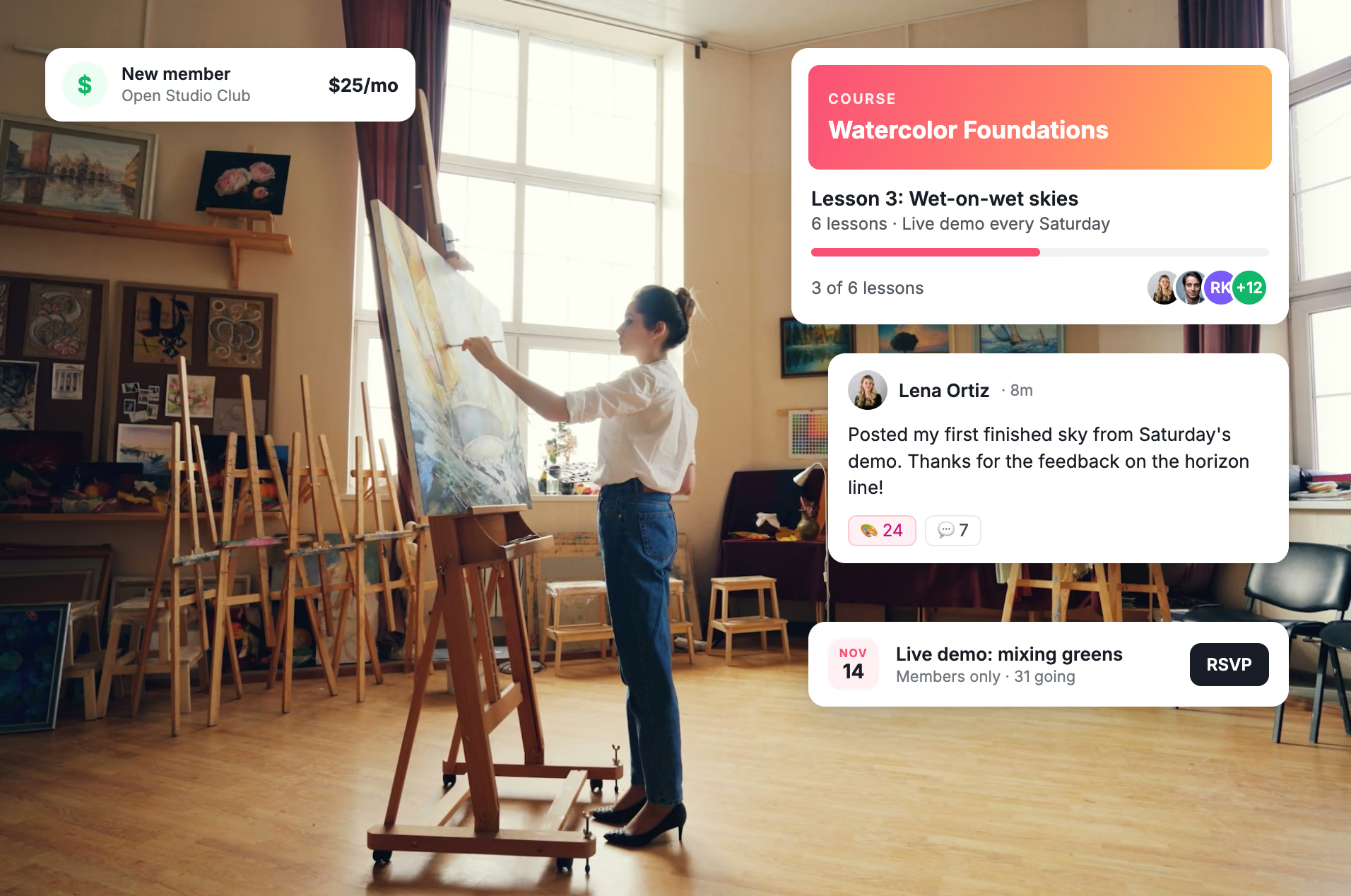
To become a working artist, practice until you have a consistent body of work, put your strongest pieces in a portfolio, and start selling originals, taking commissions or teaching. No license or degree is required to start. The Bureau of Labor Statistics (BLS) says portfolios are essential, because art directors, clients and buyers look at them when deciding whether to hire an artist or buy their work.1 Beginners can also join structured classes: the Art Students League of New York has no entrance requirements and needs no previous art experience.2
How long it takes and what it costs depends on the route you pick. A bachelor's degree takes four years, and average published tuition and fees for 2026-27 are $12,290 a year at an in-state public four-year college and $46,350 at a private nonprofit college.3 A five-day painting workshop in Santa Fe lists at $1,050,4 and a bundle of four online drawing courses from Proko, with just under 184 hours of lessons, was listed at $578.68.5 Most working artists earn from more than one source, such as sales, commissions and teaching, so it helps to plan for several income streams from the start.
People don’t lack trust in us; they lack trust in themselves. A subscription helped them start.
 Charlotte SalvanèsArt teacher, Un Autre Atelier · 80 → 900 paying studentsRead the story
What an artist does, and what they earn
BLS splits artists into two groups. Fine artists, including painters, sculptors and illustrators, make work mainly to be looked at. Craft artists make functional pieces such as pottery, glassware and textiles.1
The work day to day. An artist's week is split between making art and running a small business. Studio time goes to sketching, painting, revising and finishing pieces. Business time goes to buying materials, photographing finished work, posting it where buyers will see it, answering inquiries, sending invoices, and packing and shipping orders. Artists who teach also spend time preparing lessons and scheduling students.
Where they work. BLS says 58% of craft and fine artists are self-employed. The largest employers are independent artists, writers and performers (7%), the federal government (6%), retail (4%) and schools (4%).1 Paid art work is often part-time or short-term: in the 2025 National Survey of Artists, 61% of artists' primary jobs were part-time, 36% were temporary, and the median was 25 hours a week.6
What employed artists earn
The median annual wage for craft and fine artists was $55,290 in May 2025. Fine artists earned a median of $55,490 and craft artists $46,080. The lowest 10% earned less than $31,490, and the highest 10% more than $131,810. BLS projects employment to fall 1% from 2025 to 2035.1 BLS collects these wage figures from employers, so they cover artists on a payroll and leave out the 58% who are self-employed.
What all artists earn
The Mellon Foundation's National Survey of Artists, released in November 2025 and run with NORC at the University of Chicago, also counts self-employed artists and artists with other jobs. Across a nationally representative sample of 2,618 artists, the median income from an artist's primary job was $15,000. Nearly 30% of artists' primary income comes from work outside the arts, including nursing, teaching and sales, and 11% held three or more jobs in the past year.76 In the UK, a 2024 report by the Design and Artists Copyright Society (DACS) and the University of Glasgow put the median income of visual artists at £12,500 a year, from a survey of more than 1,200 artists.8
| Way to earn | Who pays | What the data says |
|---|---|---|
| Original work and commissions | Collectors, gift buyers, businesses | No survey tracks commission income on its own. In a 2024 UK survey, 56% of artists earned less than £5,000 from selling their art, and fewer than 10% earned over £25,000.9 |
| Prints and products | Buyers of prints, cards and stickers | You can sell the same image many times as prints, cards or stickers. No survey reports typical income from this stream. |
| Licensing and surface design | Brands and retailers | There is little public income data. The contract sets the pay, either a flat fee or a royalty. |
| Teaching | Students in classes, courses and communities | 28% of US artists identify as teaching artists.7 One watercolor teacher reports over $100,000 a year from online courses alone.10 |
Licensing works differently from selling an original. A company pays for the right to put your art on products it sells, and you keep the copyright. The contract sets which products the art can appear on, where they can be sold and for how long. Cat Coquillette went from working a 9-to-5 and living in her childhood bedroom while she paid down student debt to licensing her designs through companies including Target, Urban Outfitters and Bed Bath & Beyond.11
Training: when it matters and what it costs
BLS says most fine artists pursue postsecondary education to improve their skills and job prospects, while a formal credential is typically not needed to be a craft artist.1 Buyers, clients and students look at your portfolio rather than your qualifications, so the right route depends on whether you want a salaried job or plan to sell and teach on your own.
| Training route | Cost | Time | Who expects it |
|---|---|---|---|
| Private art school (bachelor's) | $66,460 tuition at the Rhode Island School of Design (RISD) for 2026-27, $67,676 with required fees, before housing and supplies12 | 4 years | Employers hiring for salaried roles; common among fine artists1 |
| Bachelor's degree, public college (in-state) | $12,290 a year, average published tuition and fees, 2026-273 | 4 years | Same as above |
| Associate degree, community college | $4,210 a year, average published tuition and fees, 2026-273 | 2 years | Rarely required. Credits can transfer to a bachelor's program |
| Studio classes | Priced per class; no entrance requirements at the Art Students League2 | Ongoing | Not a hiring credential. Classes build skills and a portfolio |
| Week-long workshop | $1,050 to $1,295 for five-day workshops in Santa Fe at Madeline Island School of the Arts, 2027 season4 | 5 days | No credential is awarded |
| Self-taught with online courses | $578.68 for Proko's four-course bundle (list price $851), about 184 hours of lessons5 | At your own pace | No credential. Buyers judge the finished work |
When a degree is worth it. A degree is a good investment if you want a salaried job that lists one as a requirement. If you plan to sell directly to buyers, take commissions or teach your own classes, you may not need one, and the money can go toward classes, materials and time to make new work.
What a beginner can skip
Wait on expensive materials until you know which medium you'll focus on, because professional supplies bought for the wrong medium tend to sit unused. Hold off on paid marketing until you have enough finished pieces to fill a portfolio. In the first months, most of your time and money should go into practice.
Feedback is worth paying for early on. A teacher who looks at your work, in person or online, will spot problems in composition and technique sooner than you would by yourself. Studio classes and short workshops give self-taught artists that feedback for far less than a degree costs.
Choosing a niche
Some artists choose a niche by medium, such as watercolor or murals. Others start with the buyer, such as publishers or pet owners. Many combine the two: watercolor pet portraits, or digital illustration for publishers. Each niche below includes one working artist and how they earn from it.
Illustration for publishers
Publishers hire illustrators for picture books, book covers and educational materials. The buyers are art directors and editors, and many work through agents. Robin Rosenthal signed with agent Erica Rand Silverman, who first saw her work at the New York SCBWI Portfolio Showcase in 2017. Rosenthal says the art directors and editors for her books first saw her work at SCBWI portfolio showcases too.13
Pet portraits
Pet portraits are commissioned by owners who want a gift, a keepsake or a memorial. Erica Eriksdotter, who was born and raised in Sweden and sold her first painting at 10, paints custom pet portraits and says much of her approach comes from losing her own dog.14 She left a public relations job to paint full time.15 She also runs courses for other pet portrait artists, which links this niche to teaching.14
Murals
Murals are usually commissioned by businesses, towns and community groups that want large public art. Ali Hval earned her MFA in painting and drawing at the University of Iowa in 2019 and, by 2023, had completed more than 40 public murals, most of them in Iowa. On community projects she traces the image, numbers each section and mixes the paint, so residents can help paint it like a giant paint-by-number.16
Digital art and fan support
Digital artists sell to clients and to an online audience through prints, books, commissions and memberships. Lois van Baarle, known as Loish, shared early work on oekaki boards, then DeviantArt, then Instagram, where she has 2.2 million followers. She launched a Patreon asking for a small contribution of $5, which let her step back from client work and focus on personal work.17
Licensing and surface design
Surface designers create patterns and illustrations for products such as home goods, stationery and phone cases. The buyers are brands and retailers. Cat Coquillette licenses her designs through companies including Target and Urban Outfitters.11
Teaching other artists
Many working artists earn steady income teaching other artists. Miriam Schulman, of The Inspiration Place, has created more than 18 online watercolor courses and said in 2022 that each launch typically brings in $30,000 to $50,000.10 Stan Prokopenko spent 10 years at Watts Atelier, the last five as a teacher, started his ProkoTV YouTube channel in 2012 and passed one million subscribers in 2018.18 He now sells complete online art courses on Proko.com.5
To choose, look at which of your pieces get the most response from buyers or followers, which buyers come back for a second piece, and which kind of work you would still enjoy after a hundred orders. Start with one niche and add a second once the first brings in regular income.
Artist income calculator
Start with your private students, then add a membership that doesn't need more of your hours. Your first 14 days on Heartbeat cost $0.
Profit after your free trial
$0/yr
| Line | Grow, per year |
|---|---|
| Revenue | $0 |
| Heartbeat plan | $149 |
| Heartbeat transaction fee | $0 2.5% |
| Stripe processing | $0 |
| Profit | $0 |
Your first 14 days are free, no credit card, with full Grow features.
Profit is revenue minus Heartbeat and Stripe fees (2.9% + 30¢ a charge), before taxes and other costs. The Heartbeat share is your plan plus its fee. Private students are billed outside Heartbeat. Example numbers, not an income promise. See pricing.
What artists charge
Fine artists earned a median of $55,490 a year in May 2025, but BLS wage figures leave out the self-employed, and 58% of craft and fine artists work for themselves.1 The 2025 National Survey of Artists counts them too, and it found a median of $15,000 from an artist's primary job.6 Teaching is one of the steadier ways to add to that, and 28% of US artists identify as teaching artists.7 The Heartbeat range below is what creative communities on Heartbeat charge for a monthly membership.
| Benchmark | Figure |
|---|---|
| Fine artists, BLS median pay | $55,490 a year1 |
| Income from an artist's primary job, National Survey of Artists median | $15,000 a year6 |
Creative & Arts memberships on Heartbeat
Typical $38/mo. The middle half charge $22 to $60, the bottom tenth $10 or less and the top tenth $130 or more.
64 paying communities. Stripe prices, October 2026. Every industry
Price your membershipThe offer ladder: 1:1, group, community, course
Most artists start out paid per piece, so income stops when the commission is delivered or the original sells. Once other artists start asking how you work, or collectors want more of your time, you can charge for teaching your process as well as for the work itself.
- 1:1. Portfolio reviews, private lessons or mentoring for artists building a practice. This earns the most per hour, but you can only take as many students as you have free hours in the week.
- Group. A small cohort working through the same program, such as a six-week course on portraits or on taking commissions.
- Community. A paid membership with live demos, critique sessions and a place for members to share work and ask questions between sessions. Members pay every month, so income continues between launches.
- Course. A self-paced program, like a recorded watercolor fundamentals course, that students buy and work through without you teaching live.
Many artists run several of these at once, for example a free email list, a membership for regular students, and a few private students at the highest price.
Your first 10 buyers and students
Take overflow work from other artists
When artists are fully booked or have to drop out of a project, they often pass the job to someone they know. Ali Hval's first mural came when a friend who was set to paint a mural in Clinton, Iowa, had to drop out and asked her to take it. Hval had never painted a mural, but it was her first summer as a graduate student and she needed the money.16
Next step: Tell artists in your network what kind of work you can take on when they're fully booked.
Put your portfolio in front of the people who hire
At industry events, art directors, editors and agents look at portfolios in person. Robin Rosenthal won an SCBWI Portfolio Showcase mentorship in 2014. Her future agent first saw her work at the 2017 New York showcase, and in 2018 she won the showcase.13
Next step: Find the event or juried show where buyers in your niche review portfolios, and build a portfolio page for it.
Post where your buyers already spend time
Loish built her audience by posting on oekaki boards, DeviantArt and then Instagram. She says she used social media to get in touch with clients and do client work before she moved to fan support on Patreon.17
Next step: Pick the one or two places your buyers browse, and post finished work there on a regular schedule.
Teach where you trained
The school or studio where you trained already has students, and it sometimes needs teachers. Stan Prokopenko started taking after-school classes at Watts Atelier as a high school senior, stayed 10 years, and taught there for the last five before he moved to online teaching full time.18
Next step: Ask the studio or school where you train whether it needs an assistant or a beginner-class teacher.
Build an email list before you launch a class
Miriam Schulman started teaching online after another artist messaged her through her Etsy shop in 2012 to ask whether she offered online courses. Her first course launched "to crickets," in her words, because she had no email list and no marketing plan. She built an audience first, then made her next offers to it.10
Next step: Add a free offer to your website, such as a supply list or a short demo, and start collecting emails.
Handling your first commission
A first commission goes more smoothly when everything is agreed in writing before you start. The Practical Art World recommends a written commission agreement that covers:19
- The work. Subject, size, materials, total price and a completion date that leaves time for revisions and, for paintings, drying.
- The deposit. Collect one before you start. It covers your materials and time and screens out buyers who aren't serious.
- Revisions and final payment. Many artists set one viewing when the work is partly done. Be careful about making final payment due "upon approval," which can leave you editing the piece over and over.
- Copyright. State that you keep the copyright, so you can show the finished piece on your website and in your portfolio. If the client wants prints or other rights, put that in writing.
Tools, and where Heartbeat fits
You need very little to start: a portfolio site, a way to take payment and invoice, and somewhere to post your work. If you sell prints or originals, a shop on your own site or a marketplace handles checkout and shipping details.
Heartbeat is built for artists who teach. If you run classes, mentor other artists, or want to give your regular students more than a one-off course, you can run live demos, recorded lessons, courses and a community in one place under your own brand. Courses sit next to channels where students post their work and get feedback, and live sessions can run in Heartbeat or through the Zoom integration. Pulse, Heartbeat's AI, builds a landing page for your class that goes straight to checkout, and a waitlist lets you collect sign-ups, or payments, before you open. If students recommend you, the built-in affiliate program tracks their referrals.
More than 37,000 communities run on Heartbeat, and creators have been paid more than $27 million through it. Heartbeat has a 14-day free trial, with no card required to start.
Paris-trained artists Charlotte Salvanès and Laurent moved their drawing studio online during COVID with 80 students. Their teaching was spread across Google Classroom, WhatsApp, Thinkific and Peerboard, and none of it worked well for art. On Heartbeat, Un Autre Atelier now runs four programs of about 30 courses each, with assignments that link straight into channels where students share drawings, weekly live sessions, and local groups that meet in parks and museums to draw. The academy has grown to nearly 900 paying students on a subscription. "Heartbeat felt like community, not just a tool." Read their story.
Common questions
Can you become an artist without a degree?
Yes. A formal credential is typically not needed to be a craft artist, though most fine artists pursue some postsecondary education. Buyers, clients and students decide based on your portfolio, and studio classes like those at the Art Students League of New York have no entrance requirements. A degree matters most if you want a salaried job that lists one as a requirement.
How do artists make money?
Artists sell original work, prints and products, take commissions, license designs to companies, work for illustration clients, and teach classes or courses. Most combine several of these. In the 2025 National Survey of Artists, 28% of US artists identified as teaching artists, and nearly 30% of artists' primary income came from work outside the arts.
How do you get your first art commission?
Start with people who already know your work: friends, past buyers and other artists in your niche. Show finished examples of the kind of piece you want to be commissioned for, and say plainly that you're taking commissions. Ali Hval got her first mural when a friend dropped out of a project and passed it to her. Put the terms in writing before you start.
Can you make a living as an artist?
Yes, though most artists who do it combine several sources of income. The median income from an artist's primary job was $15,000 in the 2025 National Survey of Artists, and 11% held three or more jobs in the past year. Artists who make a living usually combine sales, commissions, licensing and teaching, and many keep other work while their art income grows.
How long does it take to become a professional artist?
It depends on your starting skill, how much you practice and how quickly you reach buyers. A bachelor's degree takes four years and an associate degree two, but many artists skip school and learn through classes and practice. Ali Hval finished her MFA in 2019, and by 2023 had completed more than 40 public murals.
How much does art school cost?
Average published tuition and fees for 2026-27 are $4,210 a year at a public two-year college, $12,290 at an in-state public four-year college and $46,350 at a private nonprofit four-year college. Dedicated art schools cost more: RISD lists tuition and required fees of $67,676 for 2026-27. Housing, supplies and equipment cost extra.
Is teaching art a good way to earn steady income?
Teaching usually gives more predictable income than one-off sales, because students come back every week or month or sign up for a series of courses. You can teach in person or online. Stan Prokopenko taught at Watts Atelier for five years before moving to online teaching full time, and now sells complete courses on Proko.com.
Who owns the copyright when someone commissions art?
Unless the contract says otherwise, you usually keep it, but many clients assume that paying for a piece means they own the copyright. The Practical Art World recommends stating in your commission agreement that you keep the copyright, so you can show the work on your website and in your portfolio. If the client wants to make prints, agree that in writing. Check the copyright law where you live.
What is art licensing?
With licensing, a company pays you for the right to put your artwork on products it sells, such as home goods, stationery or clothing, while you keep the copyright. Cat Coquillette licenses her designs through companies including Target, Urban Outfitters and Bed Bath & Beyond. One design can appear on many products. There is little public data on what licensing typically pays.
How do artists sell their art online?
Some sell through their own website, others through marketplaces such as Etsy or through social media, which helps new buyers find you. Your own site and email list give you the most control over prices and how you stay in touch with buyers. Loish built an Instagram following of 2.2 million and used social media to reach clients. Whichever you use, post new work on a regular schedule and make it clear how to buy.
Do artists need a website?
You can start without one, but a website gives buyers, clients and students one place to see your portfolio, and it isn't affected when a social platform changes its rules or how many people see your posts. An email list lets you reach buyers directly in the same way. Miriam Schulman's first online course barely sold because she had no list yet.
Should you quit your job to become a full-time artist?
Most artists build their art income before they leave a job. Many artists hold more than one job: 11% held three or more in the past year. Cat Coquillette worked a 9-to-5 while she paid down student debt, before licensing became her business.
Can artists also earn from writing about their work?
Yes. A newsletter, blog, book or class notes can all bring in buyers and students, because writing about how you work helps people understand your style and your prices. Loish says people who bought her book *The Art of Loish* felt they really connected with her.
Sources
- 1.BLS, craft and fine artists
- 2.Art Students League, class guide
- 3.College Board, 2026-27 tuition
- 4.Madeline Island School of the Arts, workshops
- 5.Proko, Ultimate bundle
- 6.NORC, National Survey of Artists
- 7.Mellon Foundation, National Survey of Artists
- 8.The Art Newspaper, UK artist earnings
- 9.Creative United, 2024 artist survey
- 10.Course Method, Miriam Schulman
- 11.Tropical MBA, Cat Coquillette
- 12.RISD, 2026-27 billing
- 13.SCBWI, Robin Rosenthal
- 14.Studio Eriksdotter, about
- 15.The Columbian, pet portraits
- 16.University of Iowa, Ali Hval
- 17.Creative Bloq, Loish interview
- 18.Tubefilter, Stan Prokopenko
- 19.The Practical Art World, commission contracts