How to become a Pilates instructor
What Pilates certification costs, how long it takes, what instructors earn, and how to find your first clients

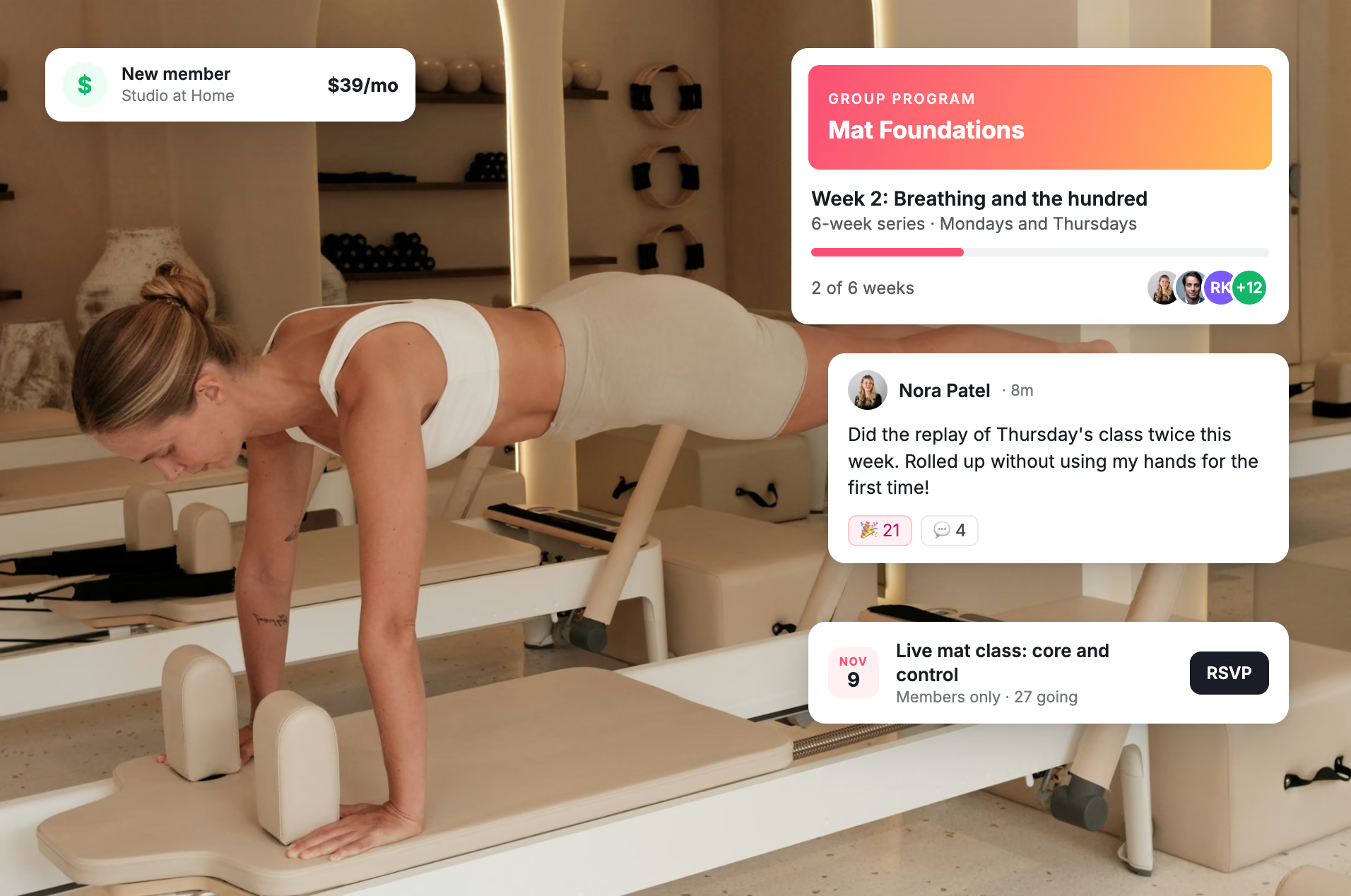
To become a Pilates instructor, take classes regularly for a while, then enroll in a teacher-training program. You can train for mat only, for the reformer, or for every piece of studio equipment in what schools call a comprehensive program. Every program combines anatomy and the Pilates repertoire with observation hours, practice on your own body and practice teaching on real people, and each one finishes with its own exams. Pilates is not a licensed profession, so no law requires a certificate.1 Studios still set their own rules, and most of them hire graduates of programs they already know.
How long it takes depends on the route. Balanced Body lists 134 total hours for its mat training, 214 for reformer, 332 for mat and reformer together, and 520 for its comprehensive program.2 Comprehensive programs elsewhere run 450 to 655 hours and often take about a year: Polestar's runs 13 to 14 months.3 An independent 2026 cost guide puts mat-only training at $1,000 to $3,000 and comprehensive programs at $5,000 to $8,000.4 If you also want an independent credential, the National Pilates Certification Program (NPCP) charges $225 for its mat exam and $300 for its comprehensive exam.1 If you plan to teach independently, buy liability insurance before your first paying student.
People don’t lack trust in us; they lack trust in themselves. A subscription helped them start.
 Charlotte SalvanèsArt teacher, Un Autre Atelier · 80 → 900 paying studentsRead the story
What a Pilates instructor does, and what they earn
Instructors usually work in one of three setups. Employees of a studio, gym or fitness center teach group and private sessions, plan classes, demonstrate exercises and correct form, and the employer takes care of bookings, marketing, equipment and rent. Independent instructors handle all of that themselves, either renting space by the hour or teaching from a room at home. A third group teaches online, for some or all of their schedule.
If you go independent, expect a good part of your week to happen outside class. You plan sessions, reply to client messages, take bookings and payments, and post on social media. You also pay costs that a studio covers for its employees: rent, insurance, equipment, software, taxes, continuing education, and travel between clients' homes or studios.
The federal government doesn't track Pilates instructors on their own. They fall under fitness trainers and instructors, whose median wage was $47,160 a year in May 2025. The lowest-paid 10% earned less than $28,800 and the top 10% more than $83,100.5 The Bureau of Labor Statistics projects 7% job growth for the category from 2025 to 2035, much faster than average.5
Studios usually pay by the class rather than by salary. One independent cost guide puts a group class at roughly $35 to $60.4 Private sessions earn more for each hour you teach, but you need a separate client for every hour, so it takes longer to fill a week with them.
What makes an instructor worth returning to
Students come back to teachers who pick up small details in how they move and who encourage them without stopping to correct every rep. A good teacher explains what each exercise is for in everyday words. They can tell when someone is nervous, returning after years without exercise, or simply having a bad day, and they give that person a modified version when something doesn't feel right. Studio owners look for these habits when they hire, alongside the certificate. Maria Leone, who has trained teachers at her Beverly Hills studio Bodyline for more than 20 years, watches how applicants greet people and carry themselves before she looks at their teaching.6
Certification: when it matters and what it costs
Pilates is unregulated, so there is no single license you have to hold.1 Each studio decides which training it accepts. Before you pay for a program, ask the two or three studios where you'd most like to teach which programs they hire from.
The first choice is between mat and comprehensive training. Mat training covers the floor repertoire, how to cue and how to design a class, with little or no equipment. It costs the least and gets you teaching group or online classes soonest. Reformer training adds the spring-loaded reformer: setup, resistance and the exercises on it. Comprehensive programs cover the whole studio, including the trapeze table (Cadillac), chair and barrels.2 Comprehensive training costs more and takes longer. It qualifies you to teach private sessions and equipment classes, and those make up most of the work in a typical studio. A mat certificate on its own doesn't let you teach on a reformer.
| Program | Who issues it | Cost | Hours | What you get |
|---|---|---|---|---|
| Mat Instructor Training | Balanced Body | Set by each host studio | 134 hours2 | Mat certificate |
| Reformer Instructor Training | Balanced Body | Set by each host studio | 214 hours2 | Reformer certificate |
| Comprehensive Instructor Training | Balanced Body | Set by each host studio | 520 hours2 | Comprehensive certificate |
| STOTT PILATES Intensive Mat-Plus and Reformer | Merrithew | Set by each training center | 95 (mat), 125 (reformer); 30 to 60 more for each other apparatus7 | Course certificate for each |
| Comprehensive Global Flex | BASI | $5,000 (Aptos, California) plus $250 exam8 | 500 student hours plus online lectures8 | Comprehensive certificate |
| Comprehensive Instructor Training | Polestar | $8,200 (Miami)3 | 450 hours over 13 to 14 months3 | Diploma that qualifies you for the NPCP exam3 |
| Comprehensive Certification | Peak Pilates | Set by each education center | 655 hours9 | Certification at each of three levels |
| Comprehensive Teacher Training | Club Pilates | Not published; ask a host studio | 450 hours, NPCP-verified10 | Comprehensive certificate; Club Pilates hires its graduates |
| 100-Hour Mat Teacher Training | Natural Pilates | $2,44511 | 100 hours11 | Mat certificate |
| Pilates Mat exam | NPCP | $2251 | Needs a 100-hour mat program1 | Independent certification, 2 years |
| Pilates Comprehensive exam | NPCP | $3001 | Needs a 450-hour comprehensive program1 | Independent certification, 2 years |
Prices change, and the same program can cost more in one city than another, so confirm the fee with the program when you enroll. Tuition is not the whole bill. Set aside money for manuals, your own classes, observation hours and, on a comprehensive program, paid time on studio equipment to practice.4
What a beginner can skip
If you want to teach mat classes in a gym or online, a mat program is enough to begin, and you can add reformer or comprehensive training after you're teaching. Equipment training costs money and hours, so take it when you have a studio or clients that use that equipment. The NPCP exam is also optional. It's a third-party credential that some instructors take after finishing their school's certificate.1 Entry requirements differ by school. Merrithew's STOTT intensives expect you to already work in fitness or movement, or to have taken its Functional Anatomy course and met its Pilates class requirements, so read the prerequisites before you enroll.7
Choosing a niche
Most new instructors start out teaching anyone who books. Picking a group of students to focus on helps those students find you, and it gives your current clients an easy way to describe you to their friends. Here are five groups instructors have built practices around.
Dancers and performers
Dancers often ask for detailed work on coordination, control and how a movement looks. Jillian Hessel danced with ballet companies in Europe and New York until a back injury led her to Pilates. She says her dance background made her a better Pilates teacher, and the Los Angeles studio she founded in 1988 blends the flow of dance with Pilates core work.12 If you have trained as a dancer yourself, you'll know the vocabulary, the common injuries and the rehearsal schedules your students are working around.
Online mat classes
Online classes work for students who travel, live far from a studio, or would rather practice at home. Viviane Marrero left a career as a criminologist, trained with STOTT PILATES and documented her training on Instagram. When lockdowns began in March 2020, her followers asked her to teach them online. Because she taught in English and Spanish from the start, she soon had clients in several cities and countries.13
Low-impact strength
Some students want to get stronger without jumping and sprinting. Lia Bartha spent her 20s and early 30s doing high-intensity cardio and teaching Pilates, then switched to low-impact training in her mid-30s and founded the fitness app B The Method around it.14 When you describe a class like this, say what students will work on, such as strength, control and confidence. Don't promise pain relief or injury prevention, because those are medical claims.
Runners and active adults
Some students do Pilates on top of running, lifting or team sports. Lucy Tomlinson, founder of Welcome Pilates, teaches Pilates for runners, working on tight hamstrings, hip mobility and the smaller muscles that support the joints. She says even one session a week makes a difference.15 Schedule your sessions around the student's training week, and leave the training plan itself to their coach. Pilates is not physical therapy, so if a student is coming back from an injury, ask them to check with their clinician before they start.
Private sessions
Some students want one-to-one attention, and some instructors build their whole business on private sessions. Adriana Rotella, a Merrithew Lead Instructor Trainer, built a private practice in a studio in her home. It grew from one client to several, all by word of mouth, some of them referred by her osteopath. She now keeps most weekends for family: "You can't preach a healthy lifestyle and be burning yourself out at the same time."16
To choose, start with the students whose questions you can answer without stepping into medical advice, then narrow to the ones you'd enjoy teaching every week and can actually reach, through a studio, a club or your own social accounts. Run a few classes for that group before you commit to it. Many instructors adjust their focus after a few months, once they see who keeps booking.
Pilates instructor income calculator
Start with your private clients, then add a membership that doesn't need more of your hours. Your first 14 days on Heartbeat cost $0.
Profit after your free trial
$0/yr
| Line | Grow, per year |
|---|---|
| Revenue | $0 |
| Heartbeat plan | $149 |
| Heartbeat transaction fee | $0 2.5% |
| Stripe processing | $0 |
| Profit | $0 |
Your first 14 days are free, no credit card, with full Grow features.
Profit is revenue minus Heartbeat and Stripe fees (2.9% + 30¢ a charge), before taxes and other costs. The Heartbeat share is your plan plus its fee. Private clients are billed outside Heartbeat. Example numbers, not an income promise. See pricing.
What Pilates instructors charge
The Bureau of Labor Statistics counts Pilates instructors with fitness trainers and instructors, who earned a median of $47,160 a year in May 2025.5 Studios usually pay by the class, roughly $35 to $60 for a group class by one estimate.4 A membership lets you teach the same class to members who pay every month, wherever they live. The Heartbeat range below is what communities on Heartbeat charge for it.
| Benchmark | Figure |
|---|---|
| Fitness trainers and instructors, BLS median pay | $47,160 a year5 |
| Group class taught at a studio, per class | $35 to $604 |
All Heartbeat communities memberships on Heartbeat
Typical $35/mo. The middle half charge $20 to $60, the bottom tenth $10 or less and the top tenth $140 or more.
860 paying communities. Stripe prices, October 2026. Every industry
Price your membershipThe offer ladder: 1:1, group, community, course
Most Pilates instructors start out paid by the hour, either for a class on a studio schedule or a private session in a client's living room. When regular students start asking for more classes than you have hours, you can offer formats that teach several of them at the same time.
- 1:1. Private sessions in person or by video. The highest price per hour and the hardest to scale.
- Group. A small cohort working through the same program, such as a six-week mat series for beginners or a reformer foundations course.
- Community. A paid membership with live classes each week, a library of recordings and a place for members to ask questions between sessions. Members pay every month, so the income continues between course launches.
- Course. A self-paced program, like a 30-day mat plan, that sells while you're teaching in the studio.
Many instructors run several of these at once, for example a free class on social media, a membership for regular students, and a few private sessions at the highest price.
Your first 10 clients
Practice on people you know
You can find your first students among people you already know. While you're still in training, invite friends, relatives or classmates to free practice sessions. At Maria Leone's Bodyline studio, apprentice teachers are encouraged to bring in friends to practice teaching before they ever work with studio clients.6
Get into a studio as an apprentice
Take classes at a studio you like and get to know its teachers. Some studios run a formal apprentice program. Leone pays apprentices to spend 10 to 15 hours a week at Bodyline observing her teach, taking classes and setting up equipment. Over time they cover classes for instructors who are out, and then get clients of their own.6
Ask for referrals
Satisfied students tell their friends, family and coworkers about you, and those people trust the recommendation more than an ad. Tell your current students you're taking new clients, and give them a booking link or schedule they can forward. Adriana Rotella's home practice grew from one interested client to several, entirely through word of mouth.16
Show how you teach on social media
Post short clips of exercises, answer questions students often ask, and show what happens in a beginner class so new people know what to expect. Most of Viviane Marrero's clients found her through social media or word of mouth, and she recommends posting useful content and collaborating with other instructors and brands for reach.13
Build relationships with local businesses
Introduce yourself to businesses that serve the same people: dance schools, gyms, physical therapy clinics, wellness centers. Marrero recommends referral relationships with local business owners who can send clients your way, and you theirs.13 Rotella's osteopath became a source of clients.16
Put it together
To get your first ten clients, run practice sessions with a few people you know, start taking classes at one studio, host a free introductory class, post about what you teach, and personally follow up with everyone who shows interest. Keep a simple spreadsheet of inquiries, trial sessions, repeat bookings and referrals, so you can see which of these brings in paying clients. Once people book, keep them: start and end on time, plan how each student will progress over several weeks, and tell them early when the schedule changes.
Tools, and where Heartbeat fits
Studios run their schedules through a booking app, and your private clients will need a way to book and pay you directly. Choose one scheduling tool and use it for everything, so clients only have one place to look.
Heartbeat is for what you sell beyond the class schedule. If you teach online, or want to give regulars more than an hour a week, you can run your live classes, recorded library, courses and community in one place under your own brand. Evergreen and cohort courses sit next to the channels where students ask questions, and live classes can run in Heartbeat or through the Zoom integration. Pulse, Heartbeat's AI, builds a landing page for your offer that goes straight to checkout, and a waitlist lets you collect sign-ups, or payments, before you open. If students recommend you, the built-in affiliate program tracks their referrals.
More than 37,000 communities run on Heartbeat, and creators have been paid more than $27 million through it. Heartbeat has a 14-day free trial, with no card required to start.
Charlotte Salvanès started teaching art online during COVID with 80 students. Her school, Un Autre Atelier, moved from one-off course sales to a subscription on Heartbeat, with courses, weekly live sessions and student meetups, and it now has nearly 900 paying students. Read her story.
Common questions
How long does it take to become a Pilates instructor?
It depends on the Pilates program. Balanced Body lists 134 total hours for mat training, 214 for reformer and 520 for comprehensive. Comprehensive programs elsewhere run 450 to 655 hours and often take about a year; Polestar's takes 13 to 14 months. Mat training can take anywhere from a few weeks to a few months. Your own practice and observation hours are on top of class time.
How much does Pilates certification cost?
An independent 2026 guide puts mat-only programs at $1,000 to $3,000 and comprehensive programs at $5,000 to $8,000. Published examples: Natural Pilates' 100-hour mat training is $2,445, BASI's comprehensive program in Aptos, California, is $5,000 plus a $250 exam, and Polestar's in Miami is $8,200. The optional NPCP exam adds $225 for mat or $300 for comprehensive.
Can you teach Pilates without a certification?
Legally, yes. Pilates is not a licensed profession in the United States, so no law requires a certificate. In practice, most studios and gyms only hire instructors who have finished a teacher-training program, and insurers may ask about your training too. Training also teaches anatomy, safe use of equipment and supervised teaching, all of which you'll use in every class. Check what the studios near you require before you choose a program.
Should you get mat or reformer certification first?
Start with mat if you want to teach group or online classes without buying equipment. It costs less, takes less time and covers the basics of the Pilates method. Go straight to reformer or comprehensive training if the studios you want to work at teach on equipment, since mat training alone doesn't qualify you to teach reformer classes. Balanced Body offers mat, reformer, both together, or comprehensive.
How much do Pilates instructors make?
The Bureau of Labor Statistics doesn't track Pilates instructors separately. Fitness trainers and instructors, the category that includes them, had a median wage of $47,160 a year in May 2025. Studio pay is usually per class, roughly $35 to $60 for a group class by one estimate. Independent instructors set their own rates but pay for space, insurance and their own time on admin.
What's the difference between mat and reformer training?
Mat Pilates is done on the floor, sometimes with small props. Reformer Pilates uses a spring-loaded machine, so training adds how to set it up, choose springs and keep clients safe on it. Both ask you to watch bodies closely and cue clearly. Mat training costs less to start with, and reformer training qualifies you for equipment classes, which is where most studio jobs are.
Can you become a Pilates instructor with no experience?
Yes. Many programs accept people with no teaching experience, though most expect you to have taken classes yourself. Balanced Body recommends 10 mat sessions before you start. Some intensives ask for more: Merrithew's STOTT intensives expect a fitness background, or its anatomy course plus required Pilates classes. Take classes for a few months first, then check each school's prerequisites.
Do you need a degree to teach Pilates?
No. Training programs and studios set their own entry rules, and none of the main Pilates programs require a college degree. The NPCP exams require you to be 18 or older and to have completed a qualifying teacher-training program of at least 100 hours for mat or 450 hours for comprehensive. What studios look at is your anatomy knowledge, your practice teaching and how you handle students in class.
Can you teach Pilates online?
Yes, especially mat classes, which need no special equipment. Teaching online takes clear verbal cues, since you can't adjust anyone by hand, and a camera angle that shows your whole body. Rachel Lawrence, a former ballet dancer, built her free YouTube channel, The Girl with the Pilates Mat, to more than 325,000 subscribers.
Do you need insurance to teach Pilates?
If you teach independently, get professional liability insurance before you take paying clients. Studios may cover their employees, and many ask freelance instructors for proof of their own policy. Policies are not expensive. Insurance Canopy advertises Pilates instructor coverage from $15 a month or $159 a year. Choose coverage that matches where you teach (studio, clients' homes, online) and how many students you see.
Can a new instructor open their own Pilates studio?
You can, but running a studio means paying for rent, equipment, staff and marketing before your first class brings in any money. Many instructors teach at other studios first. Then they rent space by the hour, or teach privately and online, to see how many paying students they can attract before they sign a lease.
Can you stand out as a new instructor without a big following?
Yes. Most instructors fill their first classes with people they know, contacts from the studio where they trained, and referrals, rather than social media followers. Adriana Rotella built her home practice entirely through word of mouth. Students recommend a teacher who explains things clearly, answers their questions and makes beginners feel comfortable, whatever the size of that teacher's account.
Sources
- 1.National Pilates Certification Program, FAQ
- 2.Balanced Body, Pilates instructor training
- 3.Polestar Pilates, Comprehensive instructor training
- 4.time2book, Pilates instructor certification cost (2026)
- 5.U.S. Bureau of Labor Statistics, Occupational Outlook Handbook: Fitness trainers and instructors
- 6.Pilates Anytime, how to hire and retain quality Pilates teachers
- 7.Merrithew, STOTT PILATES courses
- 8.BASI Pilates, Comprehensive Global Flex (Aptos)
- 9.Peak Pilates, PeakU FAQ
- 10.Club Pilates, Teacher training
- 11.Natural Pilates, 100-Hour Mat Teacher Training
- 12.VoyageLA, interview with Jillian Hessel
- 13.Merrithew blog, how a criminologist turned Pilates into her profession
- 14.Business Insider, Lia Bartha on changing workouts in her 40s
- 15.Strength from Within podcast, Pilates for runners with Lucy Tomlinson
- 16.Merrithew blog, Adriana Rotella on building an at-home Pilates studio
- 17.Hachette, Rachel Lawrence author page
- 18.Insurance Canopy, Pilates instructor insurance
- 19.Back to Movement podcast, Rachel Lawrence episode